


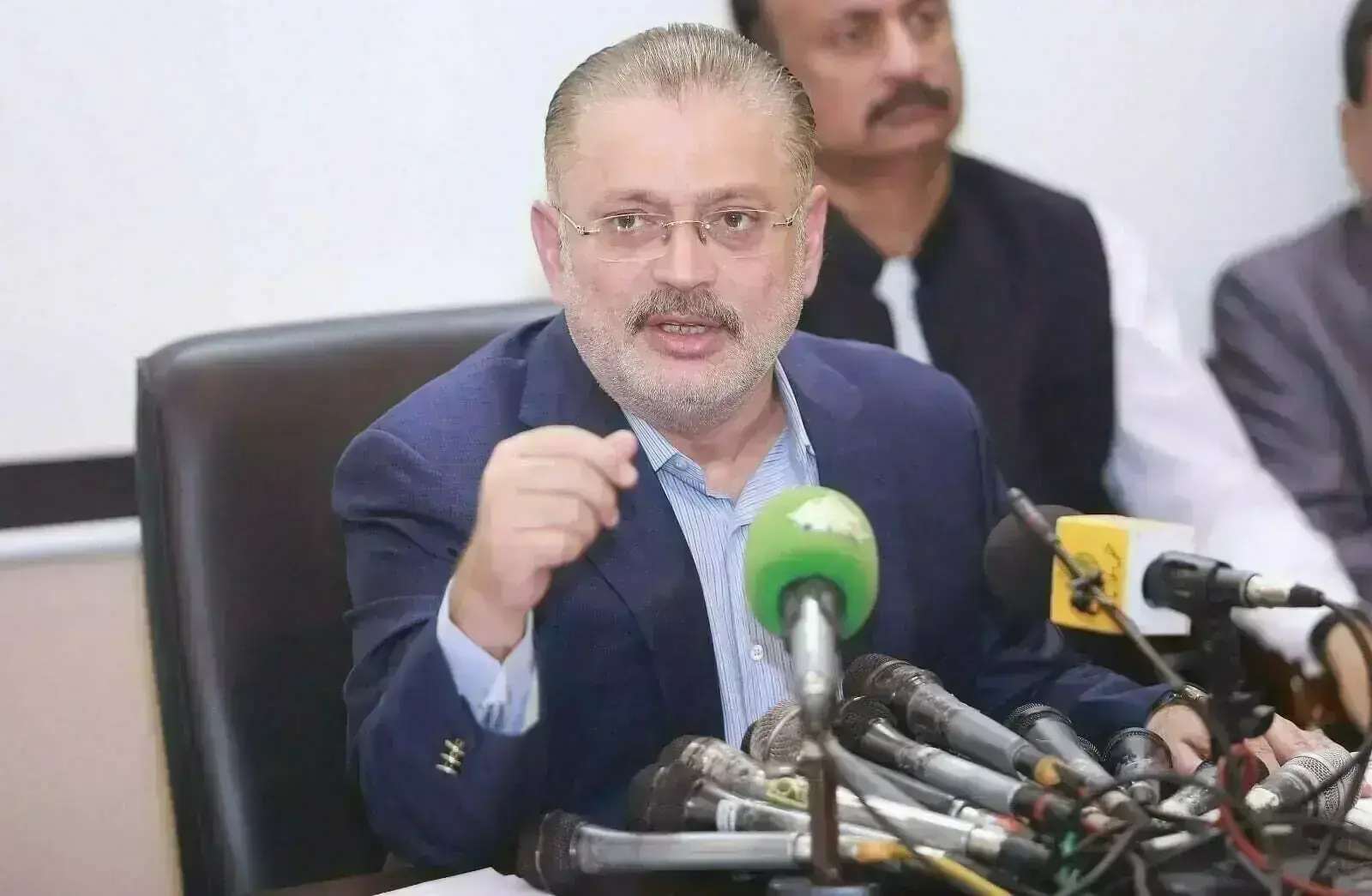
KARACHI: Sindh Senior Minister and Provincial Minister for Information, Transport and Mass Transit Sharjeel Inam Memon visited the Operations Command and Control Centre of the Green Line BRT, where he was given a detailed briefing on various aspects of the BRT system, its integration with other transport projects, passenger numbers and overall performance.
On this occasion, Secretary of the Transport Department Asad Zamin, CEO Trans Karachi Zubair Channa, Yellow Line BRT Project Director Kamal Dayo, and Managing Director of the Sindh Mass Transit Authority Behzad Memon were also accompanying him.
Senior Minister Sharjeel Inam Memon said that the Sindh government’s effort was to start road construction work in all districts of the province over the next six to eight months, so that the people of every area could have access to better travel facilities. The first priority of the Sindh government was to improve the transport system, and all aspects were being reviewed in this regard. The respective project manager of each project was working in their relevant field.
He said that the visit to China had also gone very well. The Chief Minister of Sindh would personally brief the provincial cabinet tomorrow regarding the visit. The fundamental purpose of the visit was to create opportunities for improvement for Pakistan, particularly the Sindh government and the people of Sindh. He would not answer questions on this matter before the Chief Minister’s briefing.
Sharjeel Inam Memon said that the Sindh government was moving matters forward in a democratic manner and was working in every sector. Measures were being taken in all sectors, including health, education, transport, irrigation and the local government system, to make people’s lives easier and improve their well-being.
Sharjeel Inam Memon said that political changes had emerged over the past few days. The step taken in Khyber Pakhtunkhwa was neither taken out of greed nor out of a desire for power. Had that been the case, the advisers appointed by the Governor would have been political representatives or nominated on the recommendation of a political party. However, their selection was made purely on the basis of merit.
He said that terrorism was currently the biggest challenge facing Khyber Pakhtunkhwa. This situation was affecting not only the government there but also the people of Khyber Pakhtunkhwa and the entire country. The infiltration of terrorists into Pakistan from Afghanistan across the border was a major challenge. The Khyber Pakhtunkhwa government had been told on numerous occasions to put its affairs in order, but the required progress had not been made.
Sharjeel Inam Memon said that some people cited the example of terrorism in Balochistan, but the government there was taking action against terrorism. Police personnel were being martyred, and law enforcement agencies were taking measures against terrorists. The Chief Minister of Balochistan was not being asked to open offices for terrorist organisations or to negotiate with them.
He said that, unfortunately, in Khyber Pakhtunkhwa, the head of the government led by Imran Khan and his party had continued to talk about negotiations with terrorists. During the tenure of PTI’s first government, funds had also continued to be provided to religious seminaries. The matter of providing government funding to these networks should also be reviewed, as allegations have been made that manpower for terrorists was being prepared there. If the government provides funds to such networks, where will the people go for protection?
He said that the situation had reached the point where people were afraid to leave their homes even after the Maghrib prayer. In some cities, police personnel could not go outside wearing their uniforms. The Khyber Pakhtunkhwa government was responsible for these conditions.
Sharjeel Inam Memon said that the occurrence of a terrorist incident was one matter, but adopting a lenient attitude towards terrorists was an entirely different matter. It was the government’s responsibility to ensure the protection of people’s lives and property and to take effective measures against terrorism.
He said that one of the fundamental reasons behind the current situation of terrorism in Khyber Pakhtunkhwa was also the provincial government’s soft corner for terrorists. It was the responsibility of the Chief Minister and the government there to take action against terrorists themselves, demonstrate their political will and use their forces effectively.
Senior Minister Sharjeel Inam Memon said that terrorism had once been at its peak in Karachi as well, but the Sindh government conducted operations, sought the assistance of the Rangers and other law enforcement agencies, and took practical measures to eliminate terrorism. Similarly, when conditions deteriorated in the riverine areas, the government and the relevant institutions took action against the dacoits. Today, by the grace of Allah, incidents of kidnapping for ransom in Sindh have decreased significantly.
He said that the government’s fundamental responsibility was to establish its writ and provide protection to the people. If government representatives in Khyber Pakhtunkhwa were compelled to give tickets to the Taliban, or individuals within the government system facilitated terrorists, such a situation could not be acceptable under any circumstances.
Sharjeel Inam Memon said that the Pakistan People’s Party (PPP) was among the last parties to support Governor’s Rule. We tried to resolve matters through negotiations.
Negotiations were also held, but despite this, the Chief Minister of Khyber Pakhtunkhwa did not agree on this matter.
He said that if the Chief Minister himself spoke in favour of the Taliban and terrorists in his speeches, the people could not be left helpless and abandoned. The government’s purpose could not be to remain in power while leaving people to die and placing the people of Khyber Pakhtunkhwa at the mercy of terrorists.
Senior Minister Sharjeel Inam Memon said that during PTI’s tenure, terrorists came from various areas of Balochistan, carried out operations here and then left. Innocent children were also martyred in the Peshawar tragedy, and PTI was in government at that time as well. Whenever a terrorist incident occurs, it is the government’s responsibility to give a strong and effective response so that the capabilities of terrorists can be eliminated. Talk of showing leniency towards terrorists or opening offices for them is unacceptable under any circumstances.
Sharjeel Inam Memon said that our political leaders and workers had sacrificed their lives in the struggle against terrorism. Almost all major political parties, apart from PTI, had faced terrorism. Maulana Fazlur Rehman had also been targeted in attacks. I was saddened by his recent statement.
He said that we respect and honour Maulana Fazlur Rehman, but he should also consider that he should not support a party against which allegations have been made of showing leniency towards terrorists.
He further said that Maulana Sahib should consider the challenges the country was currently facing. His own party had repeatedly been targeted by terrorism, so he should adopt a clear position against terrorism and strengthen the government’s hands.
The Senior Minister said that our law enforcement forces were continuously conducting operations against terrorists. A large number of terrorists had been killed over the past few days. Our forces and their leadership had taken important measures against terrorism.
He said that we had to strengthen our forces. We believed that political governments and Pakistan’s establishment had to come together on one page to confront the challenges facing the country.
Giving the example of Karachi, Sharjeel Inam Memon said that there was a time when 30 to 40 people were killed in the city every day, strikes took place frequently, businesses and educational institutions remained closed, and industries were relocating outside the city. At that time, the government and the establishment worked together, which helped establish peace in Karachi.
He said that today, strikes did not take place daily in Karachi as they did in the past, and terrorist incidents had also decreased significantly. This was the result of the government’s political will and mutual cooperation between institutions.
He said that in Balochistan too, the Chief Minister and the provincial government were taking measures against terrorism. The Balochistan government presented its concerns to the federal government, but efforts were made to resolve issues through negotiations and consultation. The PPP had never opposed measures against terrorism, nor had it made any kind of compromise on the issue of terrorists.
Sharjeel Inam Memon said that respecting our personnel was a duty incumbent upon all of us, whether they were civilians or members of the armed forces. The PPP was at the forefront among political parties that had suffered the most from terrorism.
He said that when Shaheed Mohtarma Benazir Bhutto returned to her homeland on 18 October, hundreds of PPP workers who had come to welcome her became victims of terrorism and sacrificed their lives. Mohtarma Benazir Bhutto herself had narrowly escaped a terrorist attack, but later she was martyred in a tragic terrorist incident in Rawalpindi. The PPP’s position against terrorism had always been clear.
Senior Minister Sharjeel Inam Memon said that in her final speeches, Shaheed Mohtarma Benazir Bhutto had expressed her determination that Pakistan’s flag would once again be raised in Swat. At that time, the Taliban and extremist elements had reached Swat. The movement of Sufi Muhammad and the activities carried out under it were no secret to anyone.
He said that after Mohtarma Benazir Bhutto’s martyrdom, Asif Ali Zardari also carried this resolve forward, and the PPP government took practical measures to eliminate terrorism.
Sharjeel Inam Memon said that approximately 800,000 people displaced as a result of the Swat operation had been relocated to various areas, including Charsadda, Karachi and other cities. After conditions improved following the operation, it became possible for these people to return to their homes. This was a major national undertaking in which the PPP government played an important role. This contribution should also be acknowledged.
He said that the PPP had always demonstrated that it did not compromise on its principles for the sake of power. When the PPP itself was in government in Balochistan and the President and Prime Minister also belonged to the same party, the PPP did not hesitate to take action even against its own government when circumstances made it necessary to take strict measures. For us, the protection of the people was more important than power.
Sharjeel Inam Memon said that if the PPP had been eager for federal ministries, it had been offered ministries in the past, and federal ministries could be available even today. The Pakistan Muslim League (N) had offered the PPP the opportunity to join the federal government on various occasions, but we preferred to remain committed to our principles.
He said that we wanted Parliament to continue functioning, the democratic system to remain in place and democracy to be strengthened. It was for this purpose that we supported the federal government, not to obtain ministries.
Senior Minister Sharjeel Inam Memon said that the PPP was not hungry for power and did not compromise on its principles for the sake of power. If people were falling victim to terrorism, innocent citizens were losing their lives and the business community was living in an atmosphere of fear, the PPP could not remain silent.
Sharjeel Inam Memon said that the law and order situation had remained extremely alarming in five of the seven divisions of Khyber Pakhtunkhwa. Terrorist incidents in Swat, Peshawar and other affected areas had caused severe difficulties for the people. It was the government’s responsibility to provide protection to businesspeople and ordinary citizens there.
He said that it would also have to be examined whether the business community was being forced to pay extortion money to the Taliban and whether the provincial government had succeeded in maintaining law and order.
He said that if provincial government representatives were under pressure from terrorists, businesspeople were being forced to pay extortion money out of fear, and the government was unable to take effective action against terrorists, this would be a serious situation. Problems would not be resolved by showing leniency towards terrorists or talking about compromises with them.
Sharjeel Inam Memon said that the fundamental responsibility of rulers was to protect the lives and property of the people. Any ruler who compromised on the protection of the people failed to fulfil their basic responsibility. Innocent citizens could not be left at the mercy of terrorists.
He said that these measures had not been taken in haste or without careful consideration. The Khyber Pakhtunkhwa government had repeatedly been told to put matters in order, and efforts had been made to resolve issues through negotiations and consultation, but the required progress had not been achieved.
He said that PTI also had leaders such as Asad Qaiser, Barrister Gohar and others who should recognise the seriousness of these matters. No compromise could be made on the issue of terrorism.
Senior Minister Sharjeel Inam Memon said that those criticising the PPP should remember that the party had always engaged in a practical struggle against terrorism and had paid a heavy price for it. If conditions in Khyber Pakhtunkhwa improved, anyone could form a government there through democratic means. These measures were not intended to keep any party permanently away from power, but to protect the lives and property of the people.
He said that the state could not hand over innocent citizens, who had neither guards nor weapons nor the means to protect themselves, to terrorists. Protecting the people was the responsibility of the state, and the PPP would never retreat from this responsibility.
In response to a question regarding the Green Line BRT, Senior Minister Sharjeel Inam Memon said that significant work had been carried out in the transport sector in Sindh over the past four to five years. This included electric scooters, Pakistan’s first electric buses and Pink Buses.
He said that the Green Line BRT had already been constructed, but it did not have a dedicated bus service for women. When women travel on public transport, they face various problems and difficulties.
Sharjeel Inam Memon said that when better travel facilities were provided to women, it encouraged them, and parents also felt safer sending their daughters outside for education and other needs. The Sindh government had taken several measures to empower women and provide them with better travel facilities, and positive results were emerging.
Speaking about the number of passengers travelling on the Green Line BRT, Sharjeel Inam Memon said that figures were not presented merely to make statements. When the Green Line was under the federal government’s control, approximately 50,000 passengers travelled on it daily.
He said that after the Sindh government took responsibility for the system, it formulated its strategy, worked hard, and the entire team of the Transport Department worked to improve its performance.
Senior Minister Sharjeel Inam Memon said that approximately 90,000 passengers were now travelling on the Green Line BRT daily. If they were claiming 90,000 passengers, that claim was based on figures and performance. They could not present false figures merely to issue a press statement.
He said that the media and other circles should also encourage such initiatives. The same infrastructure had previously been under the federal government, when approximately 50,000 passengers travelled daily, but the Sindh government had nearly doubled the number of passengers within one year. This difference had been made possible through government commitment, a better strategy and continuous hard work.
In response to another question, Sharjeel Inam Memon said that, alongside the construction of the Green Line BRT and its route, it was also necessary to integrate other BRT projects with one another. The Red Line and Yellow Line were also being connected to each other so that travel connections could be established among all BRT projects.
He said that the plan was to connect the Orange Line with the Green Line, the Green Line with the Red Line, and the Yellow Line with the Red Line as well. This integration would make it easier for passengers to transfer from one system to another and reach their destinations.
Senior Minister Sharjeel Inam Memon further said that progress was also continuing on various sections of the Yellow Line, bridges and other construction works. The Sindh government’s effort was to complete these projects soon and establish effective connections between them so that the citizens of Karachi could be provided with an integrated, modern and efficient transport system.
Copyright Business Recorder, 2026














Comments