


British International Investment terms Pakistan's stabilisation 'encouraging', but calls for policy consistency
- BII, formerly known as CDC Group, has been investing in Pakistan since 1987
British International Investment notes Pakistan's encouraging economic progress but stresses sustained reforms are crucial to attract more long-term capital, focusing on climate finance, financial inclusion, and venture capital.
- Conditions for attracting foreign investment.
- BII's focus on climate finance and financial inclusion.
- BII's significant investments in Pakistan's economy.
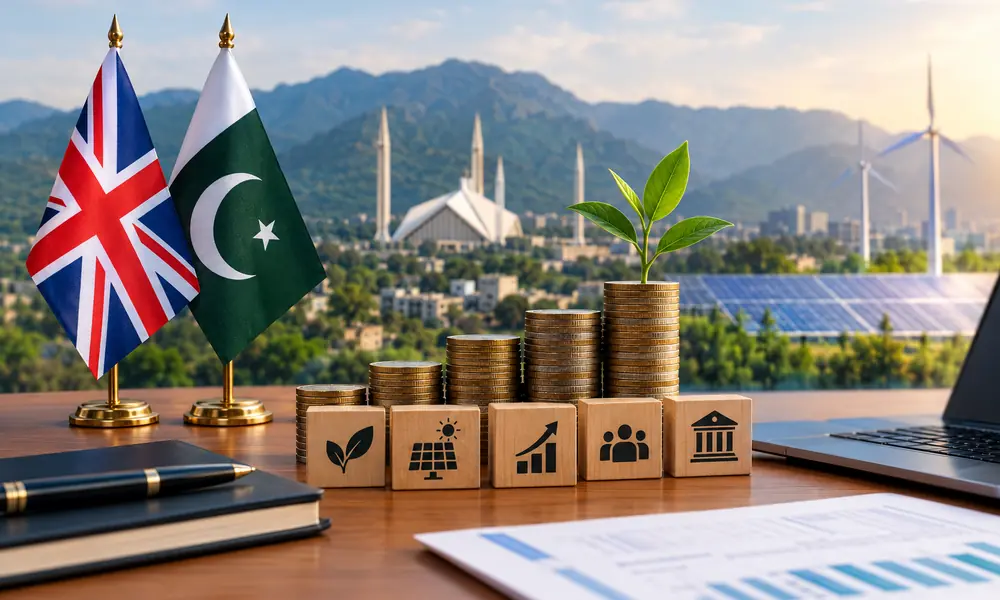
Pakistan’s recent economic progress is encouraging, but sustained reforms are essential to draw in more capital, British International Investment (BII), the UK government’s development finance institution, has said.
“Recent progress towards macroeconomic stability is encouraging and can help strengthen investor confidence,” Imtiaz Saithna, BII’s head of Pakistan, told Business Recorder in an interview.*
Saithna’s comments come as Pakistan’s economy saw a period of cautious recovery and stabilisation in the fiscal year 2025-26, with the gross domestic product (GDP) growth at 3.7%.
However, “continued reforms and policy consistency will be important to sustain that momentum”, said BII’s head of Pakistan.
‘Fragile situation’ in a ‘resilient’ economy: British International Investment CEO
BII, formerly known as the CDC Group, has been investing in Pakistan since 1987. BII’s investment mandate in Pakistan focuses on three specific areas: climate finance, financial inclusion, and venture capital.
“As a counter-cyclical investor, we have remained committed to supporting viable businesses and long-term development, while taking a disciplined approach to risk during periods of economic instability,” Saithna said.
The portfolio is valued at “close to $360 million across 38 businesses”.
Saithna did not give a new investment target or timeline for scaling up. However, when queried about what measures Pakistan should take, he listed conditions, including “maintaining macroeconomic stability, improving the ease of doing business, strengthening institutions and ensuring a predictable regulatory environment”.
“Investors also look for clear rules, efficient markets and a transparent legal and contractual framework.”
Saithna believes that Pakistan’s challenge is not a lack of opportunity. “The country has capable businesses, entrepreneurial talent and strong investment demand,” he said, adding the main constraint lies elsewhere.
“One of the biggest constraints is ensuring that long-term capital reaches the sectors and businesses that need it most,” BII official said, adding access to finance remains limited for many small and medium-sized enterprises (SMEs), farmers, women entrepreneurs and underserved communities, “which can restrict growth and job creation”.
BII reaffirms Pakistan commitment, seeks greater private capital mobilisation
Small businesses and farming are central to BII’s approach, which is also “central to Pakistan’s economy, employment and food security,” Saithna said. “These are also areas where access to finance remains limited.”
BII reaches these sectors through intermediaries, i.e. “partnerships with financial institutions and investment platforms that can channel capital to businesses and producers”.
Saithna also set out what would make these sectors more attractive to institutional money.
“To attract more institutional capital, investors need confidence in the operating environment, access to reliable information and opportunities with strong commercial fundamentals,” he said.
BII’s strategy centres on mobilising capital into developing economies.
“Pakistan is on the frontline of climate change, and increasing access to climate finance is critical to building long-term resilience and supporting sustainable growth,” Saithna said.
On a risk-sharing facility with Pakistan Microfinance Investment Company (PMIC), backed by a $15 million BII commitment, Saithna said the “facility is designed to unlock up to $30 million of additional lending through PMIC portfolio”.
“By sharing risk, the facility enables PMIC to expand lending through microfinance providers and reach customers who may otherwise struggle to access formal financial services.”
The interview also cited a $50 million BII investment in Bank Alfalah for climate finance and a $75 million facility for HBL.
“Our recent investments with Bank Alfalah and HBL reflect this approach by supporting climate resilience, food security and sustainable finance.
“We have also invested in Mega Motors to support electric vehicle manufacturing in Pakistan,” he informed.
BII’s previous notable investments in Pakistan include Daraz.pk, Jhimpir Power (Private) Limited, KASHF Foundation, and Zhenfa Pakistan New Energy Company (Pvt) Ltd.
Apart from climate financing, BII’s renewable energy portfolio in Pakistan provides over 460MW of clean energy, including the 100MW Atlas Solar and the 50MW Zephyr Wind Farm.
Looking ahead, “We agree with the government that investment in transmission and distribution infrastructure is a priority for the power sector,” said Saithna, adding BII has significant experience in this area in other markets.
“We look forward to sharing relevant lessons in Pakistan.”
On the three-to-five-year outlook, Saithna said “there is an opportunity to attract more long-term capital into productive parts of the economy” as conditions stabilise.
“BII’s role is to help catalyse that investment by working alongside local institutions and private investors,” he concluded.




















Comments