


FDI picks up, but the real test lies ahead
Pakistan's foreign direct investment reached a two-year high in August, with cumulative inflows up significantly, driven by increased gross inflows and growth in new sectors like trade and electronics.
- Pakistan's foreign direct investment reaching a two-year high.
- Key countries and sectors contributing to FDI growth.
- Challenges for sustaining and broadening investment inflows.
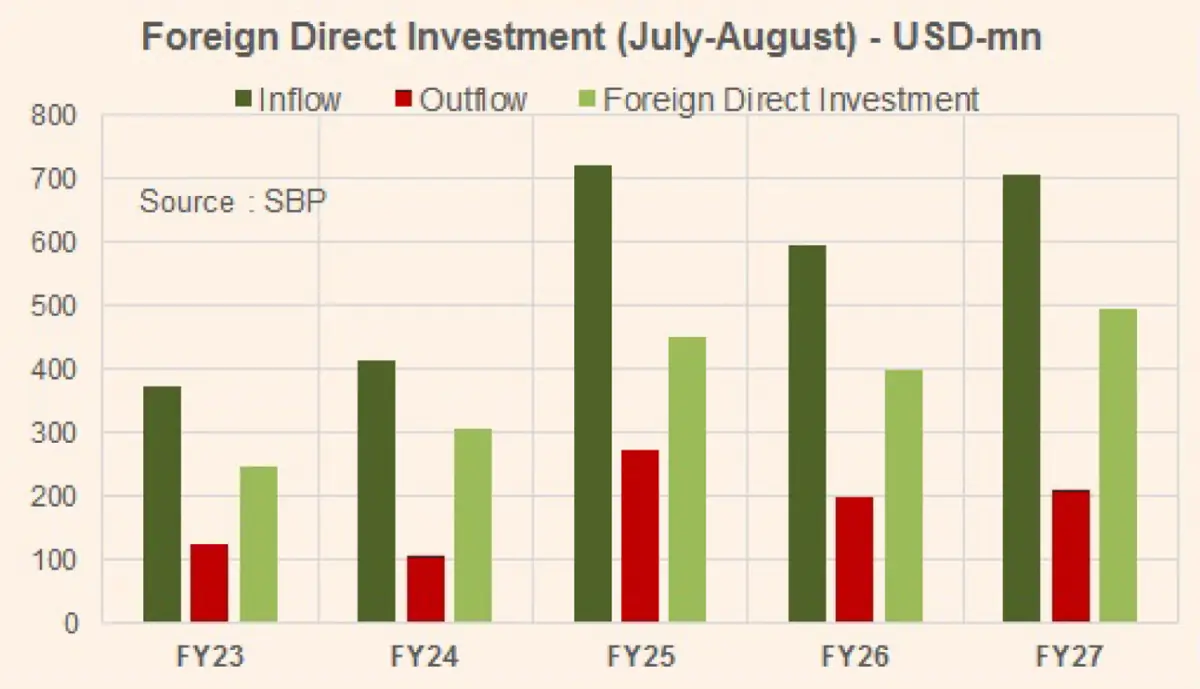
Pakistan’s foreign direct investment picked up pace in Aug-26, with net inflows reaching USD315.9 million — the highest monthly level in two years. That would be around 80 percent higher year-on-year and 77 percent above July, helped by stronger inflows and lower outflows during the month.
The August jump pushed cumulative net FDI in 2MFY27 to USD494.5 million, up 24.1 percent year-on-year from USD398.6 million in the same period last year.
Gross inflows rose by 18.4 percent year-on-year to USD705.9 million, while outflows increased to USD211.5 million by around 7 percent. In other words, the improvement so far has come mainly from more money coming in, rather than less money going out.
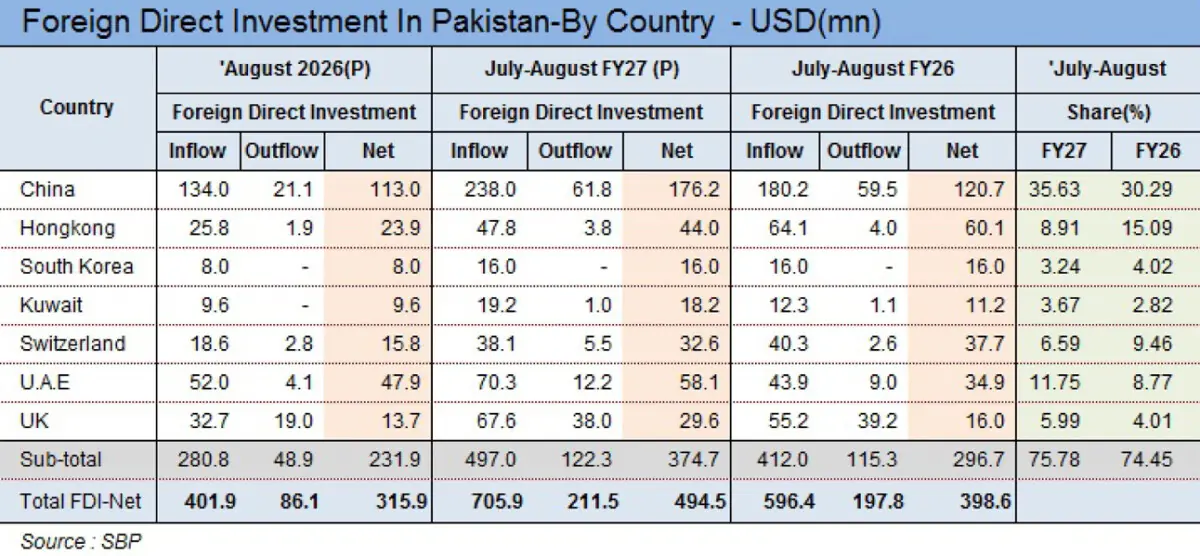
China remained the largest source of FDI, both in Aug-26 and 2MFY27. The UAE remained an important contributor during 2MFY27 as well. Canada was another notable source during the month.
There was some improvement beyond the usual large investors as well. Net investment from the UK almost doubled in 2MFY27, while Kuwait’s net FDI rose by 63 percent year-on-year. On the other hand, investment from Hong Kong and Switzerland declined, showing that the trend is still uneven.
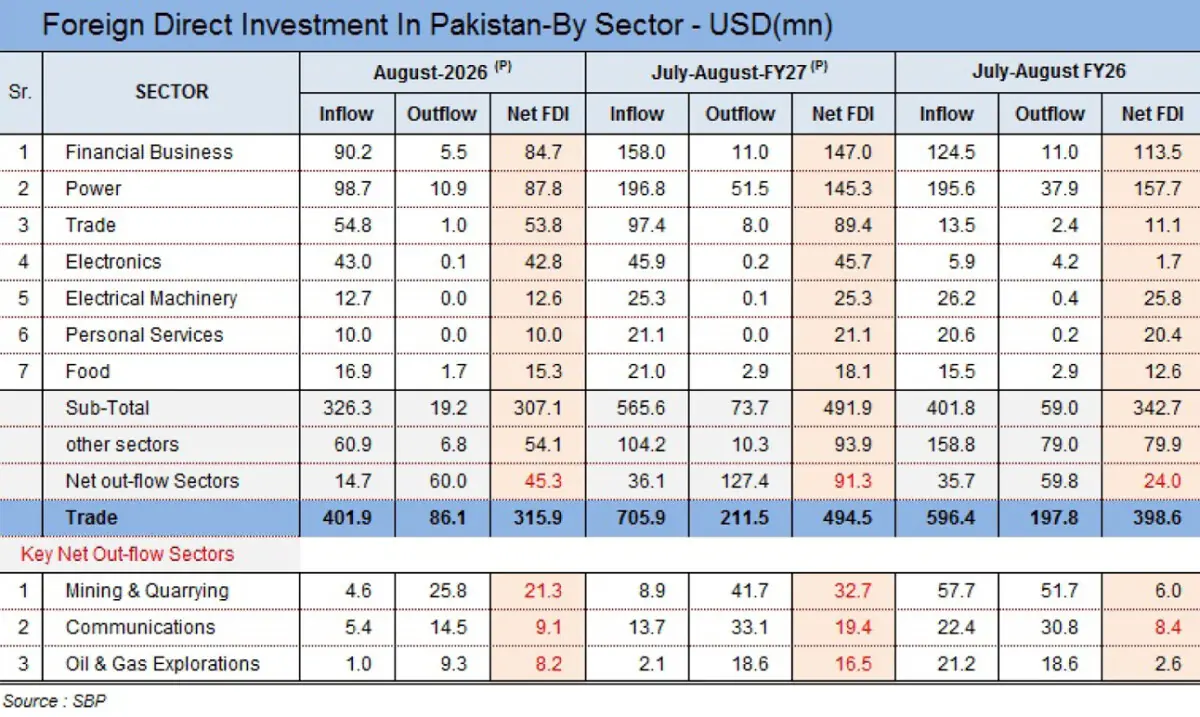
The sectoral picture tells a similar story. Financial business attracted the largest net FDI during the first two months of FY27, up by around 30 percent. Power followed, though it was slightly lower than a year earlier.
The bigger jumps came from trade and electronics. Net FDI in trade rose more than eightfold to USD89.4 million, while electronics attracted USD45.7 million in 2MFY27, nearly 27 times the previous year’s level. These increases helped broaden the sectoral base of inflows.
But the picture is not uniformly strong. Mining and quarrying, communications, and oil and gas exploration recorded a net outflowin 2MFY27. Overall, net outflow sectors accounted for USD91.3 million during 2MFY27, compared with USD24 million a year earlier.
This matters because the latest FDI numbers are being seen alongside signs of improving foreign investor interest. Where foreign participation in public-sector assets might be returning gradually - helped by the PIA transaction and interest in the FESCO privatisation process - it isstill too early to call this a broad investment turnaround.
FDI remains concentrated in a handful of countries and sectors, while overall volumes are still modest relative to the size of the economy. Pakistan has seen short bursts of stronger inflows before; the challenge has always been turning them into a sustained investment cycle.
For now, though, the direction is encouraging. August delivered the strongest monthly FDI in two years, cumulative inflows are up, and some new sectors are attracting larger amounts of foreign capital. The real test is whether this will be a one-off or a momentum and whether it will continue — and whether it can spread into manufacturing, exports, technology, and other productive parts of the economy.



















Comments