


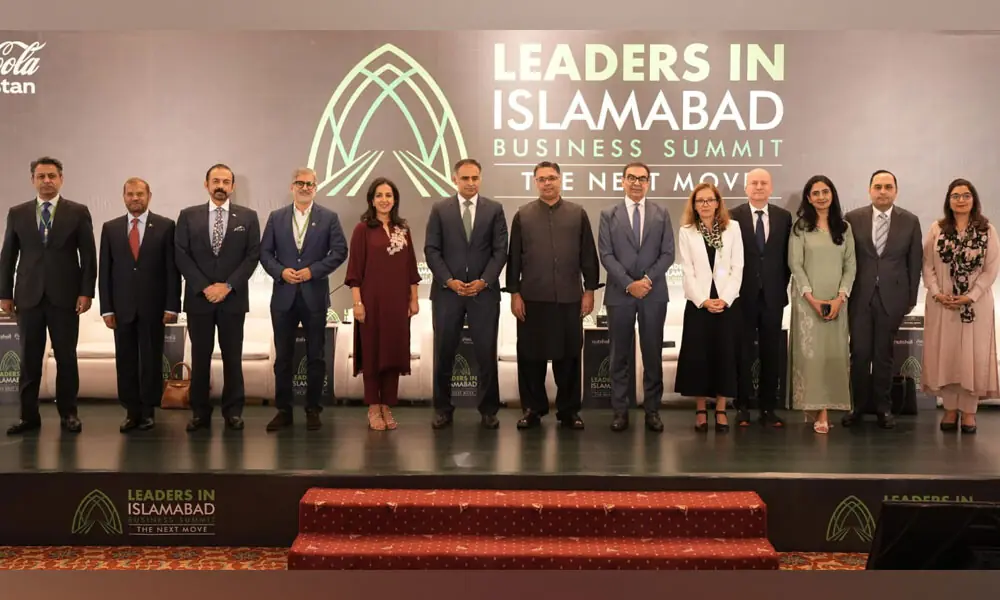
ISLAMABAD: Muhammad Ali, Federal Minister and Adviser to the Prime Minister on Privatisation, has said that Pakistan cannot just be a consumer of technology; it needs to be the creator of technology.
Addressing the “Leaders in Islamabad Business Summit” here on Thursday, the minister stressed the need for Pakistan to change its economic growth model, noting that the country’s population could reach 390 million by 2050, which could be a serious challenge. He said to address the key challenge, Pakistan should focus on converting the country’s workforce and infrastructure into productive capacity and transform Pakistan into a technology-creating country.
Pakistan needed large-scale productive businesses capable of competing with global enterprises, along with a strong education system and equal participation in the workforce, he maintained. He further said that cities should be developed as productive centres and young people equipped with skills relevant to the country’s economic future.
Muhammad Ali said the government had abolished the super tax in response to private-sector proposals, while interest rates and inflation had declined and the currency had stabilised. He said long-term planning was essential for Pakistan’s development and the government had a responsibility to provide education, healthcare, justice, security and essential goods and services. Referring to the privatisation of Pakistan International Airlines (PIA), he said all relevant ministries and institutions had worked together, and part of the proceeds had gone to the government, while a larger portion had been invested in the airline’s revival. The same principle should be followed in future, he added.
Bilal Azhar Kayani, Minister of State for Finance and Railways, speaking on the occasion, said that Pakistan has good people and the government needs to do better for them, for which all possible efforts are being made. He said that the country needs structural reforms with better governance, for which federal and provincial governance alignment is crucial.
The country needs to break away from the cycle of spending ungoverned and then turning towards IMF loans. He added that increase in Pakistan’s exports, saying that Pakistan cannot do effective policy-making without coordinating with the private sector, which is why super taxes were reduced by the government last year. The government was making sure that our agricultural sector and SMEs are getting finances. We are reforming entities like SMEDA.
Addressing the participants, Anwar-ul-Haq Kakar, Former Caretaker Prime Minister, stressed the need to address the country’s security challenges, for which structural reforms are necessary. He said that other countries facing serious violence have continued to build large export economies, adding that Pakistan, therefore, should focus on understanding and fixing the underlying economic constraints rather than simply attributing weak growth to terrorism.
Senator Dr Musadik Malik, Federal Minister for Climate Change and Environmental Coordination, stressed the need for continuity and remarked, “Policies based on elite capture always result in exploitation. With a consensus, a level playing field based on skills and merit-based policies should be created. If we have great universities, let their students do something without creating hurdles in their path. We have to change the elite capture, and we should keep trying.”
Anchored around the context of deliberating Pakistan’s future strategy, the Summit examined the country’s inflection point across economic policy, technology, and global positioning, bringing together the perspectives needed to chart a way forward. That cross-sector lens set the stage for the day’s proceedings.
CEO of Jazz and Chairman of Mobilink Bank, JazzCash and TPL Insurance Aamir Ibrahim said the use of artificial intelligence was expanding rapidly, with around USD3 trillion having been spent globally on AI factories. Pakistan also needed effective AI policies and integrated measures for data centres, AI infrastructure and digital access to participate in the next phase of the digital economy.
IFC Regional Director Saman Endrieu said Pakistan had significant potential in tourism, education, high-value exports, globally competitive products and technology but remained far behind the global economy. He said around 40 percent of crops were wasted in Pakistan and water shortages were creating difficulties for farmers; investment in agriculture could increase farmers’ incomes and strengthen the agricultural economy.
IFC Regional Director Dr Samuel Rizk said Pakistan’s economy could reach USD1 trillion by 2035, but the country remained among low-income economies and had witnessed deterioration in poverty, education and employment opportunities over the past three years.
PTCL Group Chief Business Solutions Officer Asif Ahmed said rapid advances in computing had enhanced AI capabilities, while internet connectivity, data and cooling systems were coming together to enable AI agents. The Leaders in Islamabad Business Summit, organised by Nutshell Group, concluded after discussions on economic growth, private-sector participation, exports, technology, AI, infrastructure and structural reforms.
Copyright Business Recorder, 2026


















Comments