


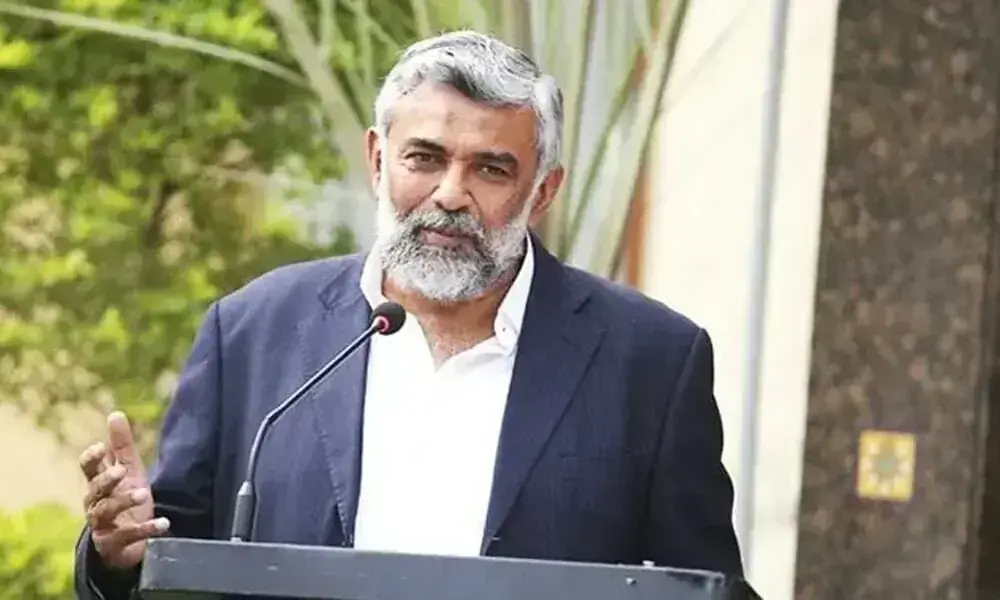
KARACHI: The rapid deterioration of Karachi’s infrastructure has become a serious threat to the megacity’s economy, imposing growing costs on businesses, workers, commuters and ordinary citizens while weakening the competitiveness of Pakistan’s largest commercial and industrial centre, said Pasban Democratic Party (PDP) chairman Altaf Shakoor here on Sunday.
Karachi generates a substantial share of the country’s economic activity, handles the bulk of Pakistan’s international trade through its port, and provides employment and livelihoods to millions of people, he said. Yet the infrastructure supporting this economic engine is increasingly unable to meet the demands of a growing metropolis.
Broken and poorly maintained roads, chronic traffic congestion, inadequate drainage, overflowing sewage, unreliable public transport, deteriorating bridges and flyovers, and the persistent accumulation of solid waste are no longer simply issues of urban inconvenience, he said.
They are economic problems that directly affect productivity, investment and the cost of doing business.
He said every hour lost in traffic represents lost working time. Delays in the movement of goods increase transportation costs and disrupt supply chains. Poor roads accelerate vehicle wear and increase fuel consumption. Waterlogging after relatively modest rainfall can bring commercial activity in entire areas to a standstill.
Businesses are consequently forced to bear costs that should not exist in a properly functioning urban economy, he said.
The deterioration of Karachi’s infrastructure also discourages new investment.
The situation is particularly damaging for small- and medium-sized businesses. Large corporations may have greater capacity to absorb additional transportation, security, maintenance and logistical costs, but smaller enterprises operate on much thinner margins.
The PDP chairman said Karachi’s infrastructure crisis is also contributing to a decline in the quality of its human capital.
He said the government must therefore stop viewing Karachi’s infrastructure requirements as a collection of isolated municipal projects. Roads, drainage, public transport, waste management, water supply and traffic management are interconnected components of the city’s economic infrastructure and must be planned accordingly.
There is also an urgent need to establish a clear division of responsibilities among the federal, provincial and local governments, he said. Karachi cannot continue to suffer from overlapping jurisdictions, institutional conflicts and uncertainty over who is responsible for maintaining essential infrastructure.
He said the megacity requires a unified, professionally managed and accountable urban governance framework.
Modern technology should be placed at the centre of Karachi’s infrastructure management, he said. Artificial intelligence, digital traffic monitoring, smart drainage systems, geographic information systems, automated waste-management tracking and real-time infrastructure monitoring can help authorities identify problems before they become major failures and allocate limited resources more efficiently.
He said most importantly, Karachi needs a shift from a culture of repairing infrastructure after it collapses to one of preventive maintenance. Roads, bridges, drainage networks and public facilities require regular inspection and scheduled maintenance.
Karachi is too important to Pakistan’s economy to be allowed to function with nineteenth-century governance mechanisms and twentieth-century infrastructure while attempting to compete in a twenty-first-century economy, he said.
Copyright Business Recorder, 2026
























Comments