


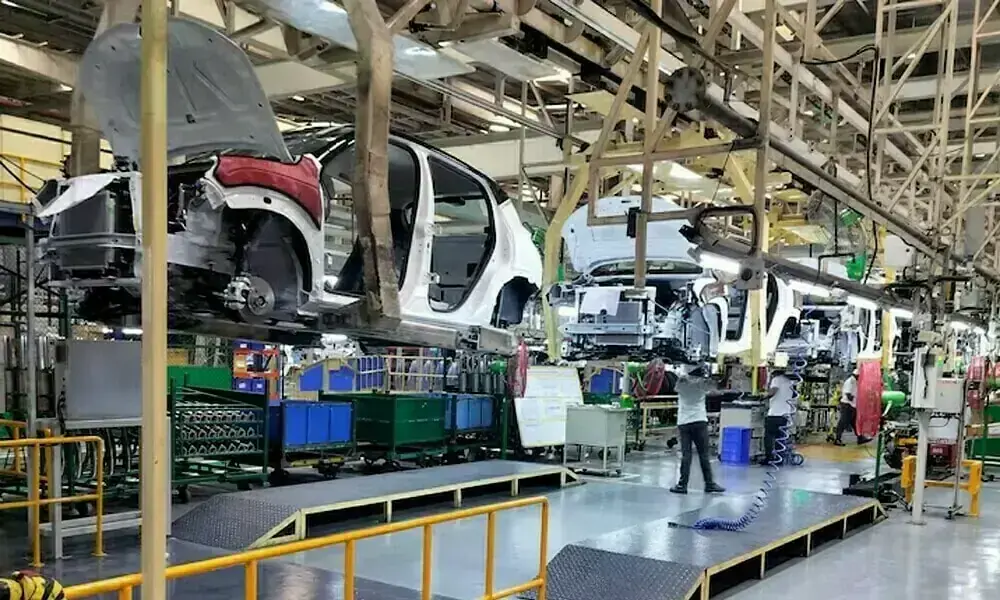
ISLAMABAD: The Pakistan Association of Automobile Parts and Accessories Manufacturers (PAAPAM) has urged Prime Minister Shehbaz Sharif to review the draft auto policy, warning that proposed incentives for New Energy Vehicles (NEVs) and reduced localisation requirements could undermine Pakistan’s domestic auto-parts industry and reverse decades of investment in local engineering.
In a press release issued on Tuesday, PAAPAM Chairman Usman Malik sought an urgent meeting with the Prime Minister to present the industry’s concerns, particularly over what the association described as the “rollback of localisation” in the proposed policy.
The association strongly objected to the proposed minimum domestic value addition (DVA) requirement of only 10 percent for NEVs during the first four years, increasing to 15 percent in the fifth year.
It also opposed the proposed reduction in localisation requirements for conventional vehicles to 20 percent in the first year, rising to only 40 percent by the fifth year.
“This is an official signal to roll back localisation,” Malik said, noting that the current level of local content in conventional vehicles is already above 50 percent.
He said the industry had expected localisation to increase to around 70 percent rather than being reduced under the new policy.
PAAPAM maintained that most components used in NEVs are already manufactured locally for conventional vehicles. Apart from batteries, motors and controllers, NEVs require structural, interior and exterior components such as seats, tyres, glass, lights, bumpers, steel bodies, plastic components and wiring.
The association argued that there was therefore no justification for allowing low-value “assembly-only” operations when established local parts-manufacturing facilities already exist.
Concern over 1pc sales tax incentive: PAAPAM also raised concerns over the proposed 1 percent sales tax on Range Extended Electric Vehicles (REEVs) and Plug-in Hybrid Electric Vehicles (PHEVs).
According to the association, these vehicles can feature full-sized 1,500cc combustion engines, fuel tanks of 60–70 litres and conventional exhaust systems, while offering battery-only ranges of less than 150 kilometres.
Malik argued that extending the 1 percent sales tax incentive to such vehicles would create a major fiscal anomaly, particularly when local auto-parts manufacturers are subject to an 18 percent sales tax on locally produced components.
He said Thailand, Malaysia and Indonesia apply standard taxation to these hybrid vehicle categories.
PAAPAM estimated that the proposed incentive could result in an annual loss of around Rs150 billion in tax revenue if 50,000 NEVs are sold.
The association also warned that the tax disparity could put local parts suppliers at a competitive disadvantage and weaken the domestic supply chain.
PAAPAM has suggested a tiered migration strategy under which incentives would be linked with substantially higher domestic value addition.
For pure battery electric vehicles (BEVs), it proposed retaining the 1 percent sales tax incentive, including for their locally manufactured parts, but introducing a minimum DVA requirement of 30 percent in the first year, increasing progressively to 60 percent by the fifth year.
For conventional vehicles, hybrids, PHEVs and REEVs, the association proposed that localisation should reach 60 percent by the fifth year.
PAAPAM said such a framework would provide manufacturers with sufficient time to transition while protecting existing investments in the domestic auto-parts industry.
The association also expressed reservations over the proposed Mandatory Export Targets (METs), saying that local manufacturers face significant structural barriers to entering international markets.
It pointed out that potential buyers from the US and European Union often face restrictions in visiting Pakistani manufacturing facilities for required audits because of travel advisories and security concerns.
PAAPAM further said manufacturers faced difficulties accessing alternative markets in Africa, Central Asia and South America because Pakistan lacks Free Trade Agreements (FTAs) with many of these markets.
As a result, Pakistani auto components face tariff disadvantages of around 25–30 percent, according to the association.
Combined with high electricity and other utility costs, heavy taxation and expensive financing, these factors have created an estimated 34 percent structural cost disadvantage for domestic manufacturers, it added.
PAAPAM argued that imposing mandatory export targets without first addressing these structural constraints could place an unrealistic burden on local parts manufacturers.
Malik made an urgent appeal to the Prime Minister for a direct meeting with PAAPAM to discuss the proposed policy and its potential implications for the industry.
He stressed that the automotive parts sector supports the livelihoods of approximately 300,000 Pakistani workers and their families, making the future of the sector an important issue for employment, industrialisation and domestic value addition.
PAAPAM called for a policy framework that promotes the transition towards electric mobility while simultaneously protecting existing local manufacturing capacity and encouraging deeper localisation rather than allowing Pakistan’s auto industry to revert to an assembly-based model.
Copyright Business Recorder, 2026





















Comments