


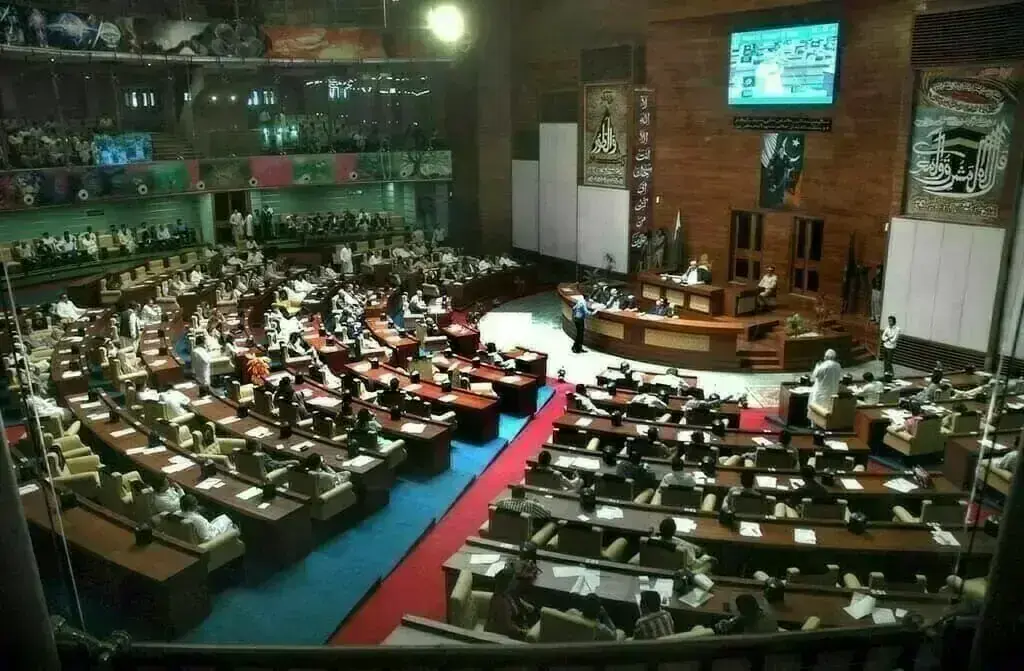
KARACHI: The Sindh Assembly on Thursday unanimously adopted a resolution rejecting any move to divide Sindh or create new provinces, after main opposition party - MQM lawmakers walked out before the vote.
The resolution ended a heated four-day debate on an adjournment motion moved by senior Pakistan People’s Party (PPP) leader Nisar Ahmed Khuhro. Sindh Chief Minister Syed Murad Ali Shah said the province’s geographical unity was non-negotiable and its boundaries could not be changed without the consent of the Sindh Assembly.
Speaking at the close of the debate, Murad said the Constitution required a two-thirds majority in the relevant provincial assembly and the National Assembly for any change to provincial boundaries, followed by the president’s assent. He said Khuhro had brought the issue to the proper constitutional forum after political statements about new provinces and administrative units triggered rallies and television debates.
Murad recalled Sindh’s role in the creation of Pakistan, including the Sindh Muslim League’s 1938 resolution and the Sindh Assembly’s role in the Pakistan movement. He also cited the 1948 resolution opposing the separation of Karachi from Sindh and described the One Unit system as a mistake. He said constitutional changes during General Zia-ul-Haq’s rule had given the National Assembly a role in changing provincial boundaries, subject to constitutional safeguards. “We repeatedly warn the National Assembly not even to talk about dividing Sindh,” he said.
He said the government had no objection to administrative reforms or the creation of districts and divisions where needed. But he questioned proposals for new administrative units if they involved separate assemblies or government offices.
“If the issue is governance, then there should be a discussion on administrative reforms to improve governance,” he said.
He rejected the argument that provinces should be created simply on the basis of population, saying administrative requirements and public needs should determine such decisions. The chief minister also criticised the MQM for what he called contradictory positions, citing earlier statements by Mustafa Kamal, Khalid Maqbool Siddiqui and Farooq Sattar on administrative units and new provinces.
He said the government had considered including devolution and administrative units in the resolution but decided to address them separately because assembly rules required a resolution to cover a single subject. Senior PPP leader Faryal Talpur said future generations would judge lawmakers by their decisions on issues concerning Sindh. Recalling the sacrifices of Zulfikar Ali Bhutto and Benazir Bhutto, she urged members to recognise their responsibility to the province.
Sindh Information and Transport Minister Sharjeel Memon said the issue was not a dispute between Sindhi- and Urdu-speaking communities but concerned the future of the entire province. “The people want unity, not division,” he said. Memon said PPP Chairman Bilawal Bhutto Zardari had maintained that decisions on creating new provinces should be taken by the relevant elected assemblies. Citing Article 239(4), he said any change to provincial boundaries had to follow the constitutional process. “If the future of Sindh is to be decided, it must be decided on the floor of the Sindh Assembly,” he said.
He said Pakistan’s integrity and sovereignty were non-negotiable and urged political parties to exercise restraint on sensitive issues. Sindh Home Minister Zia-ul-Hassan Lanjar said administrative changes should be pursued only through constitutional and legal procedures. He warned that controversy over provincial boundaries could fuel unrest and affect law and order at a time when the country was facing security challenges.
Lanjar also highlighted Karachi’s traffic problems, saying poor management was contributing to accidents and deaths. He said Rs6 billion had been spent on the first phase of the Karachi Safe City project and Rs9 billion would be spent on the second phase, with modern technology to improve security and traffic management. Similar efforts, he said, were under way in Hyderabad and Mirpurkhas, with attention also being given to Larkana.
Labour and Human Resources Minister Saeed Ghani said no political office or government position was more important than Sindh’s unity. He accused MQM leaders of previously advocating new provinces while now describing their position as a demand for administrative units. Ghani said stronger existing administrative structures could improve governance and warned against wall chalking and political campaigns demanding a new province.
Education Minister Sardar Shah stressed Sindh’s distinct historical and emotional identity and called for harmony between Sindhi- and Urdu-speaking communities. Excise Minister Mukesh Kumar Chawla said the PPP had consistently opposed attempts to divide the province. Deputy Speaker Naveed Anthony said neither government nor opposition benches supported dividing Sindh, reflecting broad agreement in the House on its territorial integrity.
PPP lawmakers, including Mumtaz Chandio, Hari Ram, Shah Hussain Shirazi, Dada Muhammad Halepoto, Gianchand Israni, Dost Muhammad Rahimoon, Paras Dero, Adil Anwar, Makhdoom Fakhr Zaman, Riyaz Shah Shirazi, Ali Ahmed Jan, Taimur Talpur, Liaquat Askani, Siraj Qasim Soomro, Taj Mallah, Farah Shah, Roma Mushtaq, Shahid Thaheem, Saima Agha, Zubair Junejo, Agha Shahbaz Durrani and Javed Arain, spoke against division and called for political stability and better governance.
MQM lawmakers Sabir Kaimkhani, Muzahir Aamir, Anil Kumar, Moeed Anwar, Sikandar Khatoon, Musarrat Jabeen and Naseer Ahmed said their party did not seek to divide Sindh but wanted empowered administrative units to address governance failures and public grievances. He questioned why the government feared discussing constitutional options despite having a two-thirds majority and said public opinion should be sought before administrative changes.
Before the vote, MQM Leader of the Opposition Ali Khursheedi called the resolution a “farce” and said the party had sought devolution of powers and empowerment of existing divisions under the spirit of the 18th Amendment, rather than a separate province. He objected to the exclusion of MQM proposals from the draft and said the party’s suggestions should have been discussed.
MQM lawmakers then walked out despite an appeal from the speaker to remain in the House. The remaining members proceeded with the vote and unanimously adopted the resolution rejecting the division of Sindh. Sharjeel Memon criticised the MQM for leaving before the vote, saying it had chosen not to participate in a historic decision of the Assembly. He also criticised PTI and Jamaat-e-Islami over their absence or boycott of the proceedings.
Copyright Business Recorder, 2026

















Comments