


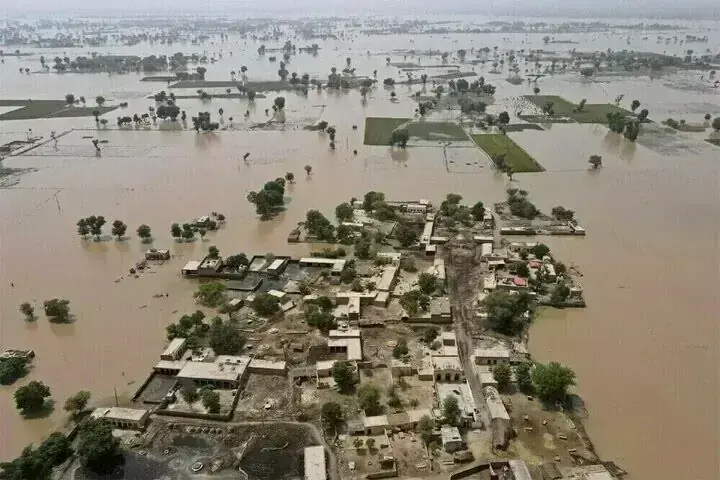
KARACHI: The Overseas Investors Chamber of Commerce and Industry (OICCI) has expressed deep sorrow over the devastating flash floods in Nepal, saying the tragedy should serve as a stark reminder for Pakistan to accelerate investment in climate resilience, early-warning systems and disaster preparedness.
OICCI extended its heartfelt sympathies to the people of Nepal following the floods that have claimed hundreds of lives and left thousands missing, affecting families and communities across the country.
“Behind these numbers are families waiting for loved ones, communities searching for survivors and lives changed in a matter of hours. Our thoughts are with everyone affected by this heartbreaking tragedy,” OICCI said in a statement.
READ MORE: Climate-related damages: Pakistan loses nearly 1pc of GDP annually: OICCI moot
The Chamber said the scale and suddenness of the disaster would resonate strongly in Pakistan, where communities have repeatedly experienced severe floods, displacement, destruction of homes and loss of livelihoods.
“For Pakistan, there is an important message in Nepal’s tragedy: we cannot wait for disasters to happen before preparing for them,” OICCI said.
Pakistan remains among the countries highly exposed to climate-related risks. The country recorded its second-warmest year in 65 years in 2025, immediately following its warmest year on record in 2024. Rising temperatures, accelerating glacial melt and changing rainfall patterns are increasing risks to communities, infrastructure, agriculture and the wider economy.
The economic consequences are equally significant. Federal Minister for Climate Change and Environmental Coordination Musadik Masood Malik, speaking at OICCI’s Pakistan Climate Conference earlier this year, highlighted that Pakistan loses around one percent of its GDP annually because of climate-related impacts.
OICCI said recent efforts by Pakistani authorities to strengthen predictive early-warning systems for glacial lake outburst floods, flash floods, urban flooding and heatwaves are therefore increasingly important.
The Chamber stressed that Pakistan must move beyond systems that merely warn people once a disaster is approaching and towards a more comprehensive model capable of anticipating risks, identifying vulnerable areas and enabling authorities and communities to act before a crisis develops.
Greater investment in climate-resilient infrastructure, predictive technology, disaster-response capacity and community preparedness will be critical as extreme weather events become more frequent and intense, it added.
“Ultimately, climate resilience is about people — a family receiving a warning in time, a community protected from the worst of a flood, and livelihoods that are strong enough to withstand the next climate shock,” OICCI said.
Copyright Business Recorder, 2026





















Comments