


FDI recovery remains elusive
Pakistan's July FDI rebounded but remains concentrated in regulated sectors, failing to attract transformative investment seen in other regional economies.
- Pakistan's FDI concentration in power and financial services.
- Regional disparities in attracting technology and manufacturing investments.
- The domestic private sector's limited role in attracting foreign capital.
- Constraints hindering broader FDI growth in Pakistan.

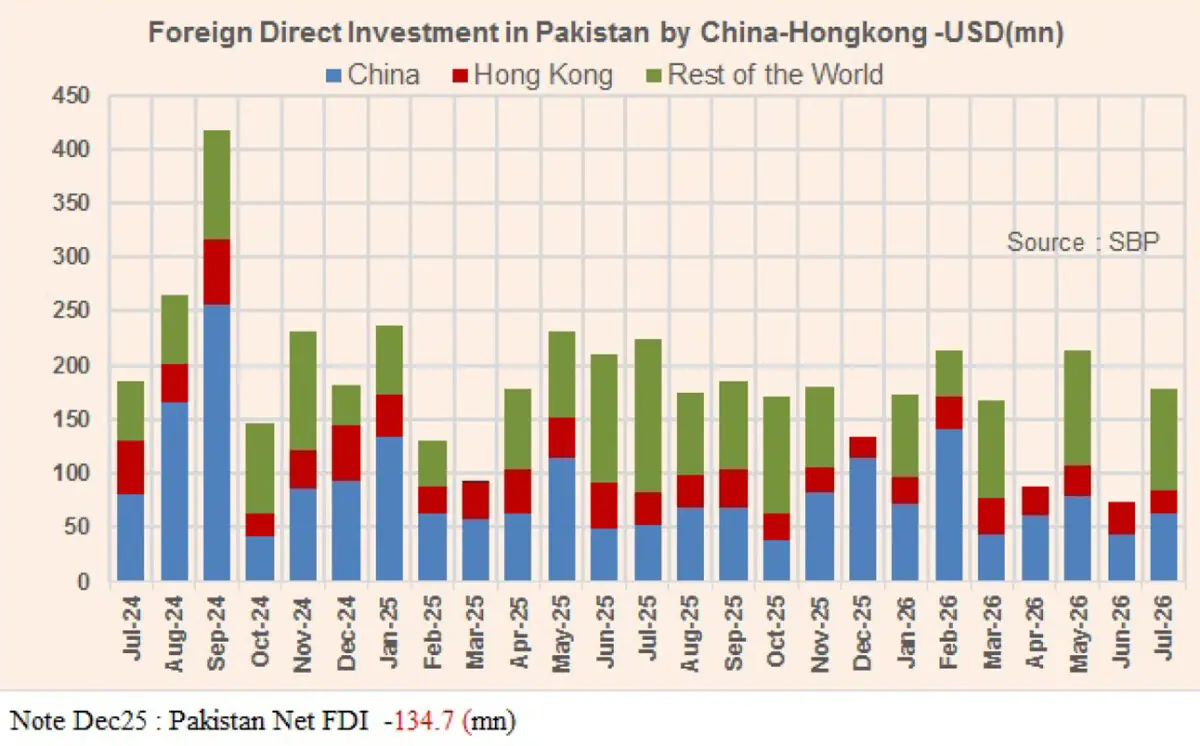
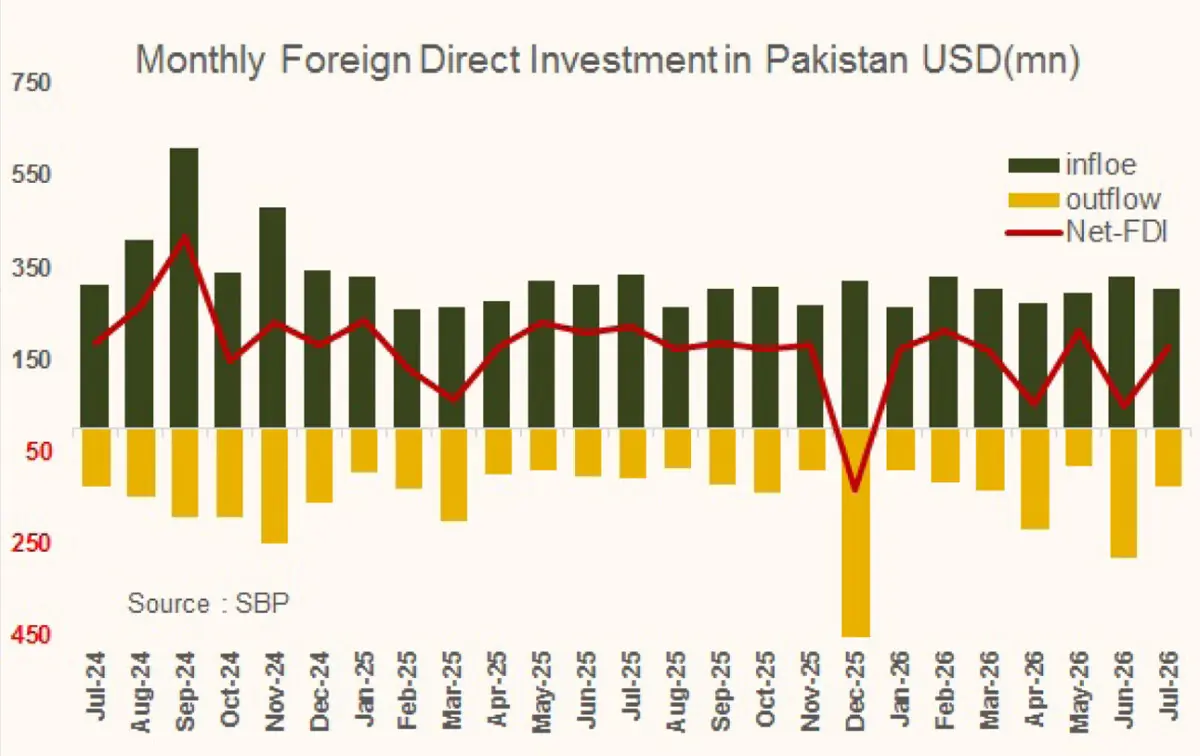
Pakistan has started FY27 with a better FDI number than the one it ended FY26 with, but not one strong enough to suggest that the investment story has materially changed. Net FDI stood at $178.6 million in July-26, recovering from just $13.5 million in June. The rebound looks encouraging at first glance, but June was an exceptionally weak month.
FDI in July was down 20 percent year-on-year, with power and financial services remaining the largest recipients. Power attracted $57.5 million, while financial services received $62.3 million. China and Canada were the leading source countries during the month.
The sector mix looks familiar. Power and financial services were again among the largest recipients, while China remained an important source of inflows. That matters because Pakistan’s FDI problem is not only about how much money comes in, but also where it comes from and where it goes.
That is where Pakistan’s FDI story increasingly falls behind the region. Global capital is moving towards data centres, AI infrastructure, semiconductors, renewable energy, and advanced manufacturing.
India is attracting technology and services investment, Vietnam is deeply integrated into export manufacturing, Malaysia has built strong electronics and semiconductor clusters, while Indonesia is using its mineral base to pull in downstream processing. Pakistan, by contrast, remains heavily dependent on investment linked to domestic demand, regulated sectors, and government-backed frameworks.
July’s numbers therefore fit a broader theme of stabilisation without transformation. Stabilisation achieved last year has not yet translated into a meaningful pickup in long-term foreign investment.
There is also a less discussed weakness in Pakistan’s FDI model: the domestic private sector is not doing enough to pull foreign capital into productive businesses.
In stronger investment destinations, local companies often become the bridge for foreign investors through joint ventures, technology partnerships, supplier relationships, and export expansion. That is how foreign capital becomes embedded in the wider economy rather than arriving only through a handful of large projects.
Pakistan has much less of that. A large share of FDI still goes into sectors that are heavily regulated, state-linked, or dependent on government policy, particularly power and finance. Without a stronger local private-sector pull, FDI is likely to remain narrow, project-based, and vulnerable to the timing of a few large transactions.
However, the private sector challenges remain the underlying constraints - largely unchanged: unpredictable taxation and regulation, expensive energy, security concerns, weak contract enforcement, and uncertainty over the longer-term policy environment.
That leaves the near-term outlook cautiously stagnant. Monthly FDI can improve, but Pakistan has yet to show that it can consistently attract investment that creates exports, builds technology capability, links domestic firms with global supply chains and generates skilled employment.
The real test for FY27 is not simply whether FDI rises from last year’s low base, but whether its composition starts shifting away from a narrow dependence towards manufacturing, technology, and export-oriented investment.



















Comments