


Governance structure in Pakistan—II
Pakistan's administrative structure, unchanged since 1969 despite massive population growth, needs realignment to improve governance, drawing lessons from India's dynamic approach to state reorganization.
- Pakistan's outdated administrative structure since 1969.
- India's dynamic approach to state reorganization.
- Factors like language, culture, and economic clusters in administrative divisions.
- Recommendations for a commission to realign Pakistan's units.

Status in other countries
Before moving further, it would be advantageous to see the administrative units in various peer countries:
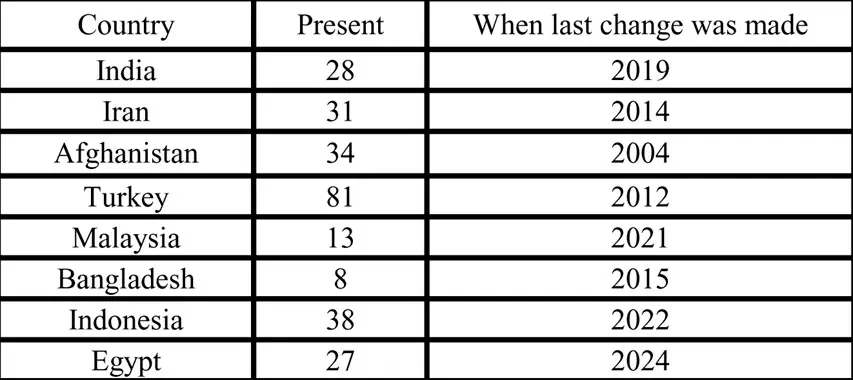
All these other countries are improving their governance structure by constant changes. In Pakistan, however, it is the same since 1969.
Pakistan’s population was 58.5 million in 1969 and is estimated to be around 259.3 million in 2026.
READ MORE: Governance structure in Pakistan—I
The ongoing administrative realignment in India serves as an instructive case study. In Pakistan, however, any discussion on restructuring is treated as a taboo for vested interests. This stance by our political elite is criminal. India provides the best example and experiment of how this can be done. When British left, the relevant provinces of India were:
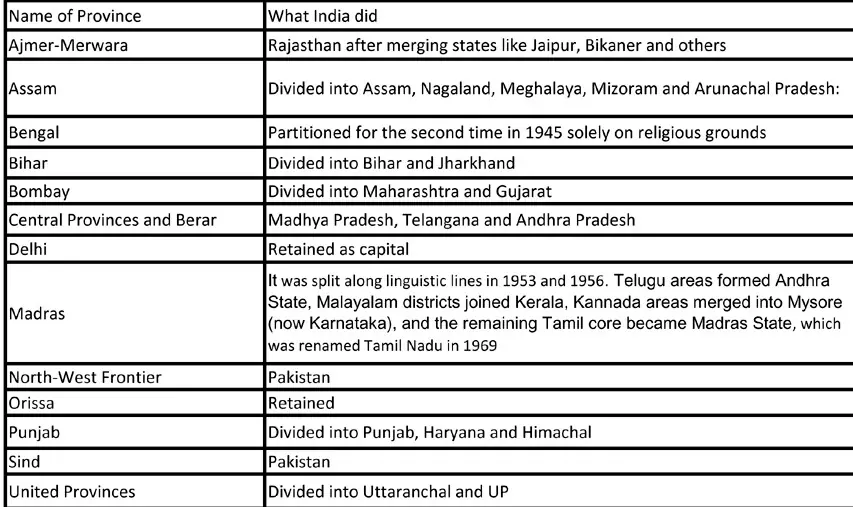
In India whole of the structuring has been done on linguistic and cultural basis. The small state of Assam has been divided into five states whereas UP has been divided into two parts only; present-day UP still has a population of around 250 million. It is so as the language and culture of units being Agra and Oudh are identical.
It is interesting to note that on May 1, 1960, the bilingual Bombay State was split into the separate states of Gujarat and Maharashtra along linguistic and cultural lines. This followed intense public agitations by Marathi-speaking and Gujarati-speaking communities.
The same was the case in Tamil Nadu. As against that, Uttar Pradesh (UP) being the new name of United Provinces of Agra and Oudh is still one unit as language and culture are the same.
However, insofar as the case of UP is concerned, only Uttaranchal (now named Uttarakhand) has been carved out of it, which is a small part comprising some of the hilly Himalayan region, for administrative reasons. However, UP still remains India’s most populous state.
Basis of division
In the past, all divisions of the working units throughout the world were made inter alia on the basis of history, culture, language and geography. This is still the primary consideration.
However, even if there are such similarities a split takes place for administrative reasons on the basis of population and area. This is the subject case for Punjab and Baluchistan.
In the recent past, however, a new trend emerged in India. Now units are being created on the basis of similar economic potential. Maharashtra got separated from Gujarat for such considerations. Nowadays ‘economic clusters’ are appearing as separable units for the reason that people of one area do not want to share their economic benefits and advantages with others. This is the basis of a benign resentment against the Union in the case of Karnataka and other southern states of India.
In Pakistan, economic clusters if designed in proper manner can give much more productive results. For example, the economic cluster of Lahore-Sheikhupura-Gujranwala-Gujrat-Wazirabad-Sialkot-Narowal now has a completely different economic, social and political landscape than other parts of the province.
Bahawalpur, Bahawa lnagar, and Rahim Yar Khan form the historic Bahawalpur Division; they have many things in common. The same is the case with the economic clusters of Sukkur-Shikarpur-Larkana-Khairpur. The coastal areas of Baluchistan have everything in common; however, there is nothing in common between Loralai and Zhob.
Suggestions and conclusion
The solution lies in having a high-powered commission to be headed by a former Chief Justice of Pakistan with equitable representation from all stakeholders. That Commission has to give a report to the Parliament for the realignment of administrative units in Pakistan. The Commission should work on a continuous basis with realignment as and when required. In this author’s view, Justice Rana Bhagwandas was a suitable person, but he has died.
In India, the States Reorganisation Commission (SRC) (1953) led by Justice Fazal Ali, K. M. Panikkar, and H. N. Kunzru recommended reorganizing state boundaries along linguistic lines, leading to the States Reorganisation Act of 1956. It is important that even in India the Dhar Commission (1948) evaluated the feasibility of linguistic states and advised against language as the primary criterion.
The JVP Committee (1948), comprising Jawaharlal Nehru, Vallabhbhai Patel, and Pattabhi Sitaramayya, rejected language as the basis for state reorganization. However, within five years, there was a change and everybody accepted the recommendations of SRC of 1953.
The same is required for Pakistan. The problem is politico-economic in nature. If the present system is continued then the delivery system will further deteriorate. In the upcoming part of this series of articles the fiscal aspect of this matter will be explained.
(To be continued)
Copyright Business Recorder, 2026




















Comments