


Netanyahu says Israel did not agree to US-backed Gaza plan
- Netanyahu denies Gaza plan, despite assurances of Hamas disarmament, as his right-wing coalition pushes back
Prime Minister Netanyahu stated Israel has not agreed to the US-backed Gaza plan, despite assurances of Hamas disarmament, facing internal political pressure while US influence shapes military actions.
- Netanyahu's position on the US-backed Gaza plan.
- Right-wing pressure on Netanyahu to reject the deal.
- New authorization requirements for Israeli military strikes.
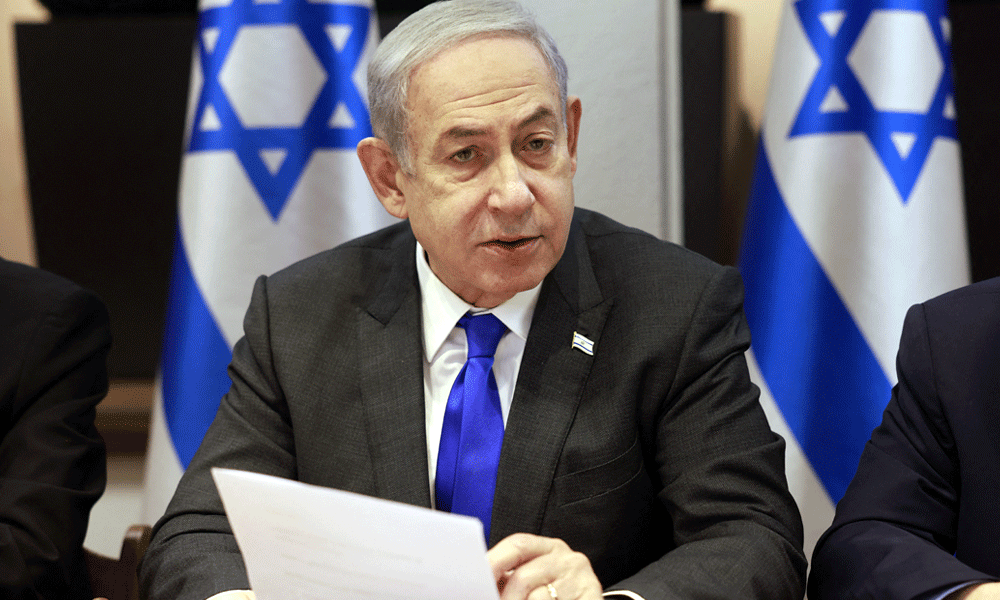

OCCUPIED JERUSALEM: Prime Minister Benjamin Netanyahu has said Israel did not agree to the US-backed plan for Gaza, even after receiving assurances that an Israeli pullout would only happen after Hamas disarms.
In a video posted to his social media accounts on Tuesday night, Netanyahu said the team of US President Donald Trump “believes that they can bring about the disarmament of Hamas and the demilitarisation of Gaza”.
“We are checking this. They sent us a draft – we did not agree to it, it is not our draft. We sent our comments,” he said.
Netanyahu met with the US-backed Board of Peace on Monday and received guarantees that the Israeli army would only be required to leave its current positions in Gaza after Hamas disarms.
But pressure has been growing on the premier from the right flank of his ruling coalition to reject the deal.
Two far-right ministers requested a new vote on the plan Tuesday, saying it does not reflect what had originally been discussed.
Israel’s security cabinet, in which the two ministers sit, already voted in favour of the proposal, which would see among other things the deployment of international peacekeeping troops in the Gaza Strip.
Netanyahu had moved to convene his security cabinet on Tuesday but the meeting was postponed to Thursday, Israeli media reported, amid primary voting in his Likud Party ahead of October 27 elections, in which he faces a tight race.
The request from Finance Minister Bezalel Smotrich and Settlement Minister Orit Strook to hold a new vote should be viewed merely “as a campaign move” to put pressure on Netanyahu, according to Tal Elovits, a researcher at Israeli think tank Molad.
“The Israeli right-wing has always tried to postpone a scenario in which this conflict becomes an international conflict. Obviously, the IDF’s behaviour will be different once you have soldiers from Kosovo, from Indonesia” and other countries, Elovits said, referring to Israel’s military.
However, Israel has no concrete possibility of tearing up the US-sponsored plan, given the country’s isolation in the international arena, Elovits added.
“Netanyahu has no other option besides listening to his only friend left in the diplomatic community,” he said, referring to Trump.
“Netanyahu is not a very active player here – he’s an active player maybe in trying to block some ideas, but Israel is not putting anything on the table.”
US pressure on Israel to curb attacks in Gaza ahead of a partial withdrawal under the plan appears to be yielding results.
According to reports in Haaretz and other Israeli media, troops have been instructed to seek authorisation from the Chief of Staff for strikes, unless they are in “immediate danger” – a change of policy from previous directives, under which attacks only required approval from the head of the regional command.
Israel’s military, when questioned, referred AFP to the “political echelon” for a response. A spokesperson for Netanyahu declined to comment.




















Comments