


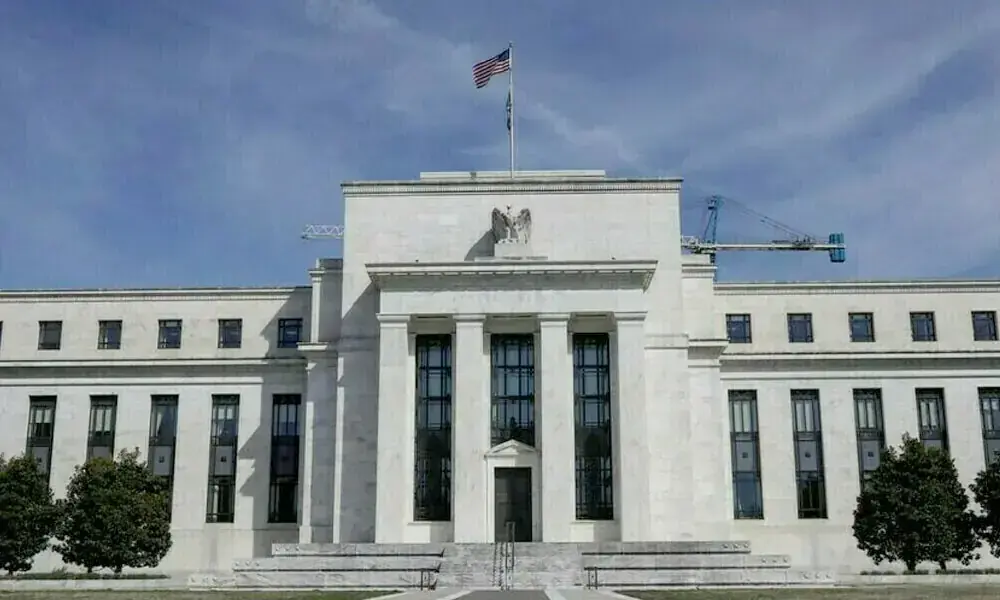

WASHINGTON: Three Federal Reserve officials who dissented at this week’s policy meeting in favor of an interest rate hike expressed concern on Friday that without an immediate increase in short-term borrowing costs inflation will stay stuck above the Fed’s 2 percent target, where it has been for more than five years.
A fourth US central banker said he too sees a strong case for tighter Fed policy but that, with June’s cooler inflation reading in hand, it may be okay to wait and assess.
The remarks are an early peek at the “family fight” that took place behind closed doors in Washington earlier this week, when Chairman Kevin Warsh led the Fed’s rate-setting committee in a 9-3 decision to leave short-term borrowing costs in the 3.50 percent-3.75 percent range.
READ MORE: Fed holds rates steady; three policymakers dissent in favor of a hike
Longer-term bond yields surged in response, in what analysts say reflects a perceived credibility gap between Warsh’s assertions that the Fed will deliver price stability and the central bank’s lack of action.
More policymakers, including Fed Governor Lisa Cook and Kansas City Fed President Jeff Schmid, are scheduled to speak next week. With Warsh sticking to his policy of giving no insight on his view of where rates should go, investors are putting more weight on what his colleagues say.
“Inflation has remained stubbornly above 2 percent for more than five years, and I am not confident it will return to our objective on its own,” Cleveland Fed President Beth Hammack said in a statement released by her regional bank.
“A higher federal funds rate would help restrain economic activity and reduce inflationary pressures” and the economy can deal with higher interest rates given the stability of the job market, Hammack said. “I preferred to move at our recent meeting because I did not see the current policy stance as appropriately restrictive.”
In a separate statement, Minneapolis Fed President Neel Kashkari also expressed worries about inflation and said the central bank’s policy-setting Federal Open Market Committee should have raised rates on Wednesday as the first in a series of hikes.
“To manage against the risk that high inflation could become entrenched, I would rather tighten policy incrementally as we gather more data on the path of inflation and employment,” Kashkari wrote.
“If inflation remains elevated, in my view, a potential series of small policy moves would be better than waiting and eventually concluding that even bolder actions were necessary,” Kashkari said.
Dallas Fed President Lorie Logan, the third policymaker to support raising the central bank’s benchmark interest rate by a quarter of a percentage point from its current 3.50 percent-3.75 percent range this week, also said she feels current monetary policy isn’t putting any downward pressure on inflation.
“Without any policy restraint, inflation will likely continue to trend above target until there’s an unanticipated shock,” Logan said in a separate statement. “The FOMC cannot count on unanticipated shocks to achieve its goals and can always adjust policy if unanticipated shocks occur.”
Like Kashkari, Logan said that raising rates by a “modest” amount “in the near term could reduce the likelihood of needing to take sharper action later.”
Richmond Fed President Tom Barkin said he sees the point. “I think there is a strong case there” for adding restraint to the economy, he told the Wall Street Journal.
“I think you could also make a case…that there’s time before the next set of meetings” to determine if that’s needed, said Barkin, who does not vote this year on the Federal Open Market Committee but takes part in the central bank’s regular policy-setting debates.
The Fed next meets September 15-16 and will deliberate again in October and December. Financial markets are currently pricing about a 65 percent chance of a rate hike at the upcoming meeting.
Sticky inflation
US President Donald Trump picked Warsh with the express intent to loosen monetary policy that Trump says is needed to ease the government’s debt burden and boost the economy. Policy dissents from a quarter of the voting members of the FOMC show Warsh is increasingly backed into a corner over whether to continue to resist those pushing for tighter policy or to disappoint Trump.
The gauge by which the Fed measures progress toward its 2 percent goal — the Personal Consumption Expenditures Price Index — rose 3.7 percent in June from a year earlier, an improvement from May’s 4.1 percent increase but under continued upward pressure.
The Fed’s decision this week to leave rates unchanged and a hint from Warsh that the central bank may look to change its inflation goalposts helped send 30-year Treasury yields above 5.2 percent, a 19-year high. They extended their rise on Thursday and Friday in a move widely seen as expressing doubts about the Fed’s inflation-fighting credibility.
Short-term Treasuries and interest-rate futures also reflected falling confidence that the central bank will raise rates at all.
While inflation has moderated substantially from the levels seen during the COVID-19 pandemic, it has remained stubbornly above the Fed’s target due in part to Trump’s import tariffs and the sharp rise in energy prices resulting from the war in the Middle East.
Inflation is also being pressured higher by investment related to the artificial intelligence sector.
The generally supply-related nature of the current inflation problem is particularly challenging for the Fed, since its policymakers would traditionally hold off on any action in such situations.
Kashkari said he agrees with the idea that monetary policy faces trade-offs when dealing with supply shocks. But he noted, “I increasingly believe that monetary policy does have an important role to play in addressing a series of successive supply shocks that might lead to entrenched higher inflation.” Warsh, speaking to reporters on Wednesday, said the dissenting votes in part reflected a very active debate among policymakers.
“I asked for a good family fight, and I got one. That’s the purpose, that’s the design feature,” the new Fed chief said. But he added that there was “large majority support for the decision that we made in the room.”
















Comments