


Digital exports’ push
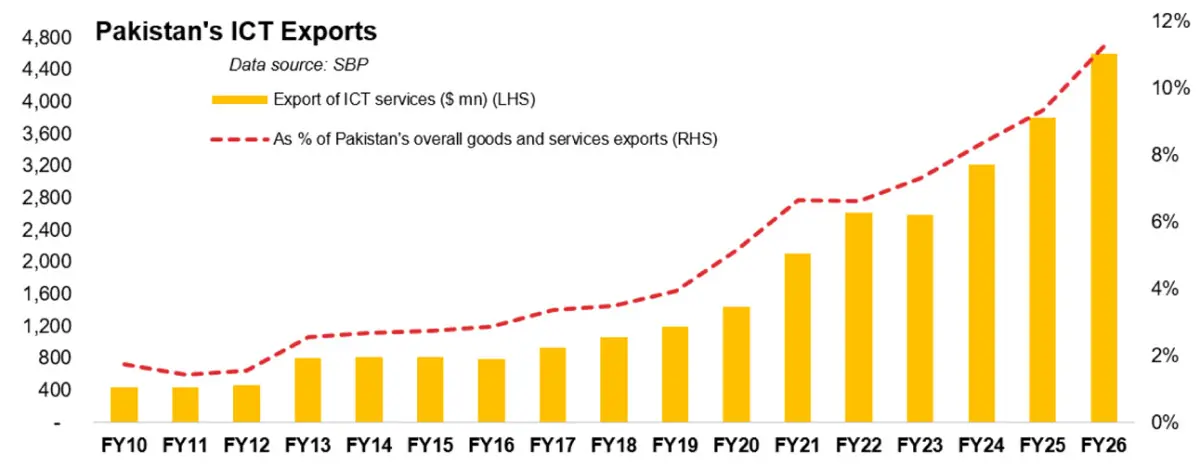
Pakistan's technology exports reached a record $4.6 billion in FY26, driven by ICT and business services. To meet future targets, the industry must diversify into higher-value services beyond current outsourcing models.
- Record growth in Pakistan's technology exports for FY26.
- Freelancers' significant contribution to IT export earnings.
- The industry's reliance on cost-competitive outsourcing.
- Strategies for achieving the $10 billion export target by FY29.

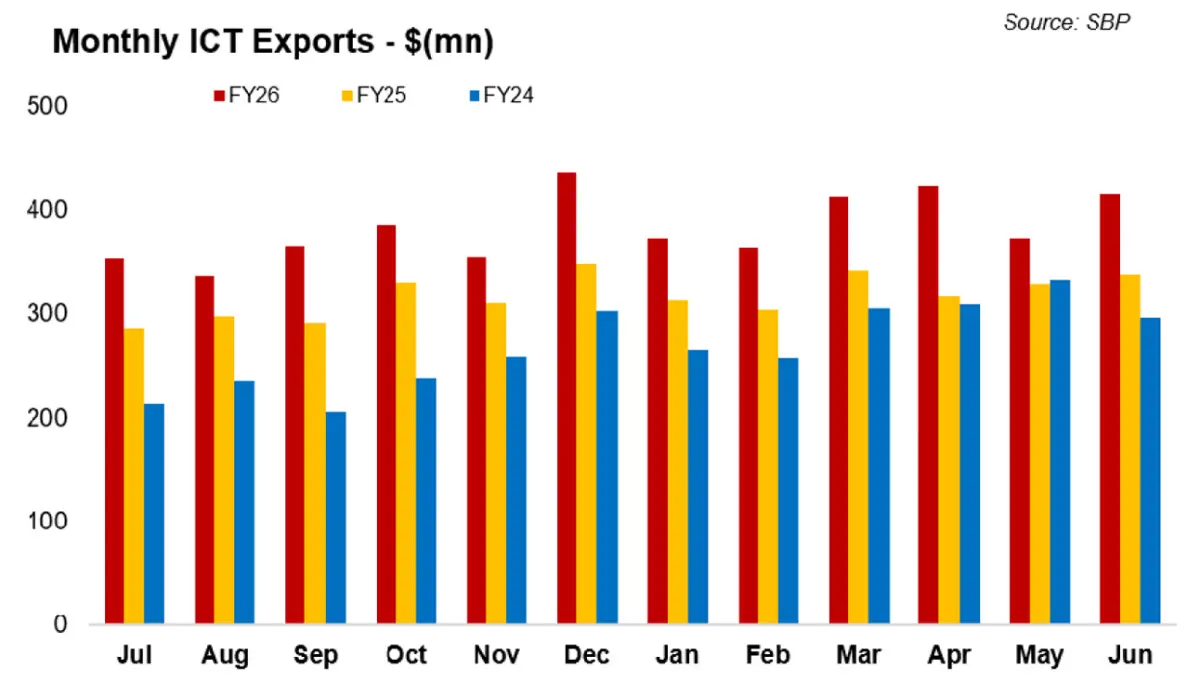
Pakistan’s technology exports closed FY26 on a strong note. ICT exports reached $416 million in June, up 23 percent year-on-year and 12 percent from May. For the full year FY26, exports rose 21 percent to a record $4.6 billion, compared with $3.8 billion in FY25, meeting the lower end of the government’s $4.5–5 billion target.
Freelancers were an important part of this growth, contributing roughly one-fourth of total IT export earnings. They have opened global markets to individuals and small teams that would otherwise struggle to find overseas clients. This has made freelancing one of Pakistan’s most accessible export industries.
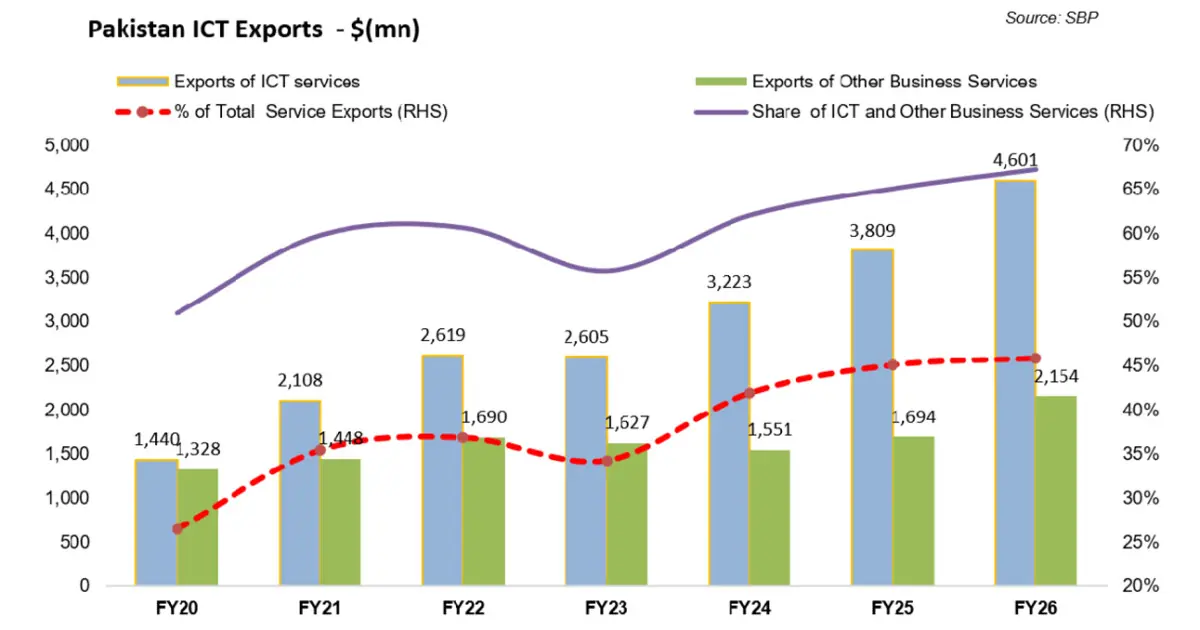
Other business services also had a strong year. Exports of professional, technical, consultancy and related services increased by around 27 percent to $2.15 billion in FY26.
Together, ICT and other business services generated about $6.76 billion in FY26 and accounted for nearly two-thirds of Pakistan’s total service exports.
Clearly, a second export engine is clearly taking shape. There areencouraging signs of diversification. Pakistani companies are beginning to look beyond traditional markets in the United States and Europe towards countries such as Japan and Singapore. But the structure remains fragile.
Pakistan’s technology industry still depends heavily on cost-competitive software development, call centres, business-process outsourcing and small gig-work contracts. These activities generate valuable foreign exchange, but they offer limited pricing power and are easier to replace.
And there are practical reasons for this. Outsourcing generates immediate cash flow, while developing a product can require years of investment before earning meaningful revenue. Many Pakistani firms remain small and undercapitalised, with limited resources for research, international marketing, and overseas sales teams.
The aim should not be to move away from freelancing and outsourcing. They remain valuable entry points into international markets. Shortages of advanced skills in artificial intelligence, cloud computing and cybersecurity also make it harder to move into higher-value work.
Large global clients also demand more than technical talent. They look for scale, cybersecurity standards, specialised certifications, strong governance, and a proven record of delivering complex projects.
Meanwhile, routine coding, design and support services are becoming increasingly exposed to automation.
Under the Uraan Pakistan plan, the government wants IT exports to reach $10 billion by FY29. That would require annual growth of almost 30 percent—well above the 21 percent achieved in FY26. Reaching that target will therefore depend not only on expanding freelancing and outsourcing, but also on helping firms move into higher-value services, build proprietary products, develop global sales capabilities, and secure larger, longer-term enterprise contracts.





















Comments