


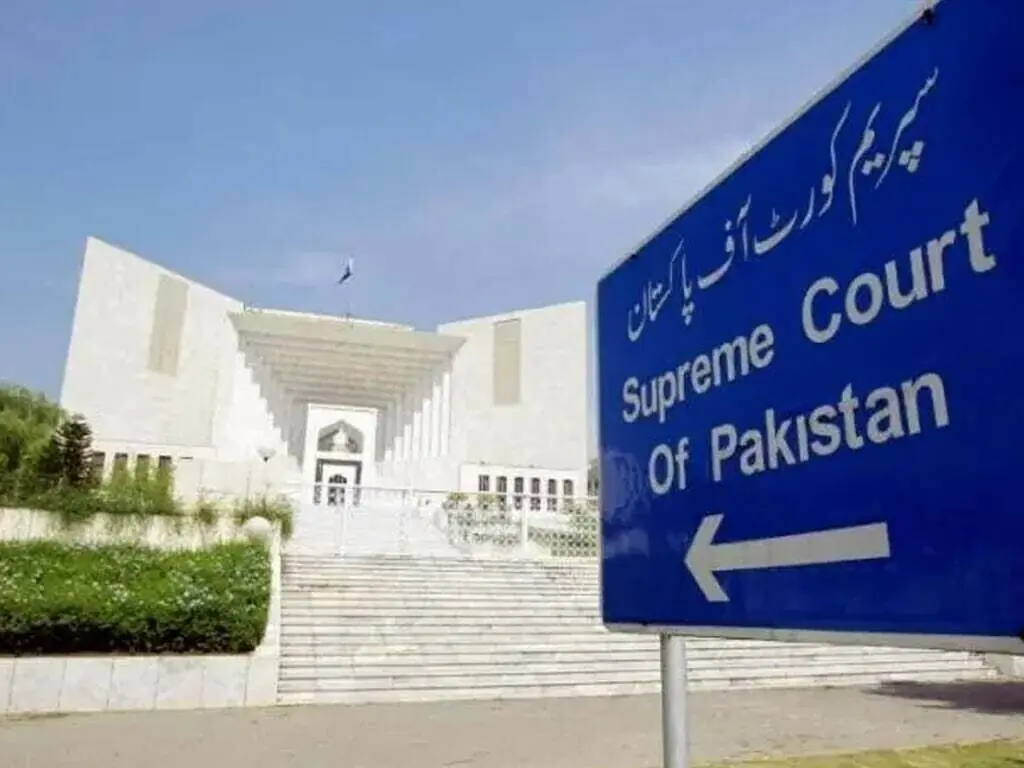

ISLAMABAD: The Supreme Court declared that it has no jurisdiction to take cognizance of the NAB cases under Article 175F (a) of the Constitution, read with Sections 32 and 32A of the National Accountability Ordinance, 1999.
The ruling came on two petitions taken up by a three-judge bench, headed by Justice Mazhar and comprising Justice Musarrat Hilali and Justice Shahid Bilal Hassan. One of the pleas was filed by the NAB, challenging an acquittal by the Peshawar High Court, and another by an under-trial prisoner, Aamir Mahmood, who challenged the Islamabad High Court’s refusal of his post-arrest bail.
The Court settled a jurisdictional dispute by transferring all pending criminal petitions for leave to appeal, as well as criminal appeals in which leave has already been granted, arising under the National Accountability Ordinance, 1999, from the Supreme Court to the Federal Constitutional Court.
The judgment, authored by Justice Mazhar, stated that the duty of the Court is to follow the law and not make decisions or assume the jurisdiction motivated by media mileage or public consumption. “We are fully conscious and also sanguine that neither the Court should assume the jurisdiction not vested in it by law nor it should abdicate its jurisdiction so vested under the law; rather, the jurisdiction is decided by the Constitution and the law itself.” “It is not a matter of surrender or conquest, but it is regulated by the law,” the 33-page judgment added.
It maintained that the exercise of jurisdiction is a fundamental regime of judicial discipline and the rule of law which does not allow crossing the boundaries of jurisdiction mandated by the Constitution and the law. “Any such attempt amounts to an overreach or usurpation of jurisdiction without statutory or Constitutional backing.”
The judgment said if any Court passes any judgment or order without jurisdiction, it is not only null and void but also hit by the doctrine of coram non judice. The jurisdiction of every court is delineated and established to adhere to and pass legal orders. “Transgressing or overriding the boundary of its jurisdiction and authority annuls and invalidates the judgments and orders.”
The judgment further said that according to the Constitution, the jurisdiction of the FCC and the SC do not override or overlap with each other, as both operate in separate spheres. It is not possible that the bail petitions should be entertained and decided by this Court, while in the same case the appeal should be heard by the FCC, which is beyond the scope and rigors of law. “If a law does not provide an avenue of appeal to this Court (SC), then the petitioner cannot invent this remedy on personal preference or consent.
Justice Mazhar wrote that for all intents and purposes, a vested right of second appeal has restructured or transformed a final appellate terminus or destination of accountability cases away from this Court to FCC, while disengaging a discretionary grant of leave into an automatic right of appeal, which commands that all pending criminal petitions for leave to appeal; criminal petitions already converted into appeals, against conviction or acquittal and all other pending criminal petitions for leave to appeal instituted for challenging the orders of the High Court either for refusing the bail or against the grant of bail to UTPs or for suspension of sentence or against the suspension of sentences must be transmitted to their final destination.
Justice Musrat Hilali, another member of the bench, in her additional note, wrote: “When the Constitution creates a new constitutional forum and the legislature transfers a class of appeals to that forum through section 32A of the NAO, the transfer must be understood as complete and effective.” Constitutional interpretation must avoid fragmenting jurisdiction between two apex constitutional courts.
She mentioned that since section 32A vests the appellate jurisdiction in the Federal Constitutional Court, the maxim “Quando lex aliquid alucuidi concedit, concedere videtur et id sine quo res ipsa esse non potest” applies with full force for the grant of principal jurisdiction necessarily includes the grant of all incidental powers essential to render that jurisdiction complete and effective.
If the legislature had intended to preserve jurisdiction in the Supreme Court over post-conviction bail, it could easily have said so. The Court cannot insert such words into the statute, the judgment said.
Copyright Business Recorder, 2026




















Comments