


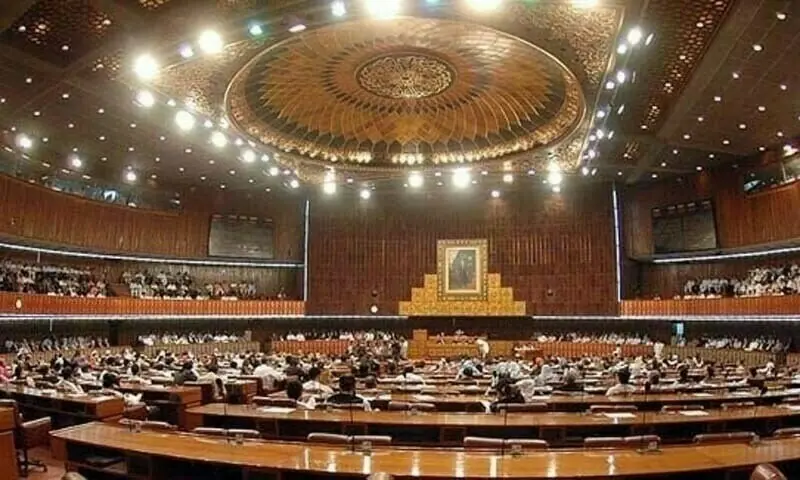

ISLAMABAD: The National Assembly’s budget debate on Tuesday descended into a sharp opposition-government clash, with lawmakers exchanging heated criticism over governance, economic strain and institutional authority as ministers defended the fiscal plans citing population pressures, security challenges and diplomatic gains.
Taking part in the ongoing debate on federal budget for 2026-27, the opposition Pakistan Tehreek-e-Insaf (PTI) lawmaker Junaid Akbar Khan set a confrontational tone almost immediately, casting doubt on the foundations of the current political system and suggesting that the real levers of power lie elsewhere.
He said the country’s political system has, for the past four years, operated under what he described as an “establishment-imposed arrangement”, arguing that elected leaders remain constrained by unseen institutional influence that continues to shape key decisions behind the formal structures of government.
He also took aim at recent remarks attributed to Finance Minister Muhammad Aurangzeb regarding poverty thresholds, particularly the suggestion that individuals earning around Rs8,400 a month should not necessarily be classified as poor.
He said the figure reflected a widening disconnect between policymakers and the economic realities faced by ordinary citizens grappling with inflation and stagnant wages.
Warning of fiscal pressures, he said the Federal Board of Revenue (FBR) was likely to miss its revenue targets, raising the prospect of a mid-year mini-budget – an outcome he argued would expose the government’s limited fiscal space and continued reliance on indirect taxation.
He also revisited past political controversies, including the 2022 “cipher” episode, and criticised inconsistencies in foreign policy positions over time.
In addition, he alleged that key decisions at the highest levels of government were not fully autonomous, stating that political leaders often proceeded only after seeking institutional approval.
Linking smuggling networks to militancy along the Afghan border, he criticised what he described as inconsistent approaches to trade and border management with Afghanistan.
He further alleged systematic discrimination against opposition lawmakers through disqualifications and institutional pressure.
Another PTI legislator, Atif Khan, argued that political narratives unfairly centre on jailed former prime minister Imran Khan while overlooking decades of governance by other parties, particularly the PPP and PML-N.
He accused mainstream political elites of consolidating wealth and industrial influence while failing to meaningfully empower elected representatives.
He also raised concerns over fiscal federalism, claiming that Rs1,200 billion was being effectively withheld from provinces despite constitutional assurances under the National Finance Commission (NFC) framework.
He criticised electricity governance as well, arguing that provinces were being blamed for power theft while responsibility lay with federal policy failures.
Investment, he added, would remain stagnant unless Parliament achieved true sovereignty, going so far as to suggest that meaningful foreign capital would not return without the release of ex-premier Imran Khan.
From the government side, Minister for National Health Mustafa Kamal warned that Pakistan’s rapidly growing population posed a serious challenge to development planning.
He said the country’s population of around 260 million was increasing by 6.7 million annually and could make Pakistan the fourth most populous country by 2030.
He linked population growth to mounting pressures on education, healthcare and housing, citing rising maternal and child health concerns as well as millions of out-of-school children.
He urged reforms in fiscal federalism, proposing a reduced weight for population in the National Finance Commission (NFC) Award and greater emphasis on performance-based indicators.
Defence Minister Khawaja Asif, speaking on security and foreign policy, said terrorism in Khyber Pakhtunkhwa and Balochistan was linked to instability in Afghanistan.
He said Pakistan had achieved significant diplomatic and military gains and credited the leadership for improving the country’s international standing.
He added that Pakistan continued to play an active role in regional diplomacy and stressed the need for collective political resolve to address security challenges, particularly in Balochistan.
Reiterating Pakistan’s position, he said the country remained open to engagement with Afghanistan, but insisted on assurances that Afghan territory would not be used against Pakistan.
He also praised what he described as Pakistan’s diplomatic resurgence, crediting the leadership of Prime Minister Shehbaz Sharif and Field Marshal AsimMunir for strengthening the country’s international position.
He rejected suggestions of external manipulation in Azad Jammu and Kashmir (AJK), warning against ethnic fragmentation in political discourse.
Minister for Religious Affairs Sardar Muhammad Yousaf described the budget as balanced and development-oriented, while pointing to longstanding infrastructure gaps in parts of Khyber Pakhtunkhwa.
He also highlighted improvements in Hajj arrangements and supported greater administrative decentralisation to improve service delivery.
Railways Minister HanifAbbasi adopted a strongly nationalist tone, warning against any attempt to restrict Pakistan’s water resources and linking future conflicts to water security.
He said Pakistan’s diplomatic outreach had improved its global image and emphasised national unity and defence preparedness.
Minister for Kashmir Affairs and Gilgit-Baltistan Amir Muqam highlighted ongoing development efforts in AJK and Gilgit-Baltistan, defended the political structure of the regions, and advocated tax relief measures for businesses in former tribal areas. He also called for coordinated solutions for tobacco farmers in Khyber Pakhtunkhwa.
Law Minister Azam Nazeer Tarar concluded the government’s response with a brief update on foreign detainees, informing the House that Islamabad was pursuing the release of 10 Pakistani citizens held in Somalia through diplomatic channels via its mission in Djibouti.
Copyright Business Recorder, 2026




















Comments