


Economic Survey: Pakistan misses GDP growth target as IMF talks continue
- Pakistan misses 4.2% GDP growth target, records 3.7% growth in FY26
- Economic size rose to $452.1 billion, the largest-ever economic size recorded in Pakistan’s history
Pakistan's economy grew 3.7% in FY2025-26, missing its 4.2% target. The Economic Survey highlights stabilization and growth across key sectors, supported by macroeconomic management and IMF reforms.
- Pakistan's 3.7% GDP growth in FY2025-26.
- Economic stabilization under the IMF program.
- Growth across agriculture, industry, and services sectors.
- Improving fiscal discipline and external reserves.
Pakistan’s economy grew 3.7% in FY2025-26, missing the government’s 4.2% target announced in last year’s budget, the Economic Survey 2025-26 showed. Finance Minister Muhammad Aurangzeb released the report on Thursday, a day before the federal budget.
Asked about an International Monetary Fund (IMF) agreement on budgetary targets, the finance minister said discussions were continuing.
“We are in talks with them, and discussions are progressing positively,“ he said.
Addressing the media persons, the finance minister shed light on the country’s economic performance during FY26.
“When we entered this fiscal year, there was trade uncertainty on account of the tariff discussion. By the end of July, we reached a competitive position with respect to our exports, especially to the US,” said Aurangzeb.
The finance minister said that Pakistan saw floods after that, and then a regional conflict from March onwards. “So these three were the exogenous factors,” he added.
GDP growth
The economy accelerated its growth momentum in FY26 and recorded a growth of 3.7% compared to 3.18% last year.
The improvement owes to effective macroeconomic management, better fiscal account, growth in Large Scale Manufacturing (LSM) sector, resilience of the agriculture sector to floods of 2025, exchange rate stability and reforms under the IMF Extended Fund Facility (EFF) Programme.
The survey flagged a mixed performance across key sectors as Pakistan’s economy continued to stabilise under the International Monetary Fund (IMF) programme.
Pakistan’s per capita income rose to $1,901 in FY26, up 9% YoY. “Income recovery has resumed alongside economic growth,” read the report.
Whereas, the country’s economic size rose to PKR 126.9 trillion ($452.1 billion) in FY26. This is the largest-ever economic size recorded in Pakistan’s history, according to the survey.
Meanwhile, the exchange rate remained stable at 280.65 Rs/USD compared to 279.35 Rs/USD in FY25.
Agriculture
Provisional data showed agriculture expanded 2.9% YoY in FY26. “This is notwithstanding the floods,” Aurangzeb said.
Government initiatives and timely support measures helped the crop sub-sector demonstrate resilience in the wake of the 2025 floods, enabling it to perform better than expected.
The livestock sector expanded by 3.75% in FY26, compared with 2.95% in 2024-25.
Industry & Services
Industrial output rose 3.5% in the outgoing fiscal, driven by manufacturing and construction, while services growth came in at 4.1% in FY26, the highest in four years.
The service sector has remained a strong growth anchor for Pakistan’s economy, as it makes up nearly 58% of the GDP, said Aurangzeb.
LSM
Pakistan’s large-scale manufacturing sector (LSM) grew by 6.1% in FY26, which is broad-based growth, said Aurangzeb.
The growth was supported by improved domestic demand, easing input constraints, and better supply conditions, read the report.
“Out of 22 sectors of manufacturing, we have observed growth in 16 sectors, including food, textiles, wearing apparel, etc.,” he said.
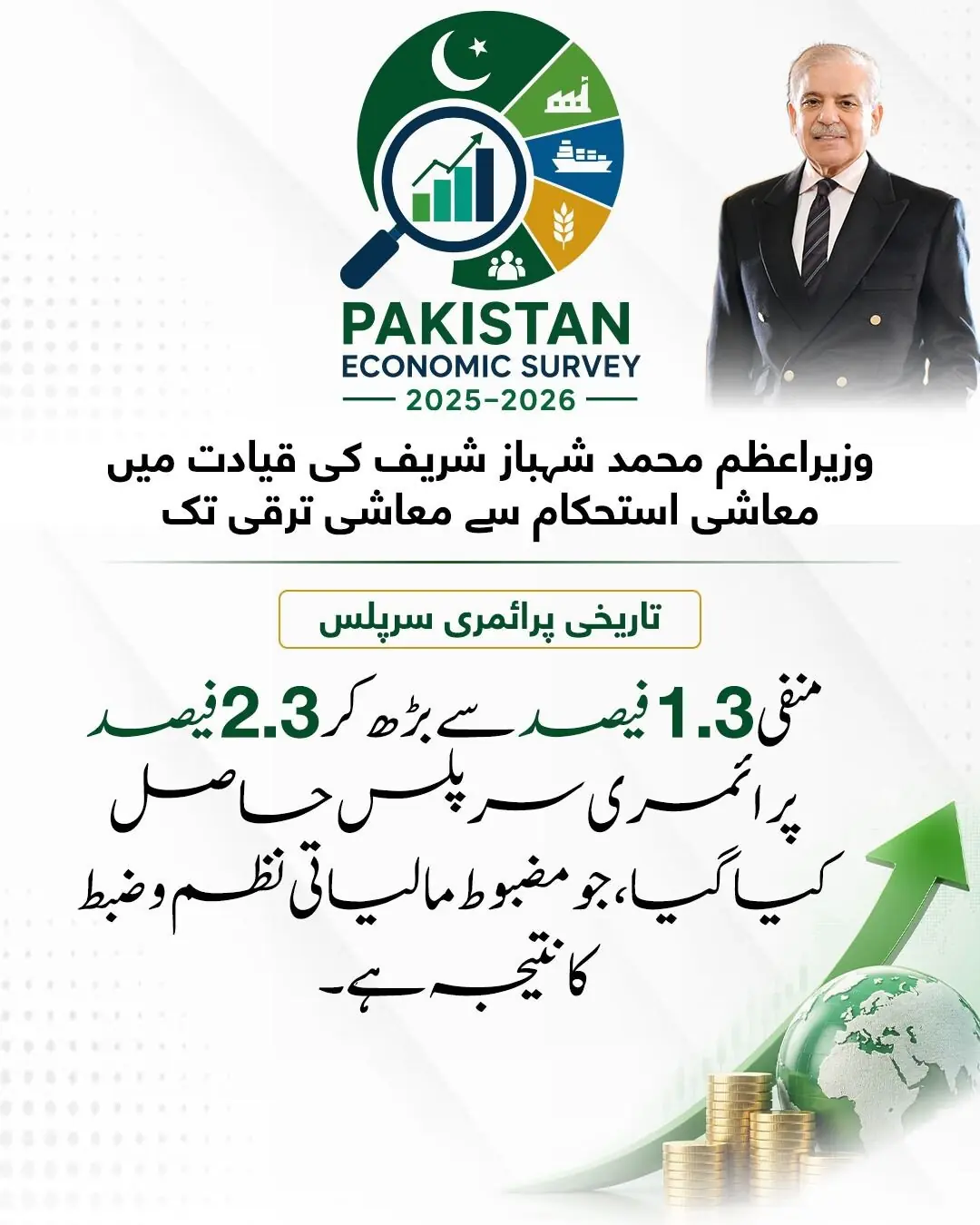
Pakistan’s fiscal deficit stood at 0.7% of the GDP in FY26 (Jul-Mar), compared to 2.6% last year. Whereas the primary surplus stood at 3.2% of the GDP in FY26.
“Fiscal discipline is translating into stronger economic fundamentals,” read the report.
Pakistan’s current account deficit was at $252 million in the July-April FY26. Whereas, the country’s trade deficit from July-March FY26 stood at $23.53 billion, showed the survey.
On the external front, the finance minister said that Pakistan needs to increase both its exports and remittance inflows.
Pakistan’s remittance inflows clocked in at $33.9 billion in FY26 (Jul-Apr), up 9% YoY.
“Remittances are part of the structural economies of our regional countries. They are and will remain a very important component of our external balancing position as we move forward,” he said, while lauding the role of Overseas Pakistanis.
Aurangzeb shared that the government expects to achieve remittances to the tune of $41-42 billion by the end of this fiscal year.
Trade Indicators
Talking about trade indicators, Aurangzeb admitted that Pakistan’s exports have declined, citing two major factors.
“Our rice exports have declined from $1.1 billion, while sugar exports, a one-off event, reduced by $400 million. Therefore, our food sector exports reduced by $1.5 billion,” he said.
Whereas Pakistan’s textile exports have improved during the outgoing fiscal year, he said.
Pakistan’s goods exports during July-March FY 2026 stood at $22.7 billion, compared with $24.7 billion in the same period last year.
“People and the industry have to review their business model and their productivity discussion,” said Aurangzeb.
Made-in-Pakistan football goes to FIFA World Cup
Aurangzeb also highlighted the increase in the export of sports goods, which stood at $319 million during July-March FY26, mentioning that the football that was to be used during the upcoming FIFA World Cup was manufactured in Pakistan.
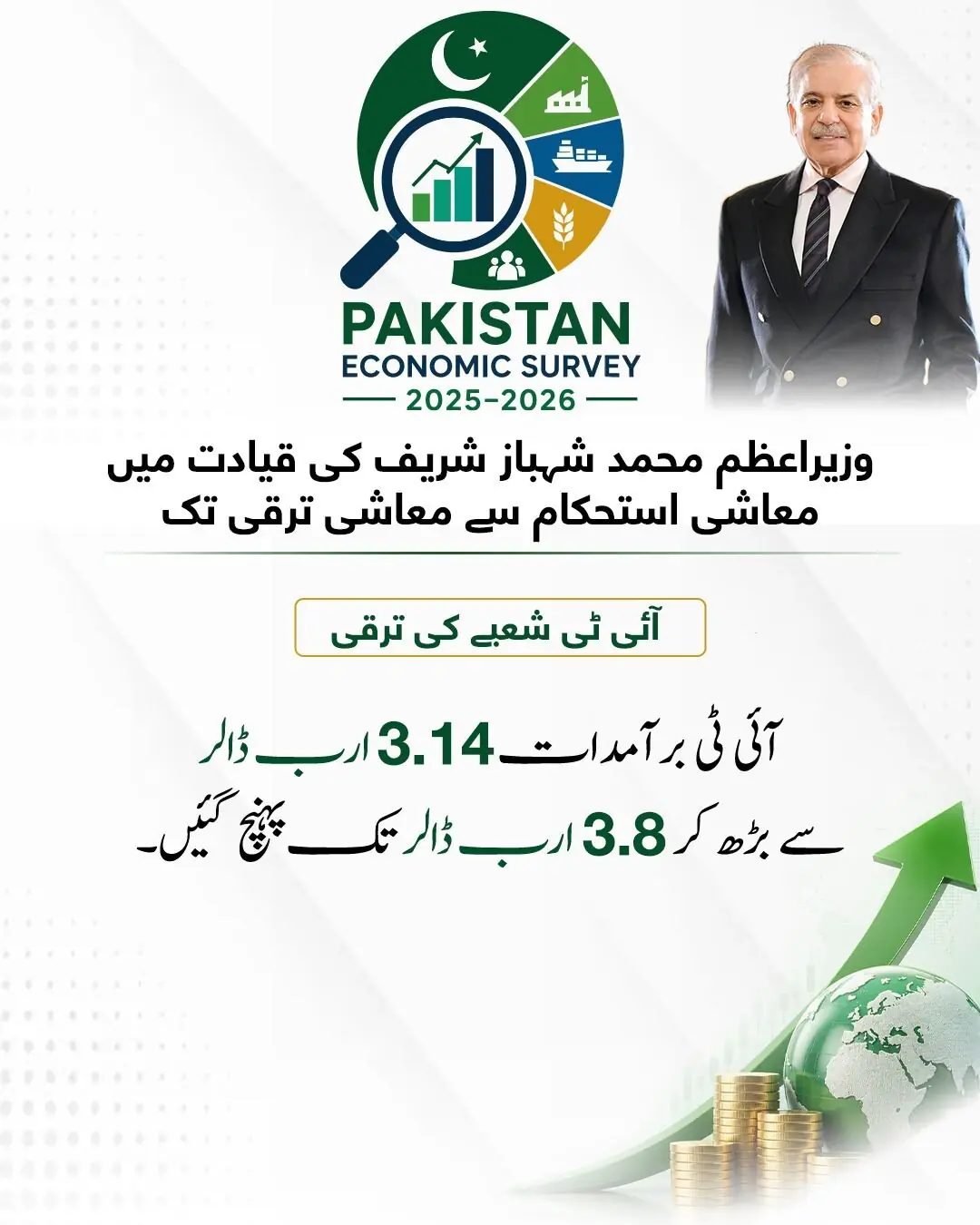
Regarding the IT sector, he said that Pakistan’s IT exports have crossed $3.8 billion in FY26 (Jul-Apr), and are expected to cross $4.5 billion by the end of this fiscal year.
As per the report, freelancers’ annual income rose from $642 million in FY25 to $959 million in FY26.
Meanwhile, during July-March FY26, imports increased by 6.9% percent to $50.7 billion, compared with $47.4 billion in the same period last year.
As per the report, the increase was mainly driven by higher imports under the transport, food, and machinery groups, reflecting stronger demand for vehicles and transport equipment, essential food items, and capital goods.
“We thought that our import bill would go down. However, because of the increase in petroleum prices, it could hit $70 billion this fiscal,” said Aurangzeb.
He said that despite the increase in imports, the country’s current account would remain manageable.
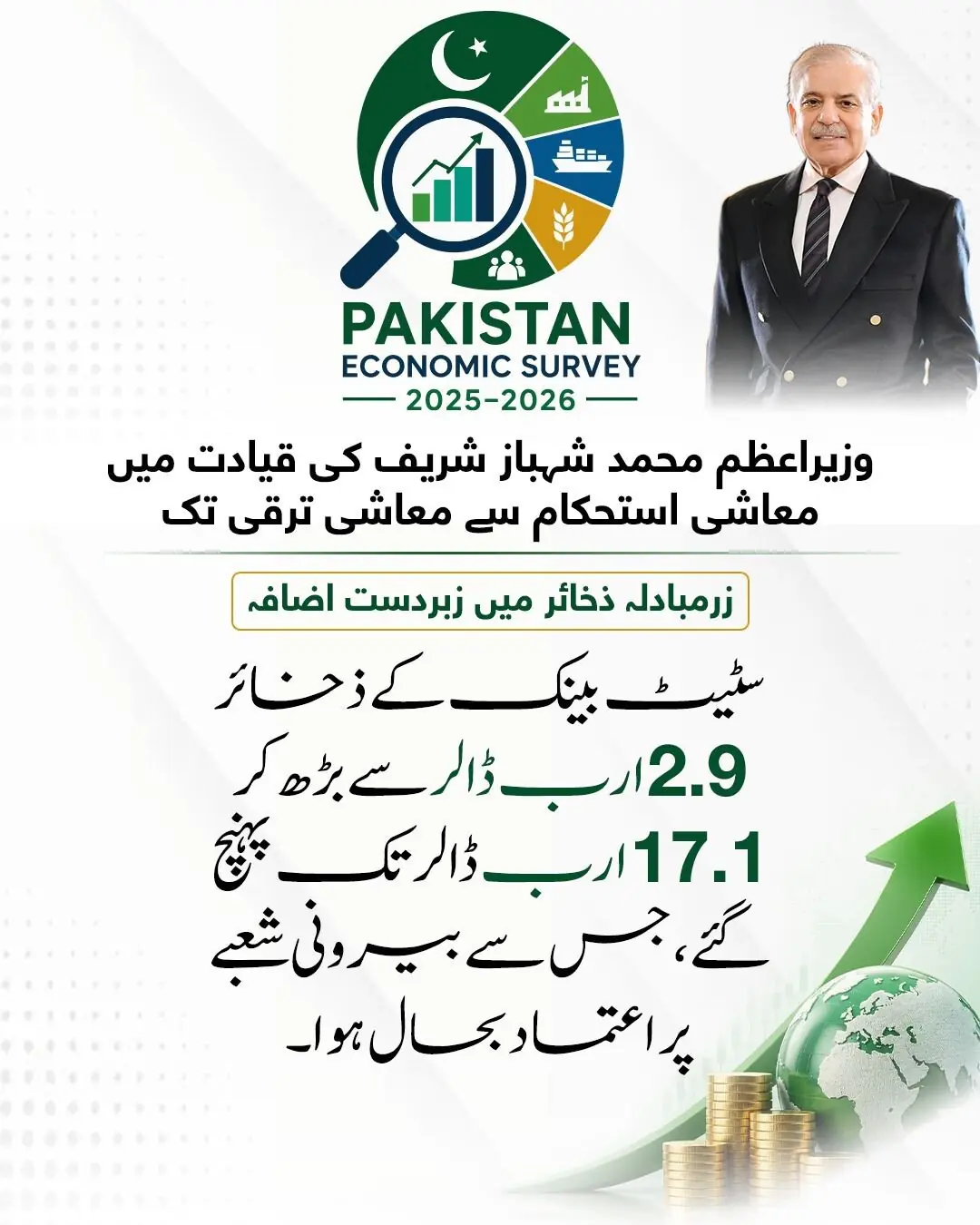
Pakistan’s forex reserves stand at $17.2 billion as of 29 May 2026, up 49% YoY.
“We are hopeful to touch $18 billion by the end of June, which will take us to 3-months of import cover, which is an internationally recognised standard,” said Aurangzeb.
Stock Performance
Talking about the stock sector performance, the finance minister noted that 11 IPOs were listed at the PSX in FY26. This is the highest in two decades, which reflects strong corporate confidence in future growth prospects, he said.
According to the Economic Survey, Pakistan’s capital markets performed well compared to major global stock markets in FY26. The KSE-100 index demonstrated a growth of 18.4% during July-March FY 2026.
“This increase can be attributed to strong corporate earnings, a decline in both the policy rate and inflation, the successful review of the IMF-EFF Programme, and subsequent tranche disbursements, all of which contributed to a stable macroeconomic environment that bolstered investor confidence,” read the report.
Debt
As per the report, Pakistan’s debt-to-GDP stood at 68.5% in FY26. “Debt sustainability is improving as the debt burden on the economy continues to decline,” it added.
External public debt was recorded at $92.2 billion at end-March 2026, showing an increase of around US $364 million during the first nine months of the current fiscal year compared to an increase of $883 million during the same period of the last fiscal year, read the document.
“Government external debt accounts for the majority, amounting to $82,261 million, while outstanding debt from the IMF stands at US $ 9,891 million.
“The IMF debt further consists of the federal government debt ($3,620 million) and the central bank debt ($6,271 million),” read the report.
The Paris Club debt amounts to $5.5 billon, representing approximately 6% of Pakistan’s total external public debt. These loans are also concessional, offering longer repayment periods and lower interest rates.
Bilateral loans from non-Paris Club countries amount to $19.03 billion i.e. 21% of total external debt.
Inflation
The inflation rate rose from 7.3% in March 2026 to 10.9% in April 2026 due to a rise in global oil prices and supply disruptions amid the Middle East crisis.
Average inflation for July-May FY26 was recorded at 6.7%. “Price stability broadly preserved despite Israel-Iran conflict and its impact on energy prices,” read the report.
Privatisation Continues
On privatisation, the finance minister shared that three electricity distribution companies (DISCOs) would be privatised by the end of the outgoing fiscal year.
Pakistan’s investment-to-GDP ratio remained stable at 14.38% in FY26, mainly supported by growth in private sector capital formation. National savings were recorded at 14.13% percent of GDP, indicating limited reliance on external financing.
During July-March FY26, tax revenue increased by 11.3% to Rs10,166.6 billion while non-tax revenue grew by 9.5% to Rs4,632.7 billion.
The country’s volume of investment through Roshan Digital Accounts (RDA) has reached $12.7 billion in FY26, it shared.
Middle East Conflict
Talking about the ongoing conflict in the Middle East, the finance minister said that the government has successfully negotiated the first-order impact of the conflict, but its impact would be felt in the coming months.
“Our oil imports, which shot up above $1 billion in April, were lowered to half a billion dollars in May, because we are now trying to manage the inflows,” he said.
“Whereas, the second-order impact of this conflict is being observed in the rising inflation rate, which has led to an increase in the policy rate,” he said.
Aurangzeb added that he remains optimistic that the country’s leadership mediating efforts would be successful. “But the reality is that the energy infrastructure has been hit and continues to be hit. We are taking that into vis-à-vis our contingency,” he added.
Economic Survey 2024-25: Pakistan misses growth target
According to the report, the ongoing conflict in the Middle East has become a significant external risk to both the global economy and emerging economies.
Disruptions in energy supply routes and damage to critical production facilities increased uncertainty in global energy markets and added downside risks to growth.
At the same time, renewed trade tensions, elevated public debt, and concerns regarding slowing productivity growth continued to weigh on the global economic outlook.
According to the World Economic Outlook (April 2026), global growth is projected to moderate to 3.1% in 2026, while global headline inflation is expected to rise to 4.4% from 4.1% in 2025.
The Economic Survey provides a comprehensive overview of the country’s economic performance during the outgoing fiscal year and serves as a key policy document ahead of the annual budget.
The government had earlier indicated that the budget would be presented on June 10, but later revised it to June 12.
The upcoming budget is expected to outline the government’s fiscal priorities, revenue measures and expenditure plans for FY27 amid ongoing efforts to stabilise the economy and sustain growth.
NEC targets
The National Economic Council (NEC) on Wednesday approved a Rs3.669 trillion national development outlay for the fiscal year 2026-27, including Rs838 billion in foreign aid and set a GDP growth target of 4%.
The meeting also sanctioned Rs1 trillion for the federal Public Sector Development Programme (PSDP), Rs2.218 trillion for provincial development programmes, and Rs451 billion for state-owned enterprises (SOEs).
The NEC unanimously approved a four-point agenda and revised economic indicators for the outgoing fiscal year 2025-26, allocating Rs820 billion for the federal PSDP, Rs2,938 billion for provincial development programmes, and Rs355 billion for SOEs.
The council approved a GDP growth target of 3.7% for 2025-26.













Comments