


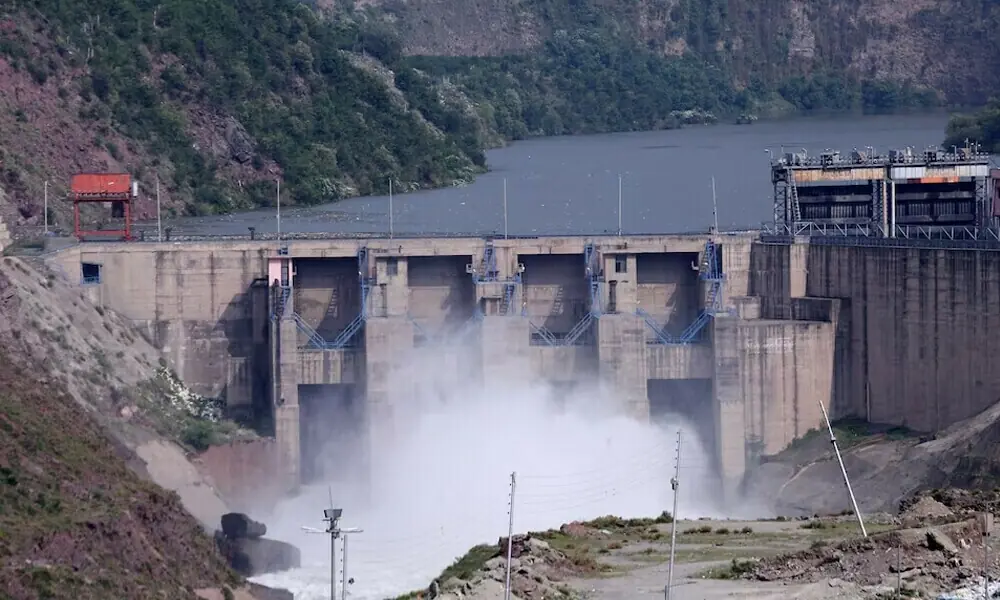
ISLAMABAD: Speakers at a seminar said that the entire South Asian region faces the threat of the “Akhand Bharat” ideology, which they described as India’s vision of reunifying the region into a single entity and politicizing the water issue.
They said that water should have been a bridge of cooperation, but it has become a dangerous threat to peace and security in the region.
The India Study Centre at the Institute of Strategic Studies Islamabad (ISSI) organised an international seminar titled “Weaponisation of Water: Legal and Strategic Implications of Undermining the Indus Waters Treaty” on Wednesday.
Renowned speakers and experts, including former minister of Law and Justice Ahmer Bilak Sufi, Dr Sofia Khanom, Research Director, Bangladesh institute of International and Strategic Studies, Dhaka, Ambassador Shafqat Kakakhel, Chairperson, Sustainable Policy development Institute (SDPI), Dr Zhang Jiadong, Director, Center for South Asian Studies and Dean, Institute of Strategic Studies and International Security, Fudan University, Shanghai, China, and Mr. Ali Tauqeer Shaikh, Senior Consultant, Asian Development Bank delivered speeches.
Addressing the gathering, Soofi said that Article 12(4) of the Indus Waters Treaty (IWT) clearly states that the treaty can only be modified if both parties agree to do so and that it cannot be abrogated or legally suspended unilaterally. Indian Prime Minister Narendra Modi had declared his intentions about the fate of IWT as soon as he assumed power in New Delhi in 2014.
This intent was mainly driven by the internal politics of India and the promises made by Indian Prime Minister Modi during his election campaign. He said that post-Pahalgam incident, there was no investigation and took a hasty decision of holding the treaty in ‘abeyance’, giving an impression as if India had been waiting for this opportunity.
Ambassador Khalid Mahmood, Chairman, Board of Governors, ISSI, said that South Asia is one of the most water-stressed regions in the world. Instead of cooperation, India chose to politicise this very important issue.
Dr Khurram Abbas, Director of the India Study Centre, said that before April 2025, the Indus Waters Treaty used to be described as one of the most successful and durable water-sharing agreements in modern history.
Dr. Sofia Khanom said that, contrary to general perception, Bangladesh is a water-stressed country. It is only during the Monsoon season that there is water everywhere, but for the rest of the year, Bangladesh experiences a shortage of water. Additionally, there are effects of climate change as well.
Ambassador Shfqat Kakakhel said that the IWT is a remarkable treaty that was signed after nine years of negotiations.
The signing of the IWT set an example across the world, and following it, some 145 transboundary agreements were signed across the world. Article 9 of the treaty shows a clear path for the settlement of disputes and differences. India has taken several+ steps that go against Pakistan’s water rights. Hence, protection of IWT is not only in Pakistan’s interest but also in the interest of all lower riparian countries of South Asia and the world at large.
Copyright Business Recorder, 2026






















Comments