


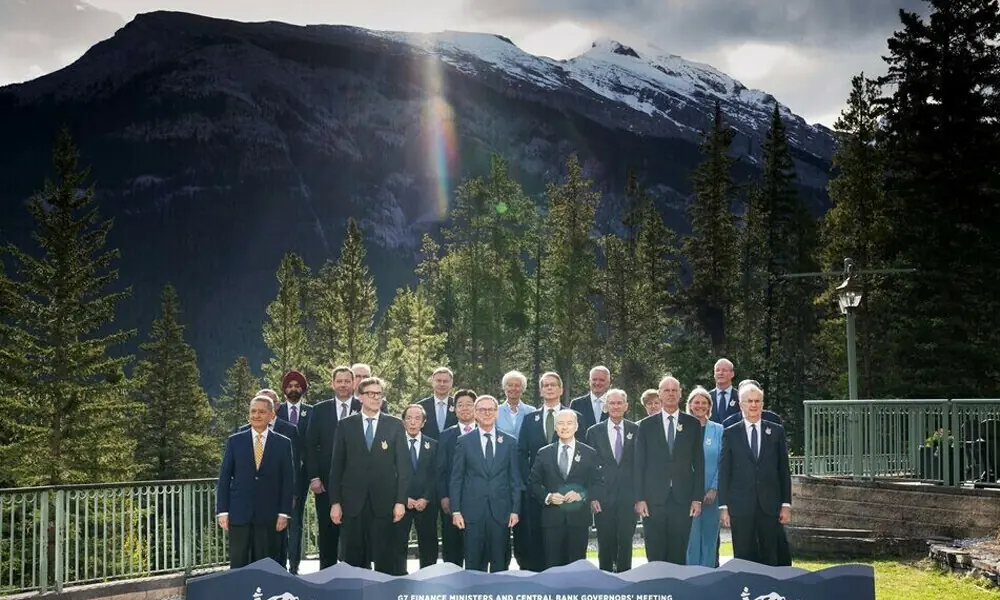

PARIS: G7 finance ministers agreed on Tuesday on the need for action to tackle trade imbalances in a fragmented global economy, saying the current situation was unsustainable, but were light on plans for concrete measures. The finance ministers and G7 central bank governors met in Paris for a second day to discuss the economic fallout from the Iran war and volatility on global bond markets.
They agreed on the need to re-open the Strait of Hormuz and support Ukraine, but some splits between the United States and the others on key issues to do with Iran and Russia remained apparent.
French Finance Minister Roland Lescure said they also discussed diversifying the supply of rare earths and critical minerals and addressing global economic imbalances - a major theme of France’s G7 presidency.
He said such imbalances were fuelling trade friction and risked a turbulent unwinding in financial markets, highlighting a pattern whereby China under-consumes, the United States over-consumes and Europe under-invests.
“We all share a common view. Those imbalances are not sustainable,” Lescure told reporters after the meeting. He called for the International Monetary Fund to improve its monitoring and analysis, and pledged to continue discussions.
The G7 ministers agreed that their domestic agendas needed to include plans to increase investments, improve productivity and curb policies that distort markets, Lescure said.
He cited large Chinese export surpluses as part of the issue, but discussions so far in the broader G20, of which China is a member, haven’t yielded much progress. US Treasury Secretary Scott Bessent said he had warned European counterparts that they needed trade protections against a flood of Chinese exports that would damage their economies.
“Unfortunately, I was right,” he told Reuters in an interview after the meeting.
G7 MINISTERS ADDRESS IRAN CONFLICT,
PRESSURE ON RUSSIA
G7 ministers said in a statement it was “imperative” to ensure a return to free and safe transit through the Strait of Hormuz and ease strains on energy, food and fertiliser supply. US President Donald Trump said on Monday he had paused a planned attack against Iran, talking up the chances of reaching a nuclear deal. Other G7 countries have expressed frustration that Washington and Israel launched strikes against Iran without considering the economic impact of the foreseeable closure of the strait, a vital waterway for energy markets, while Trump has castigated some allies like Britain and Germany for not fully supporting the operation.
Bessent said European allies needed to better enforce financial sanctions on Iran, while Asian allies should tackle Iran’s shadow fleet to prevent transfer of oil to non-sanctioned tankers.




















Comments