


Pakistan turns to grey-market generators as outages worsen amid Middle East war: report
- Informal generators are a vital, costly lifeline for Pakistanis battling persistent power outages and economic uncertainty
As Pakistan faces prolonged power outages, residents and small businesses increasingly rely on informal micro-utilities and grey-market diesel generators, highlighting the country's economic vulnerability amid energy crises.
- Informal micro-utilities and grey-market diesel generators.
- Pakistan's economic vulnerability amid energy crises and regional conflicts.
- Impact of power outages on economic growth and business operations.
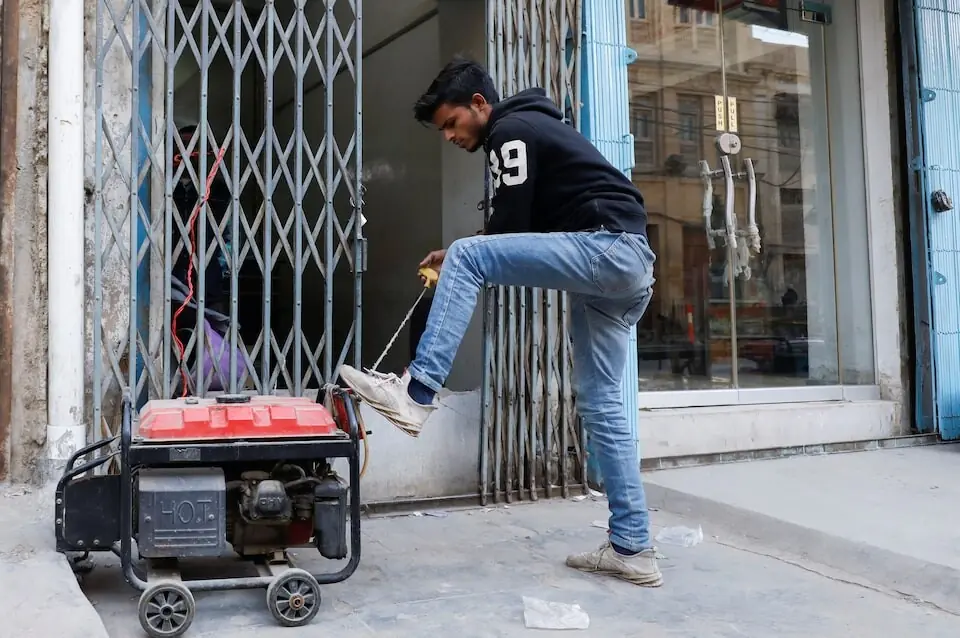

As prolonged power outages grip the country amid worsening energy supply disruptions, a growing number of residents and small businesses are turning to informal micro-utilities and grey-market diesel generators to keep their workplaces running.
According to Bloomberg, privately operated backup power networks have emerged as an alternative to the unreliable grid across different neighbourhoods of Karachi, Pakistan’s business hub, as residents continue to struggle with persistent power outages.
Mohammad Mazhar, a tailor by profession, pays a monthly fee to tap a nearby generator when his main supply cuts out.
“The connection is a lifeline for my business,” said Mazhar.
“We don’t consume much power, but without this, we have to wait for the lights to come back on before we can iron clothes for customers. The generator next door is helping us to make ends meet.”
Despite imposing austerity measures to cope with the effects of the ongoing war between the US and Iran, Pakistan’s economy remains among the most vulnerable if the conflict is prolonged.
S&P Global Market Intelligence, in its latest report, identified Pakistan as the economy facing the highest macro-financial stress risk under a prolonged Middle East conflict scenario.
The outlook projects Pakistan’s real GDP growth to ease to 3.2% in fiscal year 2027, with the balance of risks tilted to the downside, driven primarily by the ongoing war in the Middle East.
According to Bloomberg, the affluent classes in Pakistan have already tapped alternative power sources, especially solar. However, more and more residents are now choosing budget-friendly alternatives, turning to small-scale suppliers who run diesel generators and charge a marginal fee.
However, the increasing reliance on backstreet diesel generators can create further problems for the already fragile country’s economy, fueling inflation and adding pressure on precious forex reserves, warn economists.
“Persistent power outages place a limit on Pakistan’s economic growth,” said Gareth Leather, senior Asia economist at Capital Economics.
“The crisis hits both ends of the economy. It hurts domestic consumption because sky-high electricity bills and fuel costs leave households with less money to spend, and it threatens exports, because key sectors like textiles cannot guarantee steady production or meet international deadlines.”
The report noted that businesses in Karachi have cobbled together their own solutions; for example, Shahzad Alam Rajput, president of one local market in Karachi’s industrial Korangi district, is supplying electricity to hundreds of shops via two large diesel generators.
“How will these people run these businesses if there is no electricity?” asked Rajput. “We are here because there is demand. If the grid were providing uninterrupted supply, we wouldn’t be doing this.”
Although Pakistan imported two LNG shipments from the Persian Gulf in a week, the absence of a return to normal flows means the risks from a prolonged crisis remain.
However, generators cannot fix every situation, especially for high-energy users.
Abdul Sattar, a worker at an iron and aluminium welding shop, says small-scale generator providers can help stores and homes keep LED lights on, but lack the capacity to power heavy equipment.
“Even for those lucky enough to muddle through, there are challenging weeks and months ahead,” read the report.




















Comments