


Aurangzeb briefs IMF mission on fiscal strategy
Pakistan's Finance Minister briefed the IMF on economic reforms and the upcoming budget, with the IMF urging continued fiscal discipline and structural changes for sustainable stability and growth.
- IMF's call for continued reforms and fiscal discipline.
- Pakistan's macroeconomic outlook and reform priorities.
- Government's commitment to sustainable, export-led growth.
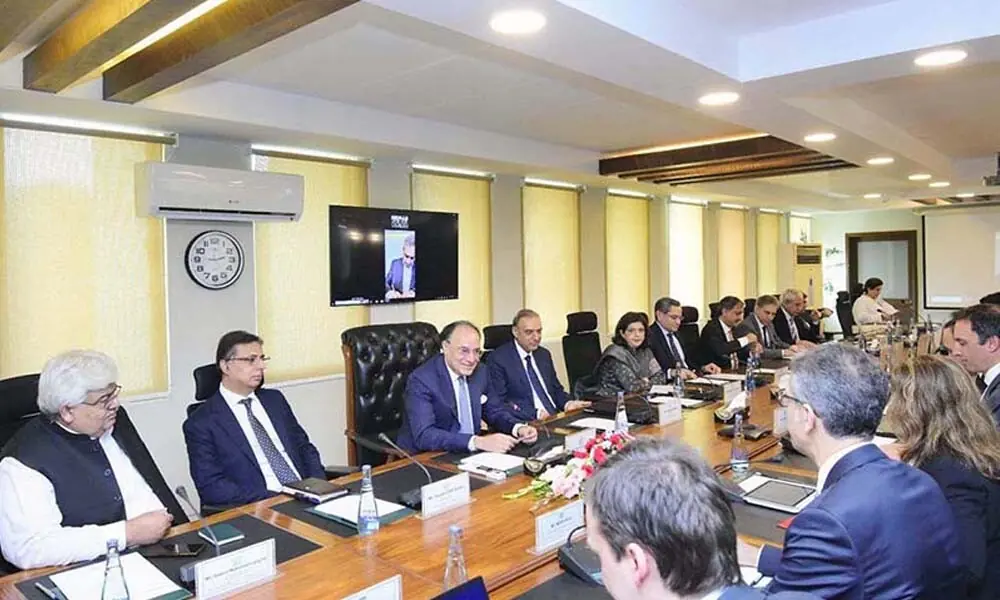
ISLAMABAD: As Pakistan is set to begin key budget talks for the next financial year with the International Monetary Fund (IMF), the visiting mission on Wednesday urged the government to continue reforms, maintain fiscal discipline, and push ahead with structural changes, warning that economic stability depends on consistent policy implementation.
The discussions focused on the upcoming federal budget, the broader macroeconomic framework, and the government’s reform agenda aimed at securing durable and inclusive growth.
An official statement issued by the Finance Division noted that Federal Minister for Finance and Revenue, Muhammad Aurangzeb, on Wednesday briefed the visiting IMF Mission, led by Mission Chief Iva Petrova, on Pakistan’s macroeconomic outlook, fiscal strategy, reform priorities, and the government’s ongoing efforts to ensure sustainable economic stability and long-term growth.
READ MORE: Pakistan receives $1.3 billion from IMF: SBP
The discussions focused on Pakistan’s macroeconomic stabilisation efforts, preparations for the upcoming federal budget, and the broader reform agenda aimed at strengthening fiscal and external sustainability while fostering sustainable economic growth.
Both sides exchanged views on maintaining reform momentum, preserving macroeconomic stability, and advancing structural reforms to promote investment, productivity, and export-led growth within a balanced and forward-looking policy framework.
Welcoming the IMF delegation to Islamabad, the Finance Minister appreciated the Fund’s continued engagement and constructive dialogue with the government of Pakistan. He particularly acknowledged the productive discussions initiated during the Spring Meetings held in Washington earlier this year.
Aurangzeb shared encouraging developments regarding Pakistan’s external sector, highlighting positive trends in remittances and export performance. He noted that recent data indicated improvement in exports on both a month-on-month and year-on-year basis, reflecting growing resilience in the economy and a gradual strengthening of macroeconomic fundamentals.
The Finance Minister emphasized that while economic stabilisation efforts had produced encouraging results, the government remained fully mindful of the structural challenges confronting the economy, particularly external liabilities and the need to accelerate sustainable, export-led growth.
He reiterated the Government’s commitment to deepening reforms aimed at strengthening macroeconomic stability without compromising long-term growth prospects. In this regard, he underscored the importance of moving Pakistan away from recurring boom-and-bust cycles through structural reforms, productivity enhancement, deregulation, and improved export competitiveness.
Aurangzeb further stated that the government’s reform agenda had been carefully calibrated in consultation with international experts and economists. He emphasized that the ongoing policy measures were not driven by short-term considerations, but formed part of a broader and technically grounded economic transformation strategy endorsed at the highest level.
The Finance Minister also briefed the Mission on Pakistan’s continued engagement with international development partners, including ongoing economic cooperation initiatives with China and efforts aimed at mobilizing long-term investment aligned with the country’s strategic economic priorities.
Copyright Business Recorder, 2026






















Comments
Comments are closed for this article.