


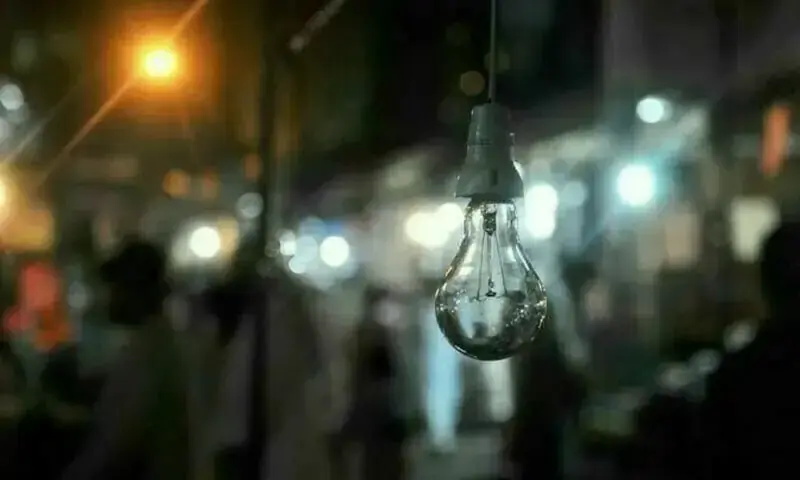

ISLAMABAD: The government has initiated power loadshedding of up to three hours to manage generation shortfalls during time caused by reduced water releases from reservoirs and to avoid imposing additional financial burden on consumers.
The move reflects a system shortfall of around 2,000–2,500 MW, primarily due to lower hydropower generation and reduced output from RLNG-fired power plants, sources told Business Recorder.
According to sources, a high-level committee headed by Finance Minister Muhammad Aurangzeb, which is monitoring the country’s energy situation, has been taken into confidence.
READ ALSO: BR RESEARCH: Power sector is only less bad
“There is no capacity shortfall in terms of installed generation. However, during peak hours, limited load management—averaging about 2.25 hours, mainly at night — is being carried out to curtail furnace oil (RFO) consumption and keep the Fuel Charges Adjustment (FCA) within limits,” sources in the committee said.
Data shared by WAPDA on Monday showed that water inflows at Tarbela stood at 20,200 cusecs, with outflows at 8,000 cusecs. At Mangla, inflows were recorded at 29,100 cusecs, while outflows remained at 8,000 cusecs.
At Tarbela, the minimum operating level is 1,402 feet, with the current level at 1,465.62 feet and a maximum conservation level of 1,550 feet. Live storage currently stands at 1.526 million acre-feet (MAF).
At Mangla, the minimum operating level is 1,050 feet, with the current level at 1,156.90 feet, a maximum conservation level of 1,242 feet, and live storage of 1.989 MAF.
Meanwhile, the price of furnace oil has surged sharply from around Rs 200,000 per ton in February 2026 to nearly Rs 400,000 per ton prior to the announcement of a recent two-week ceasefire, further increasing the cost of power generation.
Hydropower generation has declined significantly due to reduced water releases, as provinces have not submitted sufficient water indents amid ongoing rains and the harvesting season. The rains have also damaged standing crops, including wheat in Sindh and southern Punjab.
Power consumers are likely to face a positive FCA of over Rs 2 per unit for March 2026, mainly due to increased reliance on expensive furnace oil and reduced RLNG-based generation.
Sources revealed that around 3,600 MW of RLNG-based power plants located near load centres are currently being supplied limited volumes of indigenous gas.
On March 14, 2026, the Power Division indicated that the power sector’s RLNG requirement stands at approximately 300 MMCFD, against which allocation from Sui Northern Gas Pipelines Limited (SNGPL) is about 130 MMCFD, currently being supplied to only one power plant.
Gas availability further declined to around 85 MMCFD between March 20 and 30, and currently stands at about 80 MMCFD against a demand of nearly 350 MMCFD, exacerbating the generation shortfall.
Pakistan operates three major RLNG-based combined-cycle power plants established between 2015 and 2018 to address electricity shortages. These include the 1,180 MW Bhikki Power Plant in Sheikhupura, the 1,230 MW Haveli Bahadur Shah Power Plant in Jhang, and the 1,223 MW Balloki Power Plant in Kasur.
Copyright Business Recorder, 2026




















Comments