


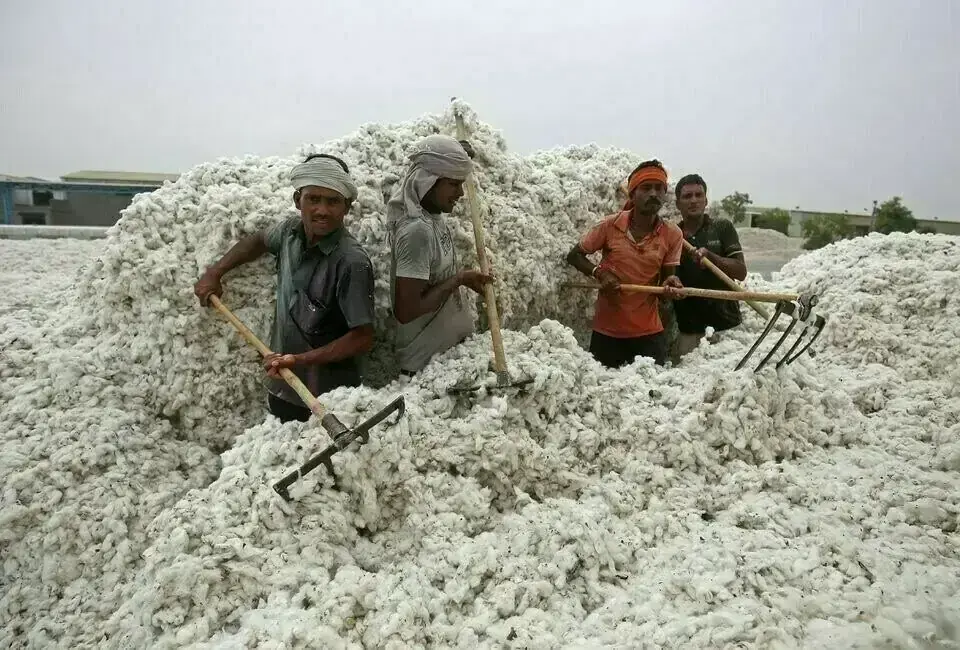

KARACHI: Overall stability was observed in cotton prices during the latest trading session, though market activity remained limited. An upward trend continued in New York cotton futures, reflecting positive sentiments in international markets. For the upcoming 2026-27 crop season, forward contracts for seed cotton and ginned cotton were settled at Rs10,000 per kilogram and Rs21,700 per maund respectively, with deliveries agreed upon between May 20 an May 30.
According to sources, there are indications that the ongoing dispute between Pakistan and Afghanistan may be resolved through Chinese mediation. If diplomatic matters progress in the right direction, the import of cotton from Afghanistan into Pakistan could resume. Sources further revealed that Afghanistan currently holds a stock of approximately 500,000 cotton bales, which could significantly ease supply pressures in the Pakistani market once trade relations are restored.
The Karachi Cotton Exchange building has remained sealed since December 12, 2025, following an operation carried out by the Evacuee Trust Property Board with the assistance of the Federal Investigation Agency. As a direct consequence of this closure, the daily cotton spot rate, which holds critical importance for market participants and industry stakeholders, has not been officially issued, creating uncertainty in the trading community.
Despite the prevailing regional tensions, Pakistan’s textile exports recorded a month-on-month increase in March, which has been widely regarded as an encouraging and positive development for the country’s export-driven economy.
Khalid Mahmood Khokhar, Chairman of Kisan Ittehad, strongly urged the government to focus on the revival of cotton cultivation in Pakistan, stressing that the national economy cannot sustain itself without this vital crop. He expressed serious concern that while White Poison, referring to sugar, is being actively promoted and encouraged, White Gold, meaning cotton, is being neglected and its cultivation systematically destroyed, warning that this misaligned agricultural policy poses a grave threat to the country’s economic future.
The local cotton market witnessed overall price stability during the past week. Although the two-week ceasefire amid escalating tensions between Iran, Israel, and the United States in the Middle East caused a decline in the prices of several commodities globally, this development also prevented cotton prices from rising significantly. In contrast, international cotton prices saw a relative increase during the same period. The limited domestic cotton stock contributed to relative price stability within the country. Meanwhile, a reduction in energy prices is expected to boost industrial production in the coming period.
On the trading front, future contracts for new cotton and Phutti have been settled for delivery between May 20 and May 30.
In a notable development, the Punjab Agriculture Department is actively pursuing efforts to rehabilitate cotton cultivation across the province. In this connection, a seminar was held in Bahawalpur last week to promote awareness and coordinate revival strategies.
In Sindh and Punjab, cotton prices ranged between Rs 18,500 and Rs 20,000 per maund, varying according to quality and payment conditions.
Trade activity in Banola, Khal, and Oil remained sluggish throughout the week.
The Karachi Cotton Exchange building has been sealed by the Evacuee Trust Property Board (ETPB) with the assistance of the Federal Investigation Agency (FIA) since December 12, due to which the critically important Daily Cotton Spot Rate has not been able to be issued.
Naseem Usman, Chairman of the Karachi Cotton Brokers Forum, stated that international cotton prices continued to rise during the period. New York cotton futures were traded between 73 and 76 US cents per pound.
According to the weekly export and sales report released by the United States Department of Agriculture (USDA), a total of 319,600 bales were sold for the marketing year 2025-26. Vietnam led all buyers by purchasing 132,500 bales, followed by Turkey in second place with 67,800 bales, while Pakistan ranked third by purchasing 36,000 bales.
For the 2026-27 marketing year, total sales stood at 14,100 bales. Costa Rica topped the list with purchases of 13,200 bales, Indonesia came in second with 9,300 bales, and South Korea ranked third with 6,500 bales.
On the export shipments front, a total of 342,700 bales were exported during the reported period. Vietnam remained the leading importer by receiving 126,200 bales, followed by China in second place with 39,000 bales. India ranked third with imports of 37,100 bales, while Pakistan came in fourth position by importing 32,900 bales.
Despite regional tensions, Pakistan’s textile exports registered a month-on-month increase in March 2026. According to sources, textile exports rose by 1.5 percent compared to February, reaching 1.35 billion dollars. However, on a year-on-year basis, textile exports recorded a decline of 6.25 percent in March. During the first nine months of the current fiscal year, textile exports witnessed a marginal decrease of 0.15 percent.
Meanwhile, Chairman of the Pakistan Cotton Ginners Association (PCGA), Shaam Lal Manglani, participated in a Zoom meeting organized by the Ministry of National Food Security and Research, where key issues related to cotton were discussed with stakeholders. Manglani actively engaged in the discussion, highlighting the concerns of the ginning sector and proposing practical solutions.
Expressing serious concern, the PCGA Chairman noted that despite surplus sugar production in the country, new sugar mills are still being established, particularly in Rahim Yar Khan, which is one of Pakistan’s most important cotton belt regions. He described this as a direct blow to cotton cultivation and a grave threat to the national textile economy, stressing that such policies must be immediately halted in order to protect the cotton sector and safeguard the country’s economic interests.
Kissan Ittehad Chairman Khalid Mahmood Khokhar also voiced his concern, stating that he wants to see the revival of cotton in the country, as the national economy cannot function without it. He lamented that while “White Poison” — referring to sugar — is being promoted, “White Gold,” which is cotton, is being systematically destroyed.
Copyright Business Recorder, 2026




















Comments