


Chinese, Taiwanese will unite, Xi tells Taiwan opposition leader
- Xi tells Cheng as the two met on Friday that 'the general trend of compatriots on both sides of the Strait getting closer'
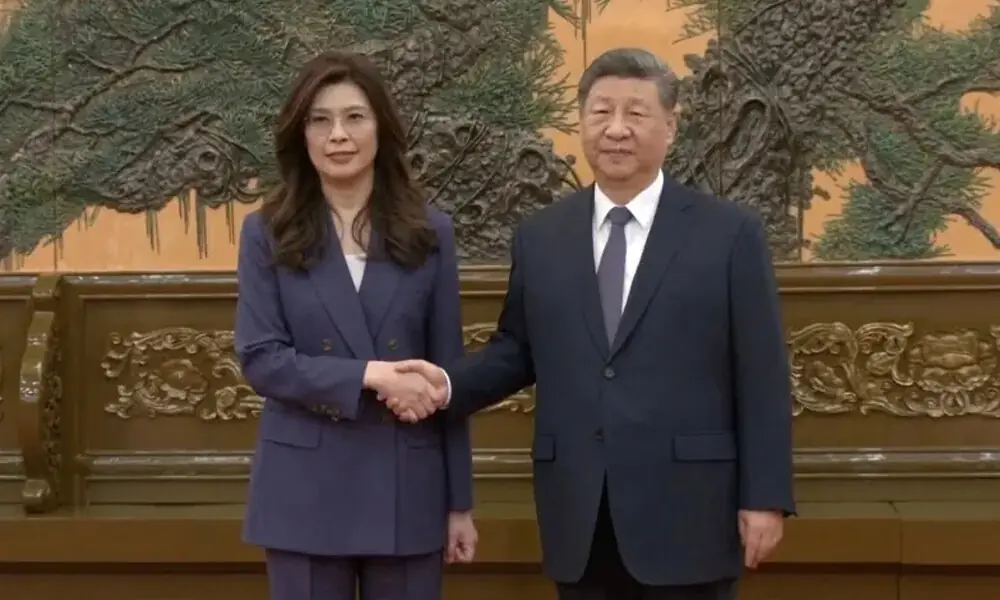

BEIJING: China’s President Xi Jinping met Taiwan’s opposition party leader Cheng Li-wun in Beijing on Friday, telling the visiting delegation he had “full confidence” that Taiwanese and Chinese people would be united.
Kuomintang (KMT) chairwoman Cheng is the party’s first leader to visit China in a decade, but her trip has sparked debate in Taiwan with critics accusing her of being too pro-Beijing.
China severed high-level contact with Taiwan in 2016 after Tsai Ing-wen of the Democratic Progressive Party (DPP) won the presidency and rejected Beijing’s claims that the self-ruled island is part of its territory.
Xi told Cheng as the two met on Friday that “the general trend of compatriots on both sides of the Strait getting closer, edging nearer and becoming united will not change”.
“This is an inevitable part of history. We have full confidence in this,” Xi said during the talks carried by Taiwanese media.
He also said China was willing to strengthen dialogue with groups in Taiwan, including the KMT, on the “common political foundation of… opposing Taiwan independence”.
Pakistan regards Taiwan as inalienable part of China
The KMT supports closer relations with China, which claims Taiwan is part of its territory and has threatened to use force to seize it.
Cheng echoed Xi’s stance at a press conference after their meeting, stressing the need for younger generations to understand “what challenges we face at this stage” and “how, by adhering to the 1992 Consensus and opposing Taiwan independence, we can avoid war”.
The so-called consensus suggests there is “one China” without specifying which is its rightful representative.
Earlier, she told Xi that the Taiwan Strait would “no longer be a focal point of potential conflict” and “both sides should transcend political confrontation”.
She also said Xi had responded “positively” to her proposal that the sides work toward Taiwan participating in international organisations such as Interpol and regional trade agreements.
A spokesman for Taiwan’s ruling DPP said China should respect Taiwan’s “commitment to freedom and democracy, rather than interfering in the choices of the Taiwanese people through division and inducement”.
“Differences between the two sides must be handled through peaceful and equal means, rather than by using suppression and intimidation,” spokesman Lee Kuen-cheng said.
South Korea’s Lee visits China, hoping to sidestep Taiwan tensions
Beijing has ramped up military pressure around Taiwan in recent years, conducting near-daily deployments of fighter jets and warships near the island and regular large-scale military drills.
Taiwanese lawmakers have been at loggerheads over the government’s plan to spend NT$1.25 trillion ($39 billion) on defence, which has been stalled for months in parliament, controlled by opposition parties including the KMT.
Defence spending
Cheng’s trip comes a month before US President Donald Trump is scheduled to visit Beijing for a summit with Xi.
The United States has been piling pressure on Taiwanese opposition lawmakers to back a proposal for defence purchases, including US weapons, to deter a potential Chinese attack.
Cheng has railed against the government’s proposal, insisting “Taiwan isn’t an ATM” and instead backing a KMT plan to allocate NT$380 billion ($12 billion) for US weapons with the option for more acquisitions.
While KMT party members regularly fly to China for exchanges with officials, its last leader to visit was Hung Hsiu-chu in 2016.
Cross-strait relations have worsened in particular since the election of Tsai’s successor, Lai Ching-te, who Beijing considers a separatist.
Lai said in a Facebook post on Friday that “China’s… military threats in and around the Taiwan Strait and the island chain have severely undermined regional peace and stability”.
Cheng landed in Shanghai on Tuesday evening, saying shortly after her arrival that “the two sides of the Taiwan Strait are not doomed to war, as the international community has feared”.
The KMT leader also travelled to the eastern city of Nanjing, where she visited the mausoleum of revolutionary leader Sun Yat-sen, one of the few Chinese historical figures revered in both Beijing and Taipei.

























Comments