


Italy sees EU easing deficit rules if Middle East crisis lasts
- 'It is clear that, unless the situation changes, discussions at the European level will be inevitable,' Giorgetti says
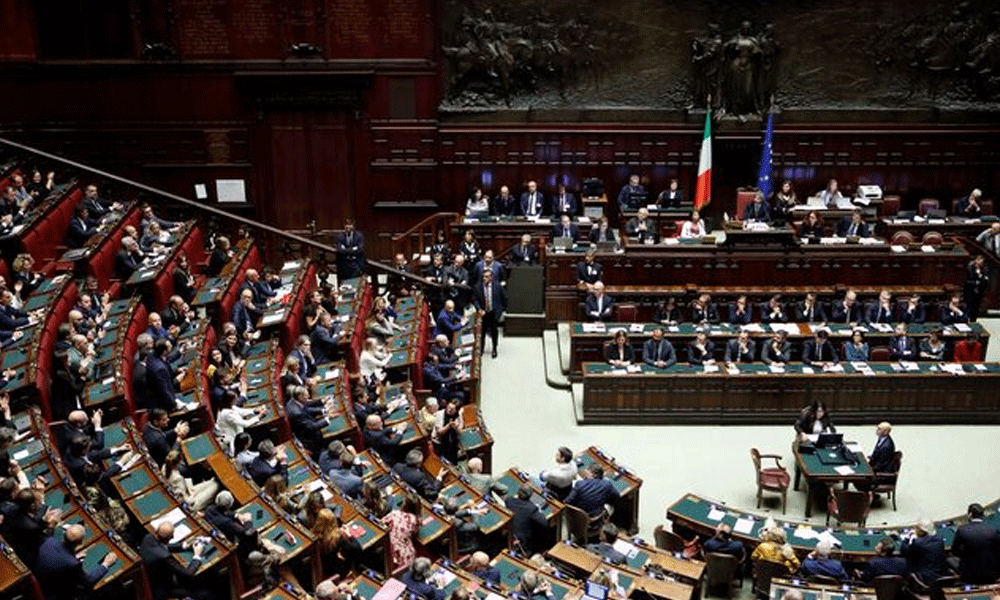

ROME: The European Union will inevitably consider easing its budget deficit rules if the U.S.-Israeli war against Iran continues to drive up energy costs for families and businesses, Italy’s economy minister said on Friday.
Minister Giancarlo Giorgetti also told reporters in Rome that the cabinet had approved a decree setting aside some 500 million euros ($577.20 million) to extend until May 1 from April 7 a cut in excise duties on fuels, in a bid to stabilise prices.
“It is clear that, unless the situation changes, discussions at the European level will be inevitable,” Giorgetti said when asked whether Italy would urge the EU to relax its rules limiting budget deficits to 3% of national output.
“I expressed this view at the very start of the conflict, reiterated it at the euro zone finance ministers’ meeting, and will do so at any international forum I attend,” Giorgetti added.
His remarks suggest Italy may fail to bring its deficit down to 2.8% of gross domestic product this year from 3.1% in 2025 as planned, due to lower-than-expected growth amid rising energy bills.
Italy adopts rules that help credit fund expansion
The EU activated between 2020 and 2023 a ‘general escape clause’ to suspend budget rules and allow member states to respond to the COVID-19 pandemic, which had triggered lockdowns and economic downturns in EU countries and the closure of Europe’s borders.
The clause has not been in force since 2024 and Italy is currently under an EU infringement procedure for its excessive deficit. The procedure reduces countries’ room for manoeuvre in taxation and spending policy.
“The issue of how long the conflict will last will, unfortunately, have consequences for both monetary and fiscal policies in the countries affected by these developments,” Giorgetti said.
European Central Bank Governing Council member Fabio Panetta said on Thursday that tensions in energy markets were a cause of concern for their potential repercussions on financial stability.
The Italian government is due this month to update its public financeand GDP growth estimates for 2026 and the following years.
Sources have told Reuters Rome is considering cutting its estimate for this year’s growth to 0.5% or 0.6% from a current 0.7% projection, and lowering next year’s outlook to 0.7% from 0.8%.
However, larger downward revisions cannot be ruled out given the darkening international outlook, the sources added.
Panetta warned that changes in global investors’ risk perception could quickly lead to pressure on government bonds, especially in highly-indebted economies such as Italy.
Adding to the challenge for Giorgia Meloni’s government, national statistics bureau ISTAT said on Friday that the politically sensitive tax burden – the level of taxes and social contributions as a proportion of GDP – rose last year to 43.1% from 42.4% in 2024, marking the highest level since 2014.
















Comments