


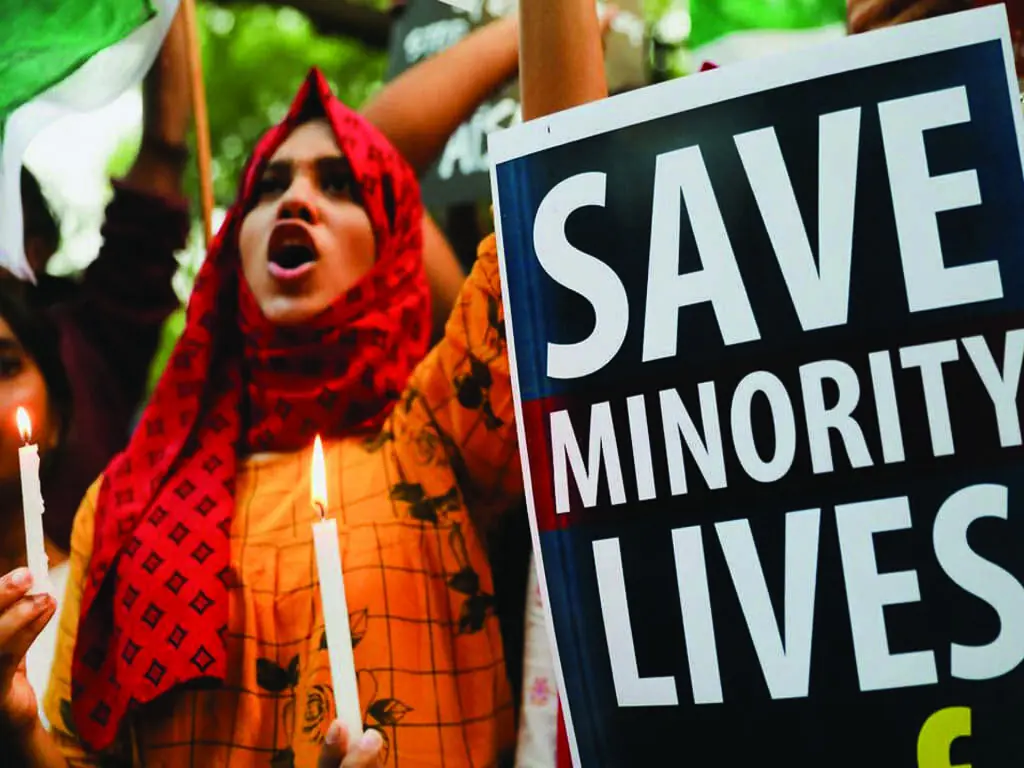
EDITORIAL: The latest report by the US Commission on International Religious Freedom (USCIRF) marks a notable escalation in international scrutiny of religious freedom conditions in India.
Unlike previous assessments, which limited themselves to expressions of concern, this report calls for India to be designated a “country of particular concern” and urges targeted sanctions against key actors, including the external intelligence agency, Research and Analysis Wing (RAW), and the Rashtriya Swayamsevak Sangh (RSS)—the ideological fountainhead of Prime Minister Narendra Modi’s ruling BJP. These measures include asset freezes and travel bans, alongside a recommendation to link trade policy directly to measurable improvements in religious freedom.
At the core of the report lies a stark indictment of state policy. Legal instruments such as the Unlawful Activities (Prevention) Act, the Citizenship (Amendment) Act, and the National Register of Citizens function as tools of systematic exclusion, targeting Muslims and Christians.
Many inside that country have also argued that these measures erode the secular foundations of India’s constitution by embedding religion into the framework of citizenship and law enforcement.
Domestic opposition has consistently identified this rupture, but it has been overridden by the political dominance of the majoritarian Hindutva ideology.
The report also lays bare the social machinery driving religious polarisation. Organisations such as the Vishwa Hindu Parishad and the Bajrang Dal, operating within the broader Sangh Parivar ecosystem, actively propagate an exclusionary vision of national identity.
Campaigns like “Ghar Waapsi,” designed to convert minorities to Hinduism, and vigilante violence carried out in the name of cow protection, are not aberrations; they are direct expressions of an emboldened Hindutva project.
These actions persist because authorities enable them through inaction, selective enforcement, and, at times, open complicity.
The report’s reference to RAW in connection with extraterritorial assassinations introduces a grave dimension to the critique.
The use of a state intelligence apparatus to target dissidents beyond national borders shows a willingness to extend repression internationally. By recommending sanctions against both ideological organisations and a state institution, USCIRF places accountability at the centre of its concern.
Unsurprisingly, New Delhi’s response has been swift and dismissive. Government representatives, including external affairs ministry spokesman Randhir Jaiswal, have rejected the findings as “motivated and biased.”
This rebuttal avoids the substance of the report. It does not contest, for instance, the documented existence of discriminatory laws, the use of cow protection as a pretext for vigilante violence, or the deployment of anti-terror legislation to suppress dissent against the Citizenship (Amendment) Act.
The implications of the report extend beyond documentation. It exposes a sustained and deliberate departure from a universally accepted human right. Yet the likelihood of the US acting on these recommendations remains remote— actually unrealistic.
Strategic, economic, and geopolitical considerations will continue to dominate Washington’s calculus, ensuring that India avoids formal designation as a “country of particular concern.”
Copyright Business Recorder, 2026





















Comments
Comments are closed for this article.