



Karachi, Pakistan’s bustling economic hub and largest city, faces a silent crisis that has recently turned into tragedy: the glaring absence of functional fire hydrants across its urban landscape. In recent years, devastating fires have exposed this vulnerability, claiming lives and destroying property due to inadequate firefighting infrastructure.
The catastrophic Gul Plaza fire in Saddar, which erupted in January 2026, serves as a stark reminder. What began as a blaze on the first floor quickly engulfed the mega shopping mall, killing at least 65, injuring several dozens, and leaving many missing in the aftermath. Rescue efforts were hampered by absence of hydrants and insufficient water supply, turning a containable incident into a prolonged inferno that burned for hours. This is not an isolated event; similar fires in commercial areas have highlighted how the non-existence of fire hydrants and often delaying response times and exacerbating damaged.
At the time of Pakistan’s independence in 1947, Karachi inherited a relatively robust fire safety system from the British colonial era. The city’s fire department, established shortly after partition, included functional hydrants connected to water networks, particularly around key areas like the port and central districts. The City of Karachi also maintained an extensive pipeline network that extended to neighborhoods such as Saddar and Soldier Bazaar, providing reliable water access for firefighting until the 1970s. This infrastructure was part of a broader system designed to support the city’s rapid growth as refugees flooded in post-partition, transforming Karachi into a metropolis.
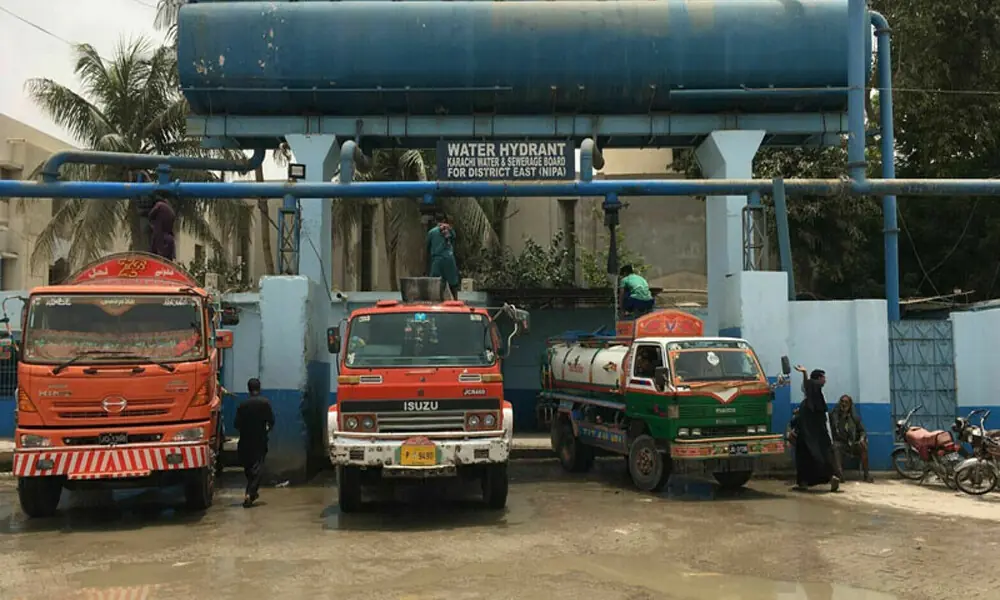
However, as the city expanded unchecked, successive authorities failed to prioritize or maintain this vital system. The Karachi Development Authority (KDA), Defence Housing Authority (DHA), Karachi Municipal Corporation (KMC), and various Cantonment Boards focused on real estate and infrastructure projects but overlooked fire hydrants. Urban sprawl led to new roads, buildings, and commercial zones being constructed without integrating hydrant networks, leaving vast swathes of the city—especially main thoroughfares—without immediate access to water for emergencies. Today, in areas like Saddar, the nearest functional water hydrant might be 20 kilometers away in places like NIPA, compounded by poor road conditions that hinder quick transport.
Karachi’s predicament stands in sharp contrast to cities worldwide that have invested in comprehensive fire hydrant networks, ensuring swift and effective responses to fires. Take Mumbai (formerly Bombay), India, a city with similar colonial roots and population density. Mumbai boasts a well-maintained fire hydrant system, supported by specialized installation and maintenance services from companies like Ceasefire Engineers and Abhishek Fire Protection Pvt Ltd. These systems are integrated into pipelines across residential, commercial, and industrial areas, allowing for rapid deployment during emergencies. The city’s emphasis on regular testing and upgrades has minimized fire-related fatalities in high-risk zones.
In New York City, fire hydrants are a ubiquitous and standardized feature of urban planning. Placed every 250 to 500 feet, they adhere to strict specifications, including a single 2.5-inch hose nozzle and a 4.5-inch pumper outlet, ensuring compatibility with firefighting equipment. This dense network, dating back to the 19th century but continually modernized, protects everything from skyscrapers to residential blocks. Even during heatwaves, when unauthorized openings can cause pressure issues, the system is designed for resilience, with quick repairs and public education campaigns to prevent misuse.
London, the UK, offers another exemplary model with over 115,000 fire hydrants strategically placed throughout the city, including at least two within 10 meters of every school. Most are underground, marked by yellow “H” signs indicating water main sizes and locations, which allows for discreet integration into the urban fabric while ensuring accessibility. The London Fire Brigade conducts regular inspections, a practice rooted in lessons from the Great Fire of 1666, which devastated the city and prompted early advancements in fire safety. These systems guarantee 24-hour water availability, enabling firefighters to respond effectively and save lives.
The absence of fire hydrants network in Karachi is not just an infrastructural oversight, it is against the basic mandatory requirement of Town Planning and it’s a direct threat to human life.
In the Gul Plaza incident, firefighters struggled and relied solely on water tankers, which proved inadequate against the spreading flames fueled by combustible materials. Witnesses reported chaotic evacuations and a lack of modern tools, such as foam suppressants or high-reach ladders, leading to preventable deaths from suffocation and burns. With only 28 fire stations serving a population of nearly 35 million, the city’s emergency response is woefully underprepared for its scale. Similar issues plagued earlier fires, where dry hydrants and low water pressure turned minor blazes into major disasters, displacing families and crippling businesses.
This crisis affects everyone—from shoppers in crowded malls to residents in high-rises. Without urgent intervention, Karachi risks more such tragedies, especially in densely populated areas prone to electrical faults and gas leaks.
A call to action: enact laws for mandatory fire hydrant network for Karachi
The time for complacency is over. Karachi must follow the lead of Mumbai, New York, and London by mandating fire hydrants as a core component of urban development. A law should be passed immediately, stipulating that no main road, pipeline, or major construction project proceeds without provisions for fire hydrants and guaranteed 24-hour water availability. This would integrate hydrants into all new and retrofitted infrastructure, enforced by the KMC, KDA, DHA, and Cantonment Boards.
Investing in fire hydrants is an investment in lives. By prioritizing this essential infrastructure, Karachi can prevent future heartbreaks and build a safer, more resilient city for generations to come.
Copyright Business Recorder, 2026
The writer is a civil Engineer and Ambassador of Pakistan in Morocco




















Comments
Comments are closed for this article.