



Recent reports from the World Bank and comments from officials confirm Pakistan’s current growth model, reliant on consumption and imports, is failing, exacerbated by pervasive corruption and weak governance, leading to economic stagnation, low investment, and high poverty, necessitating major structural reforms, increased transparency, and tackling “elite capture”.
A recent ministerial report also noted transparency gaps in the Special Investment Facilitation Council (SIFC) initiatives themselves, raising investor concern.
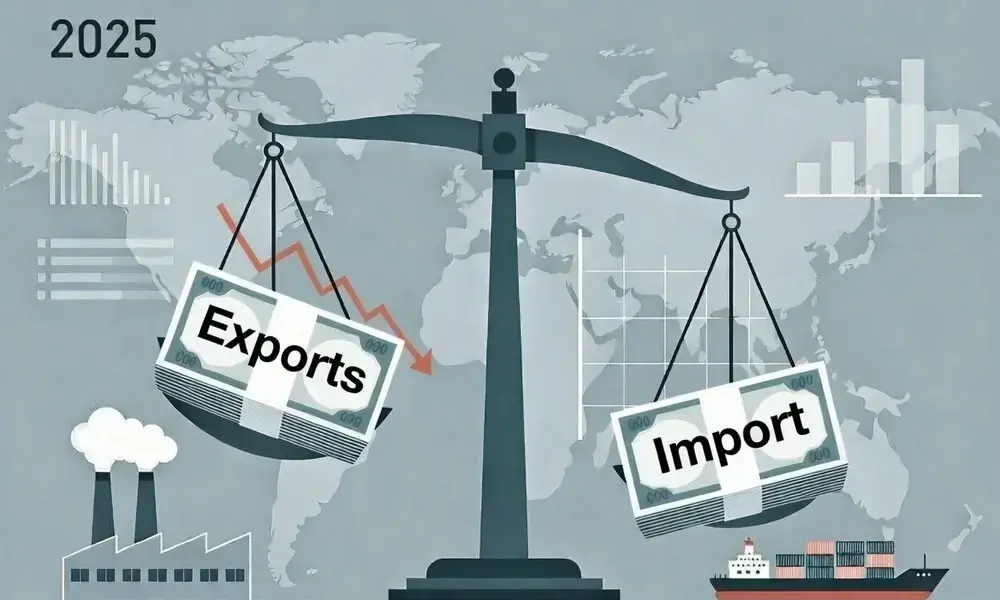
This has renewed the debate among the economic gurus along with exhuming the contributions they have made in the shape of Planning Frameworks since 2018. Export-led growth was the most popular among clichés of 2025 after ‘growth’, ‘structural reforms’ and ‘climate change’.
What does it mean? Bluntly, it means overall growth dependent on export growth and not the other way round, e.g., boosting domestic demand and growth through freebies, public sector investment in unproductive and/or grandiose long-term physical infrastructure projects plus pumping casino economy.
Operationally, in the presence of colonial bureaucratic structure, it means all relevant ministries and private sector coordinate and work in tandem to achieve a consistent double-digit export growth to support a high single digit overall growth rate for the economy. It also implies that ministries stop working in siloes to achieve the targeted export growth rate.
Missing the globalization wave and GOP’s playing geo-political, geo-economic, geo-strategic and geo-climate trump cards to supplement the intrinsic lack of political will to implement the reforms in the last three decades, the only leftover option is to achieve the consensual export targets on a war footing. This entails that export-led growth be placed at the center-stage of bureaucratic governance, complemented by specific institutional and organizational overhaul to achieve the export target.
While the above economy-wide frameworks are comprehensive, some of them require a complete reinvent and overhaul of the entire governance system of the country.
The past experiences suggests that the colonial mentality and politicians are not willing to undertake economy-wide, long-term, deep meaningful ‘structural reforms” as elaborated by some of the above frameworks. Thus, given the urgency to structurally shift exports to a higher level a piloting option can be followed within the above frameworks.
The following paras make a stylistic attempt to tweak, adapt and operationalize the main idea presented in the PIDE document titled ‘Doing Development Better” for sketching an export-led growth strategy.
The first building block is the introduction of ‘performance and accountability’ in the relevant ministerial/bureaucratic structure. Consensual export targets make it easier to evaluate performance and thereby introduce accountability into the governance system.
In the case of export-led growth, the likely candidates for assigning primary responsibility to achieve the export target is:-Ministry of Commerce (MOC), Ministry of Industries and Production (MOI&P) and Ministry of National Food Security and Research (MNFSR). Attached departments or organisations, e.g., TDAP in case of MOC, Engineering Development Board (EDB), SMEDA, in case of MOI&P should also be co-opted as responsible for achieving the targets.
All other ministries (not directly responsible for achieving the export targets) should act as supporting or secondary ministries, e.g., SBP, Ministry of communication/logistics and FBR to the above three main ministries. A question arises that the popular constraints for increasing exports mentioned by the stake holders/economic gurus are high energy costs and tardy refund management.
So why not include Ministry of energy and FBR in performance and accountability in piloting exercise? What about including the Planning commission? No doubt high energy tariffs are eroding competitiveness, but they are being dealt with at the national level and any reform in the medium term will impact the entire economy not just exports. It is doubtful if they can be resolved within the time bound export targets to assess their performance.
The real challenge for increasing exports is to achieve product and location diversification by identifying low-hanging fruits. Assessing the performance of MNSFR presents another institutional coordination challenge as agriculture is a provincial subject.
The above select ministries will resolve the issue of bureaucratic weak governance, where everybody is in-charge, yet nobody is in-charge. Assigning the responsibility to select ministries along with targets is a move towards performance and accountability.
The second building block of the export-led strategy is setting a time-bound realistic-cum-ambitious export target at the national and sectoral level. At the national level, there are now three variants of the export target floating around.
URAAN expects to increase yearly goods exports to USD 63 billion by 2030, the WB expects them to be around USD 43 billion by that time. PM wants USD 60 billion to be exported (including IT exports) in three years’ time.
All these targets would have to be tweaked if defense exports are expected to be USD 20 billion or USD 4 billion a year by 2030. However, for the purpose of this stylistic exercise, consider them as an unexpected windfall and outside the performance ambit. It makes sense to aim for USD 45 billion export of goods in 3 years’ time, a double-digit growth roughly at 13 percent per annum from the current base of USD 32-33 billion goods export. Although industry and agriculture have different export growth dynamics but, are also highly interdependent specifically in case of cotton and sugarcane. It makes sense to adopt differentiated sectoral export targets.
Yearly cotton exports are sensitive to climate change and sugar exports is subject to elite-cum-political manipulation. There can be multiple criteria to choose from. One option would be to exclude them from the assigned agriculture goods export target. Thus, MNFSR can coordinate with provinces to concentrate on generating surpluses to diversify exports of remaining agriculture, livestock, forestry and horticulture products and meet its target.
What about industry? Lot depends on how the upcoming Industrial policy is received by the stake holders. Export target can be set for three types: Textile sector, Non-textile LSM sector and SMEs. The scale economies and cost competitiveness have already been established by Bangladesh, Vietnam and China and it will take more than 3 years for technological innovation, productivity increase and lower energy costs to establish competitiveness.
The non-textile LSM sector, e.g., cement, fertilizer, iron and steel, Auto assembly and sugar industry is in the hands of elite and runs on subsidies, protection and long-term FDI contracts with no incentive to enhance productivity and competitiveness as domestic demand is assured and therefore can continue with rent seeking. Yes, tariff reduction is a 5-year commitment, but there is always ‘many a slip between the cup and the lip’. Given that the target is time-bound, concentrating on export potential of SMEs is more feasible.
Politically, it employs the largest labour force, can piggy-back on CPEC infrastructure, (e.g., clusters) and may not require scale economies for competitiveness if and that is a big ‘if’ the exported goods are innovative, specialized and are aimed at selective markets.
Small, targeted investments in innovation, skills and implementing international regulations can achieve results in time-bound targets.
(To be continued)
Copyright Business Recorder, 2026

























Comments
Comments are closed for this article.