


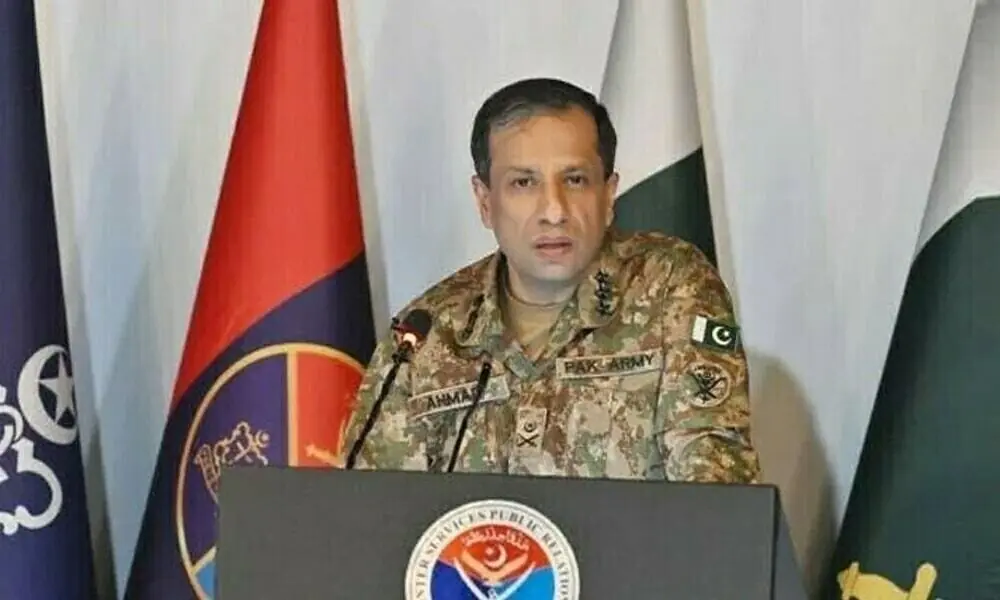
ISLAMABAD: Director General Inter-Services Public Relations (ISPR), Lieutenant General Ahmed Sharif Chaudhry while terming 2025 a landmark and consequential year in the fight against terrorism on Tuesday categorically said that Pakistan will win this war not through appeasement, but through force and strength.
Speaking at a press conference, Lt Gen Ahmed Sharif Chaudhry described 2025 as a “landmark year” in Pakistan’s fight against terrorism, citing successful counter-terrorism operations, improved intelligence coordination, and a clearer national stance on the origins of militancy.
He added that only five of the 43 Afghan refugee camps had been cleared, despite rising security concerns.
READ MORE: Afghan border closure brings down terrorist violence by almost 17%: report
In a comprehensive media briefing on national and regional security, Lt Gen Chaudhry emphasised that terrorism remained Pakistan’s greatest threat. He stressed that the fight against terrorism was not limited to the military but involved the entire nation.
Operational data presented by the DG ISPR revealed that in 2025, law enforcement agencies, including the army, police, and intelligence agencies, conducted 75,175 intelligence-based operations across Pakistan – averaging 206 per day.
Among these, 14,658 operations were carried out in KP, 58,778 in Balochistan, and 1,739 in other regions. A total of 5,397 terrorist incidents were reported, with 3,811 (71percent) occurring in KP, 1,557 (29percent) in Balochistan, and 29 in other areas.
Lt Gen Chaudhry noted that 2,597 terrorists were killed in counter-terrorism operations, with 1,800 in KP and 784 in Balochistan. Sadly, 1,235 civilians and security personnel lost their lives in terrorist attacks.
In 2025, Pakistan saw 27 suicide bombings, including 16 in KP, 10 in Balochistan, and one in Islamabad. Two of these bombings involved female bombers.
Lt Gen Chaudhry underscored that this level of violence highlighted the intensity of Pakistan’s counter-terrorism efforts.
A significant development in 2025, Lt Gen Chaudhry said, was “complete national clarity” on the issue of terrorism. He clarified that the terrorist groups operating in Pakistan, including the Tehreek-e-Taliban Pakistan (TTP), Balochistan-based militants, Al-Qaeda, and Daesh, had no religious legitimacy and were disconnected from Islam, Pakistan, or the people of Balochistan.
He further stated that Pakistan’s long-held view that Afghanistan had become a base for terrorist groups was gaining international recognition.
Citing the situation after 2021 and the Doha Agreement, he linked the rise in attacks to Afghanistan’s deteriorating security.
The withdrawal of the US from Afghanistan left behind vast amounts of military equipment, worth USD7.2 billion, which militants had accessed via black markets. He also mentioned that around 2,500 foreign terrorists had recently entered Afghanistan from Syria.
The DG ISPR reiterated Pakistan’s stance that India was the primary external sponsor of terrorism, accusing New Delhi of providing financial and logistical support to militants operating from Afghan soil. Lt Gen Chaudhry emphasised that terrorist activity had intensified following Pakistan’s military success in May 2025, with Afghanistan acting as a base for renewed attacks.
Referring to Pakistan’s cross-border strikes in October 2025, he clarified that the military targeted TTP hideouts and training camps – not Afghan Taliban forces or civilians.
He emphasised that these operations were within Pakistan’s constitutional rights and rejected comparisons with India’s cross-border actions.
He also pointed out that the closure of the Pak-Afghan border after the October 2025 operations led to a significant drop in terrorist activities, with a rise in the number of terrorists killed in the following months.
Lt Gen Chaudhry also highlighted the reinvigoration of the National Action Plan (NAP) in 2025, with the Azm-e-Istehkam counter-terrorism initiative forming part of this revised framework.
While acknowledging gaps in implementation, he stressed the broad political and societal consensus on the need to enforce the plan.
Balochistan served as an example of successful counter-terrorism coordination. The provincial government had formed district-level committees involving civilian administrations, police, intelligence agencies, and elected representatives.
Between February and November 2025, these committees held 472 meetings, leading to the completion of 127 development projects and the planning of 949 more, with significant funding allocated by both provincial and federal governments.
However, Lt Gen Chaudhry expressed concern over what he called a “politically conducive environment for terrorism” in Khyber Pakhtunkhwa.
However, he accused the opposition Pakistan Tehreek-e-Insaf (PTI) of undermining the country’s counter-terrorism efforts and recklessly engaging with Afghanistan, while revealing that a staggering 71 percent of terrorist incidents in 2025 were concentrated in the already volatile region of Khyber Pakhtunkhwa.
He pointed to issues like low conviction rates, a backlog of terrorism cases, incomplete clearance of refugee camps, and resistance to strong counter-terrorism measures.
He outlined the country’s counter-terrorism strategy, which is intelligence-led and based on three pillars: operations along the Pak-Afghan border, small-team offensives, and technical surveillance.
He revealed that terrorist groups had increasingly used armed quadcopters, with 405 such attacks reported in KP alone, while Pakistani law enforcement used drones exclusively for surveillance, avoiding any collateral damage in populated areas.
Concluding his briefing, the DG ISPR reiterated that the fight against terrorism was a national struggle that involved not just the military, but the entire population. He emphasised that Pakistan’s unity and the world’s growing recognition of Pakistan’s stance on terrorism were crucial.
“No power in the world can stop us from winning this fight,” Chaudhry declared, stressing the importance of fully implementing the National Action Plan (NAP) and maintaining national unity for lasting peace and security.
Copyright Business Recorder, 2026

















Comments
Comments are closed for this article.