


Smartphone manufacturing boom positions Pakistan for export-driven growth
- Rising share of local production reflects the expansion of manufacturing capacity and investment in the local market, says one expert
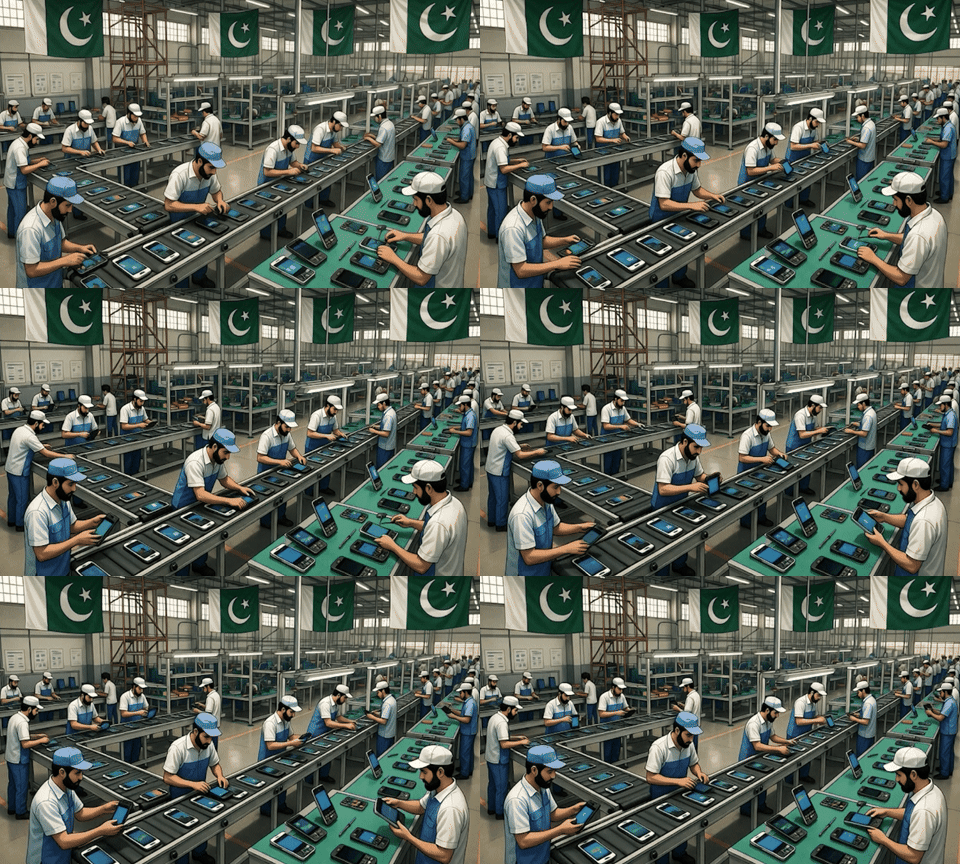

KARACHI: Smartphone production in Pakistan continues to rise, reaching 53 percent of total mobile phone output in October. The shift reflects both growing manufacturing capacity among local and foreign assemblers and an increasing national demand for smart devices.
According to data released by the Pakistan Telecommunication Authority (PTA), more than 25.11 million mobile phones were produced locally during the first 10 months of the current year. Of these, smartphones accounted for 53 percent, or 13.2 million units, while the remaining 47 percent, 11.9 million units, were 2G feature phones.
Four months earlier, local mobile phone output stood at 14.24 million units, with feature phones comprising 54 percent of production and smartphones 46 percent in June 2025.
Khushnood Aftab, CEO of tech firm Viper Group and an active advocate of ‘made-in-Pakistan’ brands, said that the rising share of local production reflects the expansion of manufacturing capacity and investment in the local market. He noted that this will not only strengthen the presence of local brands in the domestic market but also help them tap export opportunities.
He added that Pakistan has the potential to significantly expand the production of smart devices, including smartphones, tablets, laptops, and PCs, provided the government introduces favourable and investor-friendly policies. Such measures, he said, would attract both domestic and foreign investment, create jobs, and facilitate technology transfer to the local industry.
Pakistan met 94 percent of its mobile phone demand through local manufacturing and assembly in the first 10 months of 2025, a major improvement compared to the five-year (2020–2024) average of 77 percent and the nine-year (2016–2024) average of 52 percent.
Despite this progress, smartphone penetration remains low in the country, with only 31 percent of the population owning smart devices.
Rising share of local production reflects the expansion of manufacturing capacity and investment in the local market. This will not only strengthen the presence of local brands in the domestic market but also help them tap export opportunities: Khushnood Aftab, CEO of tech firm Viper Group
Dr. Noman Said, CEO of SI Global Solutions, stressed that widespread smartphone adoption is essential to empower citizens with access to education, skills development, financial services, and digital platforms. He observed that economies with high smartphone penetration enjoy significant digital advantages and improvements in quality of life. For Pakistan to follow suit, he said, the government and private sector must work together to promote smartphone adoption nationwide.
He emphasized the need for supportive policies and a cohesive ecosystem involving the government, local assemblers, and enablers, such as buy-now-pay-later services to increase smartphone accessibility in the country.
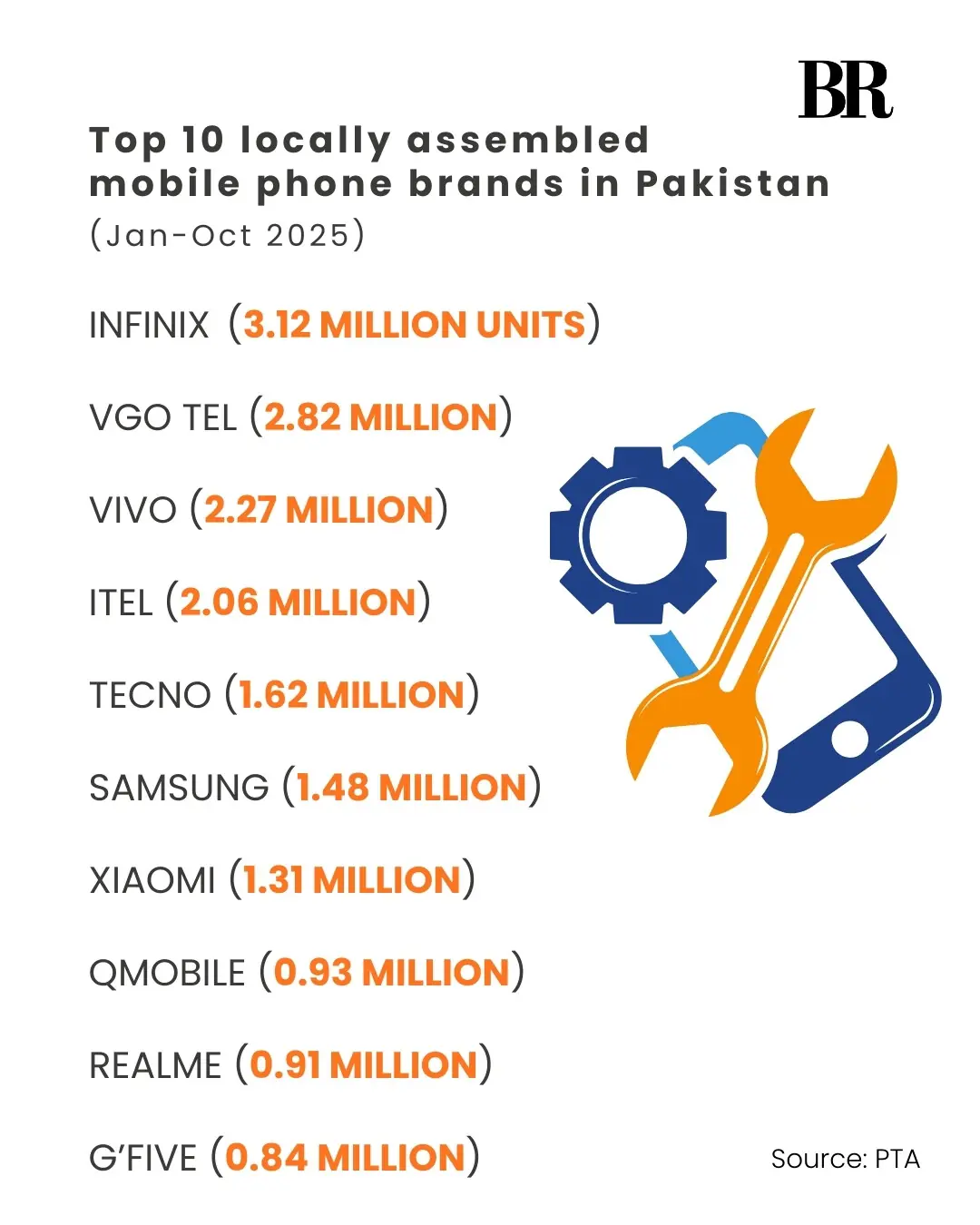
According to PTA, the top 10 locally assembled brands during the first 10 months of 2025 were Infinix (3.12 million units), followed by VGO Tel (2.82 million), Vivo (2.27 million), Itel (2.06 million), Tecno (1.62 million), Samsung (1.48 million), Xiaomi (1.31 million), QMobile (0.93 million), Realme (0.91 million), and G’Five (0.84 million units). With distributors and retailers currently holding surplus inventory, manufacturers have scaled back production to prevent further stock accumulation.
Industry analysts expect mobile phone sales to grow by 7–8 percent year-on-year over the next 12 months, supported by a stable exchange rate, easing inflation, and improving consumer purchasing power.
















Comments
Comments are closed for this article.