


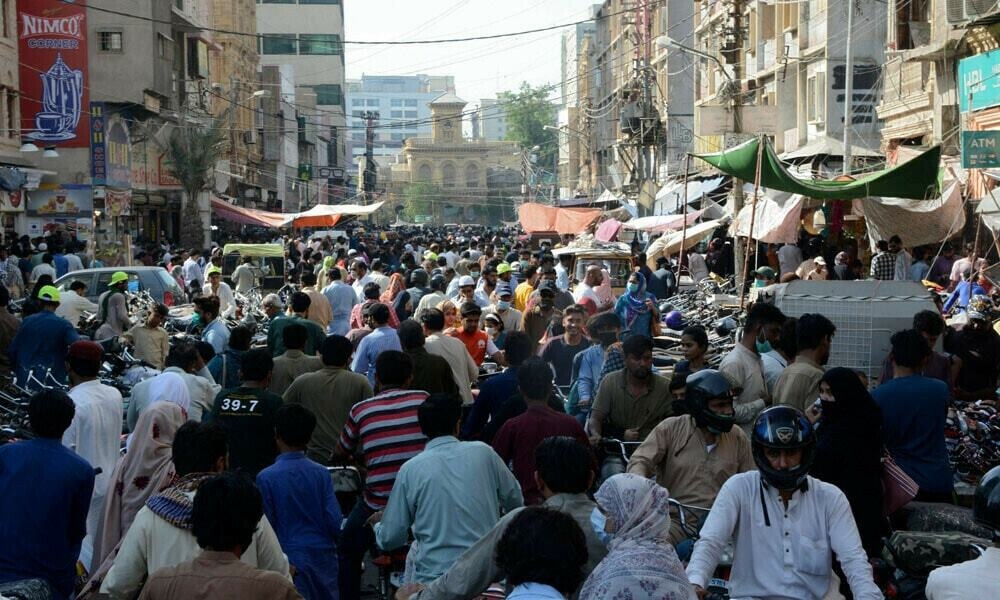

A growing population can be a national strength or a weakness. “Too many mouths and too little bread” is an old proverb, but in Pakistan today it is less a saying and more a lived reality. The speed of our population growth combined with stagnant economic productivity, has tied population and poverty into one inseparable crisis. According to the World Population Review, Pakistan is the fifth most populous country in the world.
High population growth directly fuels poverty by overstretching food supply, housing, jobs, schools, and healthcare. Poverty, in turn, fuels high population growth when poor households rely on larger families for survival and lack access to family planning. The outcome is a vicious cycle: either we must increase production to match rising numbers, or we must control population growth to break poverty’s grip.
Pakistan’s 2023 Census counted 241.5 million people, an alarming increase of nearly 34 million people in just 6 years. That is the size of an entire new country within our borders. The growth rate remains close to 2.5 percent per year—among the highest in Asia. On the other hand, the GDP per capita is increasing at about 2.7 percent which means the real increase in GDP per capita is a meager 0.1–0.2 percent.
In practical terms, the average citizen is barely any better off than before. The effect is most harshly felt by the poor. The World Bank estimates that 42 percent of Pakistanis now live below the poverty line of USD 3.65/day (PPP). On top of this, the unprecedented events such as the 2025 floods exacerbate the economic situation, pushing already vulnerable families into even deeper despair.
The opportunities in Pakistan are not expanding at the pace of its population, creating fiercer competition for limited jobs, housing and education. Those from the privileged class insulate themselves with quality private schools, hospitals, and gated communities, while the poor struggle merely to survive. For the poor, the dream of improving their quality of life drifts further away while they experience a steadily deteriorating quality of life in an economy weighed down by inflation and inequity.
The affluent and privileged class manages their way around even in the harshest economic downturns, shielded by resources that remain out of reach for the poor—foreign passports, global education, property, foreign bank accounts, and influential networks. The poor, by contrast, are left with the limited options that match their limited backgrounds and education.
Lacking proficiency in English and training in modern technology, they fall further behind in the ruthless pace of today’s world. Since most of the rewarding degrees, certifications and examinations are conducted in English, the poor remain excluded. Lacking financial resources, they study in Urdu-medium public schools as they cannot afford the expensive English-medium private schools that open doors to opportunity.
Our neighbour China is a good example to learn from. In the 1950s, Chinese women had an average of five to six children. Their population nearly doubled between 1949 and 1976 rising from 540 million to a striking 940 million. The annual growth rate in 1960s to 70s was around 2 percent which is similar to Pakistan’s current pace. However, things started to change in China after the 1980 one-child policy.
Fertility dropped below 3-child per woman by 1980 and to around 1.5 to 1.7 by the 1990s. The population growth was below 1 percent by the 1990s. These changes gave space for investment in education, industrialisation and poverty reduction. As a result, the GDP per capita rose from USD 195 in 1980 to around USD 12,700 by 2022, lifting more than 800 million people out of poverty in the process, according to the World Bank. Despite the yuan’s depreciation against US dollar—from ¥1.50 to ¥7.20 per US$ over the same period, China’s economic rise remains one of the most extraordinary economic transformations in modern history.
Our eastern neighbour, India, managed to slow its fertility through education, economic reforms and increasing family planning awareness. In the 1950s, Indian women bore an average of about six children, almost identical to Pakistan’s current rate in rural districts.
Over the years, through the government’s efforts in female literacy, healthcare, and awareness, India was able to gradually lower its fertility rate and population growth. Fertility fell to around 3.8 by 1990 and reached 2.0 by 2023. Economic reforms and urbanization in the 1980s and 1990s raised the cost of raising children while increasing opportunities for women in education and employment.
As a result, India’s population growth stabilized without harsh measures, and its GDP per capita grew from USD 270 in 1980 to about USD 2,700 in 2024, expanding its middle class and reducing extreme poverty.
Even though the Indian rupee has depreciated substantially over this period from around IR 8 to IR 83 per US dollar, India’s output and incomes grew at a much faster pace. The PPP-adjusted GDP per capita is around USD 9800 per capita in 2024 which provides a clearer picture of the average Indian’s real purchasing power after adjusting for local prices.
Similarly, Indonesia succeeded through voluntary family planning and strong community-based programmes. Fertility fell from 5.6 children per woman in 1960 to 2.3 today, supported by widespread education, women’s empowerment, and investments in healthcare.
Its GDP per capita rose from USD 530 in 1980 to about USD 5000 in 2024, even as the rupiah depreciated sharply from roughly Rp 625 to Rp 15,700 per US dollar. Adjusted for inflation, Indonesia’s real GDP per capita has tripled, and in purchasing purchasing-power-parity (PPP) terms it now exceeds USD 14,000 which reflects a remarkable rise in living standards. The country’s steady population policy and investment in people led to economic gains and improved quality of life.
Pakistan’s fertility rate in comparison has declined by 6.8 births per woman in 1960 to 3.61 births per woman. Although, this represents nearly a halving of the fertility rate, GDP per capita increased only modestly from about USD 412 to roughly over USD 1500, over the same period.
In Pakistan’s case, the rupee has depreciated dramatically against the US dollar from about Rs 9.9 per US$ in 1980 to around 283 rupees per US$ today yet the PPP-adjusted GDP per capita has reached roughly US$5,500–6,000 in recent years—indicating that despite currency weakness, there has been measurable improvement in domestic purchasing power.
Despite these figures and some improvements, Pakistan’s progress remains painfully slow. The fertility rate of 3.61 births per woman is still among the highest in the region, far above China, India and Indonesia. High population growth continues to dilute the gains of economic expansion leading to a lower per capita income.
To change course, Pakistan must work on two fronts simultaneously: reducing fertility through efforts in education, healthcare and family planning, and boosting local production through industrial revival, business friendly policies and investment in human capital. Only by balancing population and productivity can Pakistan achieve the sustainable growth and living standards its people deserve.
Copyright Business Recorder, 2025
The writer is a Chartered Accountant and CEO of the welfare organisation RubySher, which aims to eliminate poverty in Pakistan




















Comments
Comments are closed for this article.