


‘Uraan Pakistan Vision’ to lay foundation of economy: Ahsan
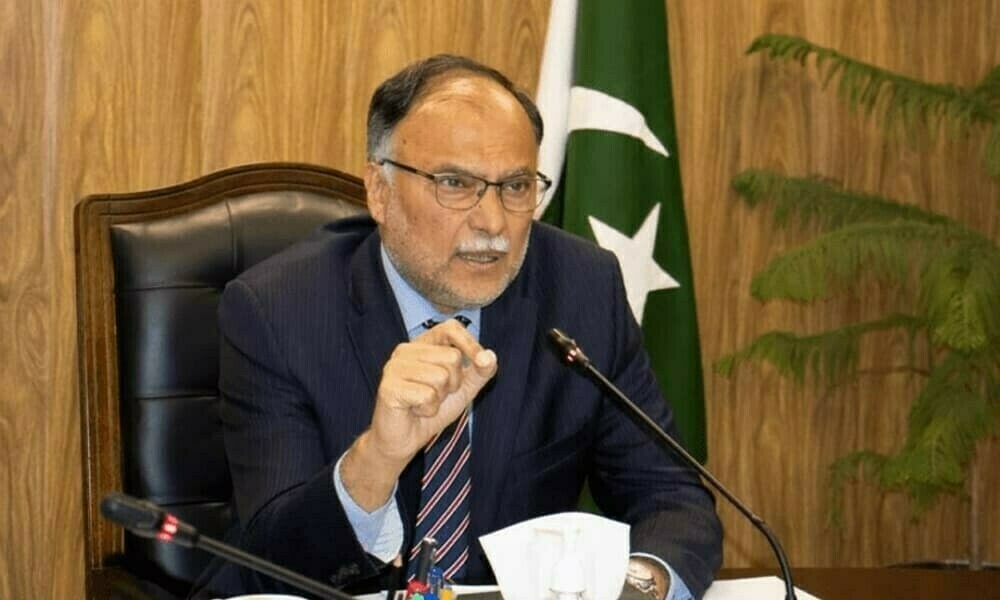

ISLAMABAD: Federal Minister for Planning, Development and Special Initiatives, Ahsan Iqbal has said the “Uraan Pakistan Vision” will lay the foundation of Pakistan’s economy on knowledge, innovation and technology-driven development.
The Minister expressed these views while addressing the inaugural ceremony of the International Symposium on Advanced Materials as the Chief Guest, held at the National Centre for Physics in Islamabad on Monday.
The Minister also announced the establishment of the National Centre for Advanced Materials at the Quaid-e-Azam University, in the name of the late Dr A Q Khan. He lauded the efforts of the late scientist for his all-out contributions in making this country self-reliant. He said the government is establishing the Dr A Q Khan Institute of Material Sciences, which will serve as a hub for cutting-edge research, industrial collaboration, and training of young scientists.
Highlighting the importance of science and technology, Ahsan Iqbal said that “Islam places great emphasis on acquiring modern knowledge.” He noted that 70 percent of global trade is based on materials-related products, underlining that material science forms the backbone of the new global economy.
He further revealed that by 2035, Pakistan will establish five national research and development clusters in material sciences, along with 100 universities–industry partnerships to strengthen innovation-driven growth. He said the government aims at producing 5,000 specialized scientists and engineers in the field.
Ahsan Iqbal expressed confidence that these initiatives will enable Pakistan to join the top 30 nations in material innovation by 2035.
The Minister said that materials science lies at the heart of global innovation, driving progress in clean energy, healthcare, environmental sustainability, and defence. He noted the growing convergence of disciplines such as physics, chemistry, nanotechnology, and artificial intelligence in developing next-generation materials that are stronger, lighter, smarter, and more sustainable.
The Minister emphasized that developing countries like Pakistan must not remain on the sidelines of scientific advancement. “Science and technology are no longer optional—they are a strategic necessity,” he said. “We must invest in research, train our youth, and build stronger links between academia and industry to drive national progress.”
Announcing a major initiative, the Minister revealed that the government is establishing a National Centre for Advanced Materials, dedicated to specialized research in aerospace, energy, defence, and other strategic industries. The new centre will promote applied research, technical training, and international collaboration, he said.
Concluding his remarks, the Minister underscored that “the real value of science lies in how it serves humanity.” He encouraged participants to translate knowledge into impact and innovation into shared progress, reaffirming Pakistan’s commitment to advancing science for peace, prosperity, and sustainable development.
While speaking at the inaugural ceremony, President of the Pakistan Advanced Materials Forum (PAMF), Mirza Rizwan Baig, said that the International Symposium on Advanced Materials is not just another event, but a platform for collaboration, innovation, and shared learning — spanning borders, sectors, and disciplines.
He also shared that alongside the symposium, PAMF and the Institute of Space Technology (IST) are also hosting a Technology Exhibition, RISE 2025, showcasing cutting-edge innovations and linking researchers with industry partners and investors, to promote commercialization and industrial linkages.
Highlighting the transformative role of materials science, he said that materials lie at the core of every major innovation—from clean energy to quantum computing, from advanced healthcare to next-generation mobility.
He emphasized that materials science now spans an incredible range of applications—from microchips to mega-structures, polymers to smart textiles, and superconductors to bio-compatible implants—requiring interdisciplinary collaboration among engineers, chemists, physicists, and computer scientists.
The PAMF President also highlighted the growing integration of Artificial Intelligence (AI) in materials research, which is revolutionizing discovery and innovation. “AI allows us to analyze vast datasets, predict material properties, and discover new compounds at record speed,” he explained. “This powerful synergy between AI and materials is opening new possibilities across industries such as aerospace, energy, and biomedicine.”
Copyright Business Recorder, 2025




















Comments
Comments are closed for this article.