


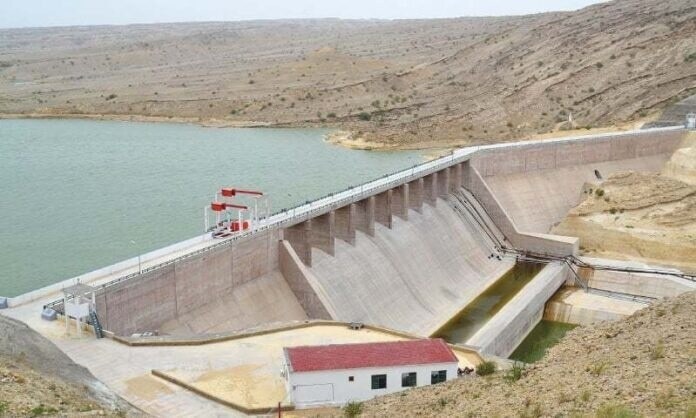

Pakistan faces an acute water crisis that continues to deepen due to prolonged neglect of small and medium-sized dam projects.
Fifteen years after their launch, eleven out of twelve multipurpose dams across all four provinces remain incomplete—despite billions of rupees already spent. This long delay is costing the national economy heavily each year, while both federal and provincial governments remain largely indifferent.
At a time of growing water scarcity and looming food insecurity, Pakistan has lost the capacity to cumulatively store about 3.20 million acre-feet (MAF) of water annually. Had these small dam projects been completed, they could have irrigated over 0.38 million acres of additional land. Originally scheduled for completion within three to four years, these projects have been left to decay, depriving the country of vital water resources.
Project financing
The twelve projects were approved during 2009–2010 as multipurpose reservoirs in remote areas with favourable topography and rainfall patterns. The Executive Committee of the National Economic Council (ECNEC) cleared these schemes at a total cost of around one billion US dollars. China had pledged $700 million in soft-term loans through the China Eximbank, covering 70 percent of the total cost, while Pakistan was to contribute $300 million in local currency.
Fifteen years later, however, only one dam—Darawat—has been completed and that too at thrice its original cost. Several projects never even broke ground despite tenders being issued during 2009–2010. Pakistan has already spent over Rs 69 billion on six under-construction or stalled projects, while costs have surged by nearly 250 percent. The situation worsened when the China Eximbank withdrew its financial support due to repeated delays and weak execution of these projects.
Mismanagement and institutional apathy
Rampant mismanagement, corruption, and the absence of political will have crippled the construction programme. Successive governments have failed to ensure timely release of funds, effective monitoring, or cost control. Though allocations were made under the Public Sector Development Programme (PSDP), many projects were left unfunded. As a result, a crucial national priority has been consistently overlooked.
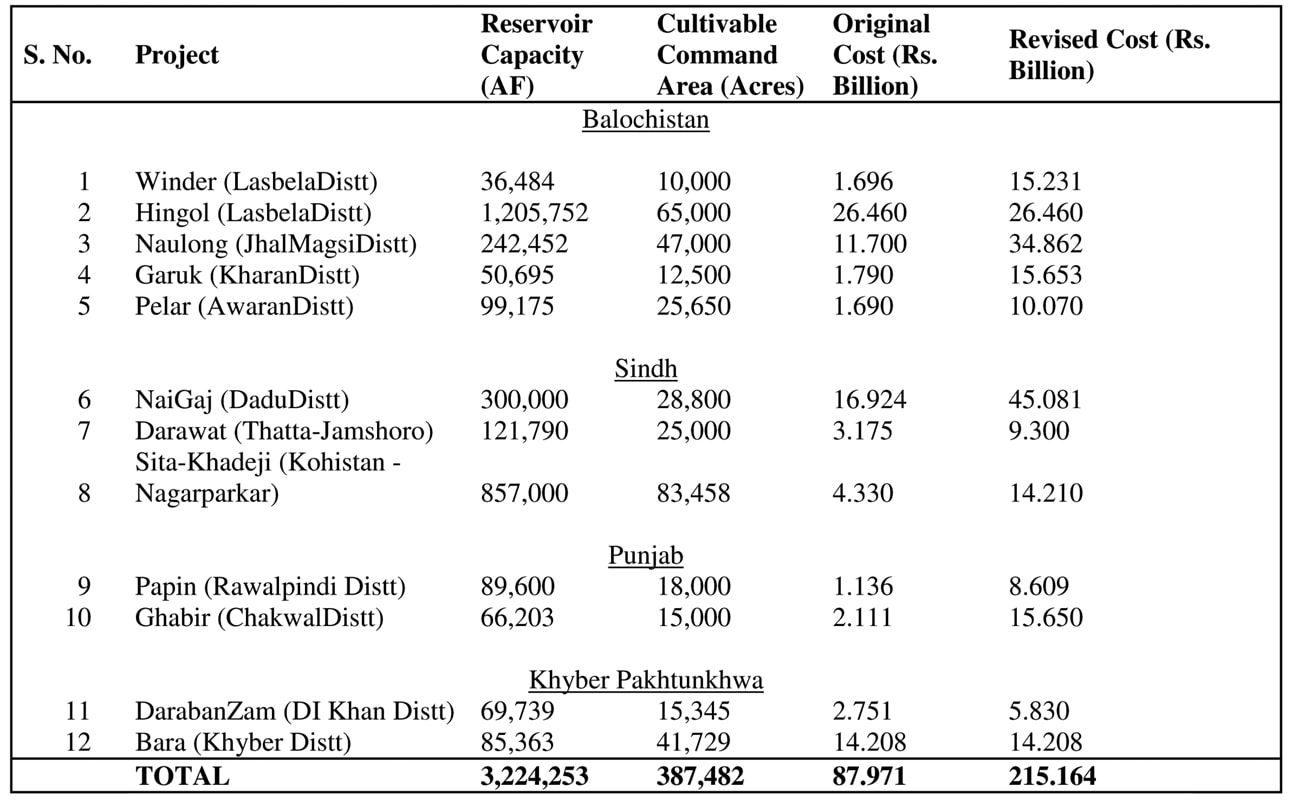
The 12 dams included Winder, Naulong, Hingol, Pelar, and Garuk in Balochistan; NaiGaj, Darawat, and Sita-Khadeji in Sindh; Ghabir and Papin in Punjab; and Bara and Daraban Zam in Khyber Pakhtunkhwa. Of these, Sita-Khadeji was allocated Rs 41 million in the 2011–12 PSDP (public sector development plan) but was later dropped due to “financial constraints.” Bara in Khyber District never took off owing to funding shortages and security concerns, while Daraban Zam in Dera Ismail Khan remains dormant at the redesign stage. Hingol underwent major redesigns and is now partly financed by the Abu Dhabi Fund.
Funding for Pelar was stopped in 2011, and Garuk has been under construction since 2019. Ghabir and Papin remain stalled following the withdrawal of Chinese financing, while Nai Gaj and Naulong are still incomplete. Details are given in Table below.
Unused potential and climatic consequences
The urgency of these projects has been highlighted repeatedly by the devastation caused by seasonal floods—exacerbated by climate change—which destroy lives, infrastructure, and farmland. Small dams could play a critical role in storing excess rainfall and conserving water for dry months. Beyond flood control, their benefits include improved food security, groundwater recharge, and sustainable local water availability.
Pakistan currently has about 142 small and medium-sized dams: 64 in Balochistan, 28 in KP, 23 in Punjab, 22 in Sindh, 3 in Islamabad, and 2 in Gilgit-Baltistan. Yet there has been no major expansion since 1996 despite an estimated potential for another 750. Many provincial projects remain mired in bureaucratic inefficiency and poor resource management, even though technical expertise exists within provincial Small Dams Organisations.
Preference for mega projects
One major reason for the neglect of small dams is policymakers’ persistent bias toward large, high-visibility water projects. Large dams, while politically attractive, are expensive, socially disruptive, environmentally risky, and often take more than a decade to complete. Since Tarbela, no major dam has been finished, though Diamer-Bhasha, Mohmand and Dasu are under construction.
The contrast in cost is striking: twelve small dams in the Potohar region were completed in 1996 for just $35 million, whereas Diamer-Basha alone will cost an estimated $14 billion (excluding its power generation component). Globally, too, the number of large dams constructed each year has declined sharply—from about 500 in the 1980s to roughly 100 in the early 2000s—reflecting a worldwide shift toward smaller, community-based storage solutions.
The case for small dams
Small dams are easier, faster, and cheaper to build and maintain. They can be constructed with local materials and labour, reducing dependence on imported technology. Examples such as Rawal, Simli, and Misriot in the Rawalpindi–Islamabad region, and Tanaza in Fateh Jang, show how such reservoirs can effectively meet urban and suburban water needs.
While small dams cannot entirely replace large multipurpose projects, they are an essential complement. They help expand irrigation, secure drinking water, recharge groundwater, and even generate low-cost electricity. Bara Dam is designed to produce 5.8 MW, Nai Gaj 4.5 MW, and Naulong 4.4 MW, with several others planned for smaller outputs.
The way forward
Despite once being water-rich, Pakistan is now among the most water-stressed nations on earth, partly because nearly half of its irrigation water is wasted through poor management and inadequate infrastructure. Enormous volumes of rainwater flow into the sea each monsoon, untapped and unused.
The construction of small and medium-sized dams is therefore no longer optional—it is an urgent national imperative. The government must act decisively to revive and complete these stalled projects by mobilizing domestic resources and seeking renewed international assistance. Any further delay will deepen the water crisis, undermine food security, and waste a vital opportunity to secure Pakistan’s sustainable development.
Copyright Business Recorder, 2025
The writer is retired Chairman of the State Engineering Corporation and former Chairman of the Institution of Engineers, Pakistan




















Comments
Comments are closed for this article.