


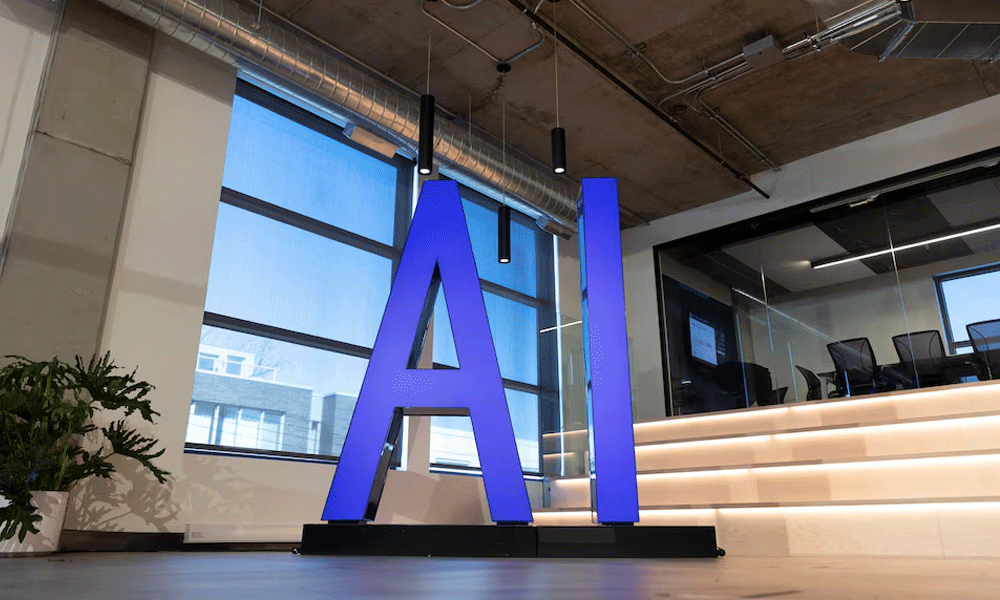

“AI isn’t magic. It’s not a genie in a bottle. It’s a prediction technology- like spreadsheets or the steam engine-just better at certain things. And the economic question it raises are familiar ones: “Who benefits? Who bears the risk?” This is what a renowned researcher from Princeton remarked while exploring the question: what can artificial intelligence realistically deliver for development, and where we should be cautious?
Who bears the risk?
What happens when AI does all the heavy lifting? What is left for the human brain to do? Where does our creativity perish? Is it possible for our minds to grow rusty if not put to use because we have AI chatbots now? What happens when the less experienced and young minds use AI without proper education about it?
AI has transformed our lives, which seems nothing less than magic. It has nearly revolutionized everything, be it brainstorming, writing, designing or diagnosis. It felt no less than gaining hold of a magic wand when tools like ChatGPT, Bard or other generative AI first arrived on the scene.
Yet almost immediately, dependence crept in. It goes without saying that AI augments human capabilities. Yet its over-reliance poses a risk. What started as occasional assistance turned into near-constant reliance. For instance, students using AI for sentence formation in early grades, researchers trusting AI-generated code without fully understanding it, tasks that once required struggle are now outsourced.
Some processes e.g., analytical reasoning, hypothesis formation, the process of drawing links between past and present are neither instantaneous nor convenient. They develop with effort, failure and reflection. Additionally, unsupervised use of AI among children and teenagers has numerous dangers; the most significant being the compromise of data privacy. Hence it is fair to ask whether AI’s advantages erode creativity and compromise privacy.
Recent research suggests that overreliance on AI can reduce critical thinking. In a 2025 survey by Microsoft and Carnegie Mellon involving 319 knowledge workers and 936 real-world examples of generative AI usage, the researchers found that higher confidence in AI correlates with less critical thinking effort, whereas greater self-confidence is associated with more critical thinking.
Another study by Cornell University finds a very notable drop in creative diversity (i.e., there is a decline in the ideas generated when AI is used) is recorded for users of AI, although they have performed better than those without it. For parents and educators of Gen Alpha, the worry is clear: overreliance on AI shrinks opportunities to struggle with hard problems, to fail and retry, to question, and to improvise.
To tackle the issues regarding overreliance on AI, there is a need to implement several measures. It is pertinent that children struggle and learn through problem-solving in their early phases such as forming sentences and simple assignments. For that, it automatically becomes necessary to restrict the usage of AI for basic tasks in early grades. Similarly, “AI Literacy” classes are very important for children to understand how AI works, its limitations, privacy, and data security concerns, and how to verify its outputs while developing critical thinking and prompt creation skills.
Special attention should be given to reduce the rural-urban divide, and hence every school should be equipped with functioning computer labs, reliable internet, and trained instructors. Such assignments and creative projects (essays, debates, and MUNs) should be encouraged, which involve limited AI support and only after the students have attempted the tasks themselves.
Globally, there is growing awareness, and Pakistan has made its own strategic policy moves. On July 30-31, 2025, Pakistan’s Federal Cabinet unanimously approved the National Artificial Intelligence (AI) Policy 2025. This Policy aims to transform Pakistan into a knowledge-based economy, promote innovation, protect data privacy, build infrastructure, and equip youth with skills.
It sets concrete targets: training one million AI professionals by 2030, establishing a National AI Fund (permanently allocating 30 percent of the R&D Fund) to support startups, research, and innovation. Other aims include creating Centers of Excellence in major cities, supporting AI-based public services and products, and ensuring inclusive access for women and people with disabilities.
In government policy, it is essential to enforce quality standards and ensure transparency in AI systems used in public services, especially in education. There should be ongoing monitoring and evaluation of how AI tools impact student outcomes, focusing on creativity and critical thinking. Allocating funds to support infrastructure, teacher training, and research into the cognitive effects of AI is crucial, and Pakistan’s AI Policy, with its allocation of 30% of the R&D Fund, is a positive step forward.
Moreover, AI use in curricula must be regulated, potentially setting minimum grades before AI tools are allowed and defining specific tasks that AI can or cannot assist with at different levels. For individuals, teachers, and parents, it’s important to reflect on how much we rely on AI—are we using it to enhance our thinking, or to avoid it?
Teachers should assign tasks that encourage students to practice logic, problem-solving, and hypothesis formation. Parents can foster creativity by encouraging offline activities such as reading, writing, puzzles, and experimentation. Finally, AI should be seen as a tool, not a crutch: it can assist in brainstorming or refining drafts, but human effort and critical thinking should always remain at the core of learning and development.
AI is a transformative force. It offers access, efficiency, and new possibilities. But when we surrender too much of the thinking to machines, something vital is at risk. Creativity, critical thinking, the struggle to learn; they are not luxuries but the foundation of innovation and fulfillment- the likes of Gen AI itself.
In Pakistan and beyond, with strong policies like National AI Policy 2025 being approved, there is hope. But policy must be matched by infrastructure, by teaching, and by everyday choices: giving young people the opportunity to think, to fail, to invent.
If we strike the right balance, AI can be our partner—not replacement. But if we lean too far toward consumption, toward outsourcing thinking, we risk losing what makes us human.
Copyright Business Recorder, 2025
The writer is a Staff Economist at the Pakistan Institute of Development Economics (PIDE). She can be reached at: [email protected]





















Comments
Comments are closed for this article.