


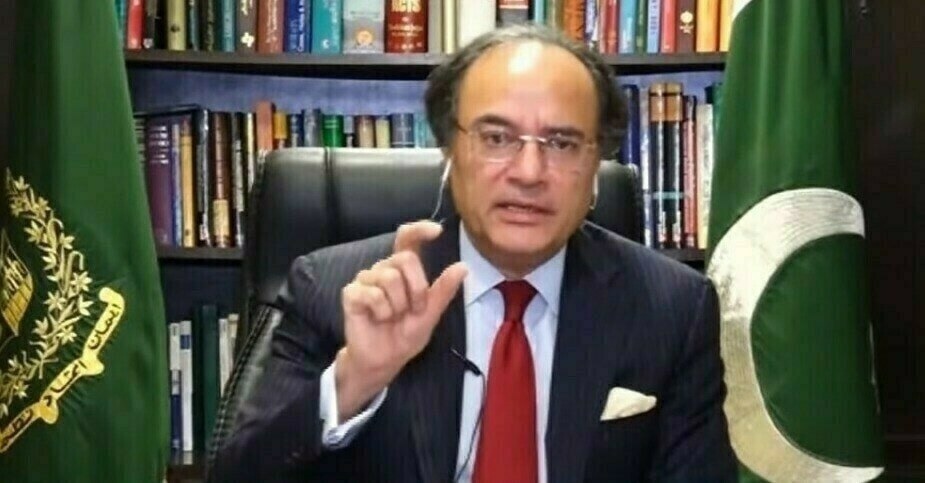

PESHAWAR: Minister for Finance and Revenue Senator Muhammad Aurangzeb has emphasized that the government’s role is to ensure macroeconomic stability, introduce structural reforms and provide the right ecosystem for business and investment in the country.
Addressing “Pakistan Business Summit” in Peshawar Thursday, he underlined the government’s commitment to creating an enabling environment for the private sector to lead Pakistan’s economic growth. Senator Muhammad Aurangzeb said that country is moving in right economic direction due to effective policy making and confidence of people on decisions of government.
The minister for finance said that remittances have been increased due to stability in currency adding that we are expecting remittances of 41 billion dollars very soon. He said that country has successfully made payment of Eurobond recently that indicates growth in economy.
Pakistan-US trade deal: Aurangzeb declines to disclose ‘key details’
He said that role of private sector in country’s economy is growing with each passing day adding that growth would induce structural reforms that would help making country self-reliant. He said that government would provide ecosystem and environment for contributing to world economy.
He said that finance division is working on tax policy while Federal Board of Revenue is focusing tax collection. He said that government is working to deepen and widen tax base and added that we have to restore confidence of people on taxation system.
Senator Aurangzeb also highlighted significance of provinces regarding Public Sector Development Funds saying that better coordination and liaison between federal government and provinces would produce desired results.
He said that government is also working to promote export-led growth by focusing taxation and energy providing sector. He said that we desired to introduce tariff reforms to facilitate export industry.
Finance minister said that we have recently signed 24 joint ventures with China in Beijing that reflects economic growth and our commitment to strengthen country’s economy. He said that efforts are underway to access capital market in China.
Senator Aurangzeb said that we have upgraded by Moody and Fitch and country would venture in international capital market very soon. He said that public should realize and work on challenges associated with climate change and population.
The Finance Minister commended the organizers for convening a high-profile forum in Peshawar and underlined the government’s commitment to creating an enabling environment for the private sector to lead Pakistan’s economic growth. He emphasized that the government’s role is to ensure macroeconomic stability, introduce structural reforms, and provide the right ecosystem for business and investment.
Reviewing recent economic progress, Senator Aurangzeb highlighted a sharp decline in financing costs following reductions in the policy rate, improved foreign exchange reserves covering close to three months of imports, and stability in the exchange rate. He noted that these developments have strengthened investor confidence and facilitated repatriation of dividends and profits.
The Minister also reported a significant improvement in remittances, which reached USD 38 billion last year and are projected to grow to USD 41–43 billion in the current fiscal year. He further pointed out that Pakistan successfully repaid USD 500 million in Eurobond obligations in September without market disruption and is well-positioned to meet the upcoming USD 1.3 billion repayment in April 2026.
Addressing structural reforms, Senator Aurangzeb reaffirmed the government’s resolve to implement comprehensive tax reforms, separating tax policy from tax administration to restore credibility and consistency for investors. He underlined ongoing reforms in state-owned enterprises, privatization efforts, and energy pricing as critical components of the economic reform agenda.
The Finance Minister also discussed Pakistan’s export-led growth strategy, tariff reforms aimed at reducing duties on raw materials and intermediate goods, and measures to attract efficient foreign direct investment (FDI).
He cited recent engagements in Beijing, Riyadh, Washington, and New York as evidence of renewed investor confidence, including the signing of 24 joint venture agreements with Chinese companies.
He further announced plans for Pakistan’s inaugural Panda Bond issuance before the year’s end, opening access to China’s deep capital markets.
Senator Aurangzeb underscored that Pakistan’s path to sustainable growth rests on greater competitiveness, private sector dynamism, and closer coordination between the federation and provinces. He also stressed the need to prioritize effective utilization of the Rs. 4.3 trillion national development budgets for infrastructure, health, and education.
Highlighting long-term challenges, the Finance Minister identified climate change and population growth as existential issues for Pakistan. He emphasized the urgency of addressing child stunting, learning poverty, and climate resilience alongside economic recovery, noting that these factors directly affect Pakistan’s future productivity and leadership.
Concluding his address, Senator Aurangzeb reaffirmed the government’s commitment to steering Pakistan towards sustainable economic recovery, global competitiveness, and resilience, while ensuring that reforms and growth translate into tangible benefits for the people of Pakistan.
Copyright Business Recorder, 2025




















Comments
Comments are closed for this article.