


Pakistan-US trade deal: Aurangzeb declines to disclose ‘key details’
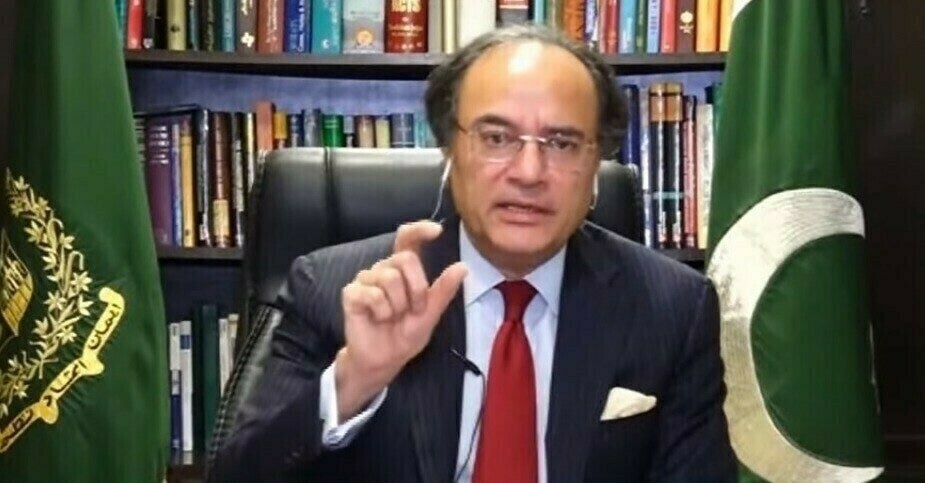

ISLAMABAD: Weeks after ‘hastily’ finalising a trade agreement with the United States – labelled as a significant boost to bilateral trade and investment – Federal Minister for Finance Muhammad Aurangzeb on Wednesday declined to disclose key details of the deal, raising concerns about transparency and potential hidden costs.
Talking to reporters after attending the CIPFA-ICAP Public Financial Management Conference 2025, the minister offered only some vague reassurances, describing the agreement as a ‘combination of trade and investment’ and promising further details ‘in the coming days’, without providing a specific timeline when pressed for specifics.
At the conference’s opening, organised by the Institute of Chartered Accountants of Pakistan (ICAP), he outlined Pakistan’s plans to re-enter international capital markets, beginning with the issuance of ‘Panda Bond’. He expressed optimism that the inaugural issuance could take place before the end of the year.
Pakistan, US vow to advance new trade agreement, boost trade & investment
“Alongside Prime Minister Shehbaz Sharif, I will visit China next week. We will discuss our plans to return to international capital markets, starting with the Panda Bond. We are hopeful the inaugural issue will happen before the year ends,” he said.
He added that if credit ratings and spreads continue to improve, Pakistan could explore other global markets during the current fiscal year.
Commenting on recent macroeconomic indicators, the minister said: “For the first time in a long while, all three major international rating agencies – Fitch, S&P, and Moody’s – are aligned. This is external validation of the progress we’ve made.”
“We are moving in the right direction in terms of sentiment. We need to stay the course and avoid boom-and-bust cycles,” he said, describing the newly achieved economic stability as ‘a means to an end’.
The minister acknowledged Pakistan’s past economic volatility and said the government is focused on sustaining stability. He noted that Letters of Credit (LCs) for industries are opening, foreign companies are repatriating profits, and interest rates have declined.
The finance minister also identified climate change as an existential threat to Pakistan.
Turning to tax reforms, he highlighted the role of technology in transforming the Federal Board of Revenue (FBR). He noted that the FBR chairman is not part of the Technology Board, which includes technical experts such as the chairman of National Database and Registration Authority (Nadra). Efforts have been made to ease tax filing for the salaried class, reducing the number of return fields from 800 to around 35 or 40.
“The salaried class will go through the tax return phase,” he said, adding that tax policy responsibilities have shifted from the Federal Board of Revenue (FBR) to the Finance Division as part of broader reforms.
He said reforms are under way across government institutions, covering 43 ministries and 400 agencies, with 24 institutions slated for privatisation. “Tough decisions have been made on reforms.
Government institutions must be strategic and necessary. Right-sizing aims to eliminate corruption, which is the key to safeguarding the national exchequer,” he said, adding that subsidies in Pakistan have often been misused. “We have at least stopped the bleeding: the Public Works Department and Utility Stores have been closed. Further decisions will be made with cabinet approval.”
He acknowledged that reform decisions have financial implications, including asset management and voluntary separation schemes, which the government plans to implement respectfully. Tariff reforms are also under way.
The minister urged attendees to help identify investable and bankable projects, and said the tax filing process has been simplified. On taxation policy, he clarified that the FBR is not involved in policymaking, which now falls under the Finance Division.
On state-owned enterprise (SOE) reforms, he said 24 SOEs are under the Privatisation Commission. “We need to be strategic and essential,” he said, adding that privatisation and right-sizing will reduce corruption, representing ‘real savings’ for the national exchequer.
He emphasised that the private sector should lead Pakistan’s economy while the government provides a conducive and enabling environment.
About the cryptocurrency issue, the minister said regulations would be introduced before moving forward on the issue. He noted that Pakistan’s Virtual Assets Regulatory Authority, which includes representatives from the State Bank of Pakistan (SBP), Federal Investigation Agency (FIA), and Anti-Money Laundering units, has already been established.
When asked whether Pakistan would seek international assistance to cope with flood damage, he said the government would first rely on its own resources.
He noted that while the international community aided Pakistan during the 2022 floods, viable reconstruction projects were not realized. “How were hotels and houses built on riverbanks? Let us pray for no further flood damage,” he added.
The minister said that after affecting Punjab, the floods were moving toward Sindh, with relief and rescue efforts ongoing. Rehabilitation and reconstruction will follow. “To become a $3 trillion economy by 2047, we must address population growth and climate change threats. Without this, we cannot harness Pakistan’s full potential,” he said.
Highlighting the toll of recent floods, Aurangzeb said around 800 people already dead, with significant damage in Gilgit-Baltistan and northern areas. Punjab is also severely affected.
“Climate change and population growth are huge challenges. Investable projects must be developed to address these threats,” he said, noting that foreign pledges after 2022 did not translate into viable projects.
On tax reforms, he reiterated that the FBR’s transformation program is under way, with reforms also initiated in the Pakistan Revenue Automation Limited (PRAL).
Copyright Business Recorder, 2025
















Comments
Comments are closed for this article.