


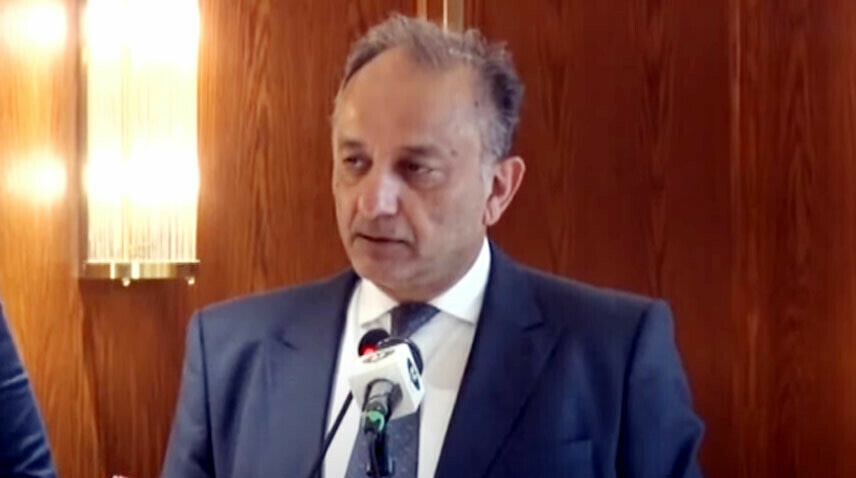

ISLAMABAD: Federal Minister for Climate Change Dr Musadik Malik on Wednesday urged capacity building to address climate change, saying the federal government will support provinces in improving urban drainage, disaster preparedness, and zoning enforcement.
Speaking at a seminar titled “Building a Resilient Public Financial Management Ecosystem”, jointly organised by the Institute of Chartered Accountants of Pakistan (ICAP) and the Chartered Institute of Public Finance and Accountancy (CIPFA), Malik said Punjab, Sindh, Khyber Pakhtunkhwa, Balochistan, Gilgit-Baltistan, and Azad Jammu and Kashmir will receive equal support from the federation.
Calling climate change “a present and undeniable reality,” he stressed the urgency of both local reforms and global fairness. “We cannot afford delay. Unsafe riverbank construction must go, our cities must prepare, and the world must deliver justice,” he said.
He pointed out that Pakistan’s share of global emissions is less than one per cent but it remains among the worst-hit countries. He added that nations responsible for most emissions consume nearly 80 per cent of the Green Climate Fund.
Admitting gaps in Pakistan’s ability to access international funding, he called for stronger technical capacity and better-prepared projects to secure global financing. “It is not only the world’s fault. Unless we improve, we will continue to lose out.”
The minister also announced a federal strategy to demolish all illegal and unsafe resorts built along riverbanks to mitigate flood risks, warning that no one will be spared regardless of their influence. “These luxury resorts, whether legal or illegal, are not just buildings. In floods, they turn into missiles that smash through downstream villages, destroying lives and livelihoods,” Malik said, adding that Prime Minister Shehbaz Sharif has already issued clear orders for their removal.
He highlighted that unregulated construction along riverbanks has worsened flood impacts, compounding Pakistan’s climate vulnerability. With over 7,000 glaciers feeding rivers from the Himalayas, Pakistan faces frequent flash floods and glacial lake outburst floods (GLOFs). “When glacial lakes burst, they unleash walls of water and boulders. Any obstacle in their way becomes a weapon of destruction.”
Linking Pakistan’s crisis to global climate injustice, he noted that a few major economies contribute nearly three-quarters of the world’s carbon emissions, while vulnerable countries like Pakistan suffer the consequences.
Speaking on the occasion, Saifullah, President of ICAP, reaffirmed the organisation’s commitment to promoting transparency and institutional capacity across Pakistan’s public sector. He thanked policymakers, development partners, and industry leaders for their participation, emphasising the need for collaboration to build fiscal resilience and governance reforms.
Khalid Rahman, Chairman of ICAP’s Public Sector Committee, described the conference as a milestone in advancing fiscal governance and institutional resilience.
Khalid Hamid, Director International at CIPFA, highlighted the institute’s commitment to public financial management reforms globally.
Other speakers included Muhammad Ali, Minister of Privatisation Commission; Ross Smith, Programme and Technical Director at the International Public Sector Accounting Standards Board (IPSASB); and panellists from various government and financial institutions.
The conference featured roundtable discussions on enhancing State-Owned Enterprise (SOE) governance and expanding Pakistan’s tax revenue capacity, gathering policymakers, regulators, development partners, and senior corporate leaders.
Akif Saeed, Chairman of the Securities and Exchange Commission of Pakistan (SECP), emphasised the importance of robust SOE oversight, while Dr Iram Anjum Khan, Additional Auditor General of Pakistan, called for stronger fiscal accountability and audit reforms.
Former State Bank Governor Shahid Kardar shared insights on developing an equitable and sustainable tax system, and Dr Najeeb Ahmad, Member Inland Revenue (Policy) at the Federal Board of Revenue (FBR), stressed the need for a progressive, technology-enabled tax framework.
Panels also discussed embedding Environmental, Social, and Governance (ESG) principles into public financial management and advancing globally recognised accounting standards, featuring experts from the World Bank, State Bank of Pakistan, and international accounting bodies.
The event concluded with recommendations to strengthen Pakistan’s public financial management and institutional performance.
Copyright Business Recorder, 2025

























Comments
Comments are closed for this article.