



How do economies grow? By putting their productive resources to the most efficient use. Yet in Pakistan, nearly half of this potential remains underutilized. Women make up 49 percent of the population, but only 21.4 percent of working-age women participate in the labour force. This is among the lowest rates in the world and the region (global average: 52.6 percent; South Asia: 25.2 percent).
In stark contrast, nearly 60 percent of Pakistan’s female population is enrolled in the Benazir Income Support Programme (BISP), the country’s flagship cash transfer scheme for vulnerable, women-headed households.
While BISP provides vital short-term relief, mounting evidence suggests an unintended consequence: declining female labour force participation (FLFP) over time.
According to the neoclassical household labour supply model, unconditional non-labour income such as cash transfers can reduce labour supply, particularly in the absence of active labour market policies. Over time, such dependency becomes entrenched and increasingly difficult to reverse. With limited fiscal space, governments tend to prioritize short-term relief measures, particularly when it is politically expedient, often at the expense of long-term investment in human capital.
This trade-off is reflected in Pakistan’s federal budgets.
Since BISP has evolved into a robust, data-driven platform, it should be used for more strategic resource allocation by shifting the focus from broad coverage to meaningful impact. To achieve this, two shifts are essential.
First, BISP support should be linked to formal, women-friendly employment to break the cycle of reliance and promote women’s economic mobility. This requires revising eligibility so that employed women who meet vulnerability criteria still qualify. Support can include disability aid, daycare, transport subsidies, school stipends for children of widowed or divorced women, micro-loans, and one-time grants for major life events like a daughter’s marriage. These measures would reduce reliance on handouts and boost FLFP.
Second, BISP should help offset cost-of-living pressures that weigh heavily on low-income households. Utility bills constitute recurring burden that often push vulnerable families into debt. Targeted subsidies for gas and electricity, routed through BISP for lifeline consumers, could reduce household stress while focusing fiscal resources on clearly defined eligible groups.
However, if the current structure of BISP continues, Pakistan risks pushing its female population into a vicious cycle of dependency, which we must avoid.
And here is why.
The hidden cost of dependency:
The Economic Survey 2025 describes social protection as a ‘strategic investment in the nation’s future’. Yet without women’s participation in formal economic activity, that claim remains open to question.
Heavy reliance on social protection affects resource allocation in two ways: it increases the population’s dependency on non-labour income and shifts government spending from long-term productivity to short-term relief.
The concern is particularly relevant in Pakistan, where 55 percent of BISP’s allocation goes to unconditional transfers with limited linkages to employment or skills training.
As of 2025, 71.7 million women, or nearly 60 percent of Pakistan’s female population, are listed in the National Socioeconomic Registry (NSER), according to BISP’s data portal. Of these, 9.87 million are already receiving cash transfers. This means that if BISP were to extend support to all registered women, its budget would need to be more than double, increasing by 2.6 times.
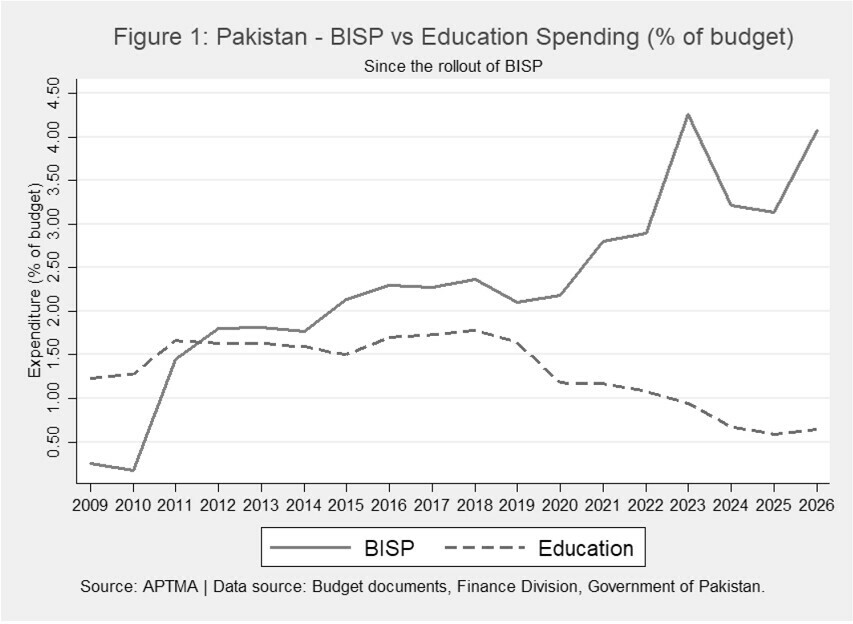
At the same time, government spending priorities have shifted. Prior to BISP’s launch in 2008, federal allocations for education were higher than those for social protection. Since then, BISP’s budget share has steadily increased, eventually surpassing education, which has seen a consistent decline (Figure 1).
This shift has long-term consequences.
Female literacy, still below 50 percent, limits access to formal employment and creates a cycle: undereducated women struggle to secure jobs, rely on handouts, female labour force participation (FLFP) drops, incomes fall, and poverty deepens.
Evidence of a trade-off:
Empirical research supports this trend.
Majid and Riaz (2022) found that women receiving BISP were more likely to remain out of the workforce or in vulnerable jobs. Sarfraz et al. (2022) observed that early gains in reducing vulnerable employment vanished within five years, with no sustained improvements in work outcomes.
An IMF study (Ivanova et al., 2019) found that in societies with strong gender norms, cash transfers can reduce women’s willingness to work unless paired with incentives like better pay or job access.
This pattern is not unique to Pakistan; cross-country data show that greater reliance on social protection is often associated with persistently low FLFP, particularly in low- and lower-middle-income countries.
Figure 2 illustrates that Afghanistan and Iraq, with above-average social protection spending (as percent of GDP), report some of the lowest FLFP rates, primarily due to cultural barriers followed by other contributing factors. In contrast, Bangladesh appears in the top-left quadrant, with relatively high FLFP despite lower welfare spending.
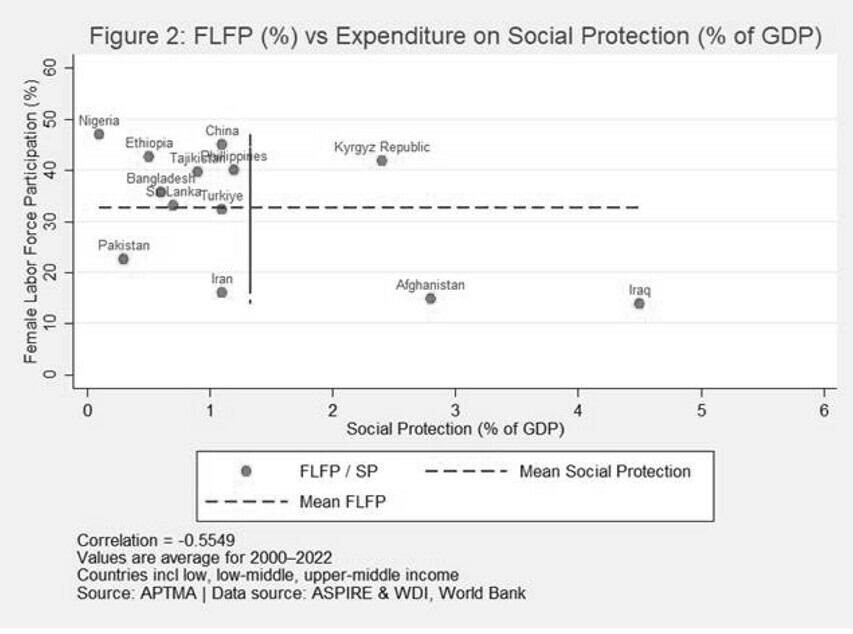
Pakistan currently performs below the global average on both metrics, but with BISP spending on the rise (Figure 1), it risks shifting into the bottom right quadrant, where dependence on social protection coincides with low female labour force participation (FLFP). The moderately negative correlation (r = 0.5549) between the two indicators suggests that without a focus on building long-term human capital, social protection systems may inadvertently deter women from joining the workforce. The rarity of countries in the top right quadrant, which achieve both high FLFP and high social protection spending, highlights how rare this balance is in practice.
Political will for development outcomes:
Social protection is often tied to the broader goal of human development. However, Pakistan’s HDI ranking has dropped from 161 to 168 out of 191 countries between 2022 and 2025, with a noticeable decline in women’s empowerment indicators.
If BISP were meaningfully advancing human development, these indicators would reflect that progress, especially given the programme’s rising coverage and increasing share in the federal budget.
Instead, the government continues to expand BISP coverage without creating sustainable economic linkages. This has made the trade-off between education, FLFP, and welfare dependency more visible. While the cash transfer of Rs 13,500 per quarter offers psychological comfort, it delivers little meaningful relief.
To be effective, BISP must either support sustainable income generation through increased FLFP or ease living costs through targeted energy subsidies.
With 60 percent of Pakistani women already registered in BISP’s database, the platform could be used to identify vulnerable women-headed households with electricity usage under 200 units per month and offer targeted relief.
Such reforms demand political will but would reposition BISP as a genuine tool for long-term development.
Returning to the central premise: economies thrive when resources are used efficiently. If BISP is not rechanneled now, Pakistan will face a defining question in the years ahead: Is BISP a ‘strategic investment in the country’s future’ or another misallocation of public resources?
Copyright Business Recorder, 2025

PUBLIC SECTOR EXPERIENCE: He has served as Member Energy of the Planning Commission of Pakistan & has also been an advisor at: Ministry of Finance Ministry of Petroleum Ministry of Water & Power
PRIVATE SECTOR EXPERIENCE: He has held senior management positions with various energy sector entities and has worked with the World Bank, USAID and DFID since 1988. Mr. Shahid Sattar joined All Pakistan Textile Mills Association in 2017 and holds the office of Executive Director and Secretary General of APTMA.
He has many international publications and has been regularly writing articles in Pakistani newspapers on the industry and economic issues which can be viewed in Articles & Blogs Section of this website.
Sarah Javaid is an Economist by education and practice, with experience in the Ministry of Commerce, the textile sector, and think tanks. She has participated in the monitoring mission of the Pakistan Regional Economic Integration Activity for USAID. Her writings focus on international trade and export competitiveness. Currently, she serves as a Trade Economist at the All Pakistan Textile Mills Association




















Comments
Comments are closed for this article.