



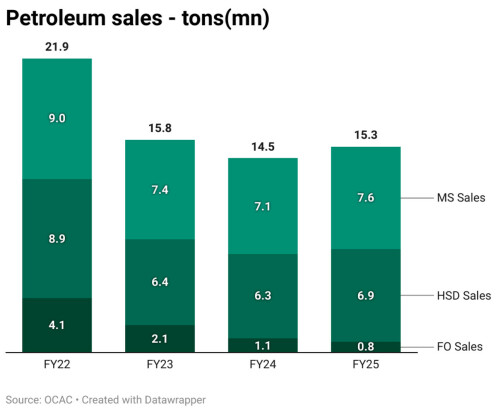
Pakistan’s oil marketing companies (OMCs) posted a notable recovery in petroleum sales in FY25, signalling gradual stabilization in demand amid a complex macroeconomic environment. Total oil sales for the fiscal year reached 16.32 million tons, marking a 7 percent year-on-year increase compared to 15.28 million tons in FY24.
This growth was primarily driven by increased consumption of motor spirit (MS) and high-speed diesel (HSD), while furnace oil (FO) sales continued to decline. MS sales rose by 6 percent to 7.6 million tons, supported by higher automobile sales and relatively lower fuel prices compared to the previous year.
HSD volumes grew 10 percent to 6.89 million tons, benefiting from improved agricultural and transport sector activity during parts of the year, although seasonal variations remained a factor.
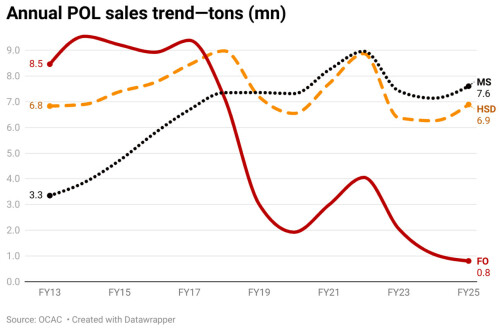
FO sales, on the other hand, declined by 23 percent to 0.81 million tons due to the shift away from FO-based power generation. However, June 2025 saw a temporary surge in FO sales, which jumped 62 percent month-on-month and 22 percent year-on-year to 129,000 tons, as buyers engaged in pre-buying ahead of an expected imposition of petroleum development levy (PDL) from July.
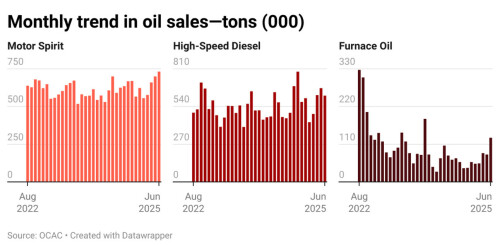
Total oil sales in June 2025 stood at 1.57 million tons, up 8 percent year-on-year and 2 percent from May. This uptick was driven by a 5 percent monthly increase in MS sales, which reached a three-year high of 732,000 tons, while HSD volumes declined 8 percent month-on-month to 618,000 tons due to the end of the harvesting season. The rebound in oil sales throughout the year was closely tied to fuel price movements.
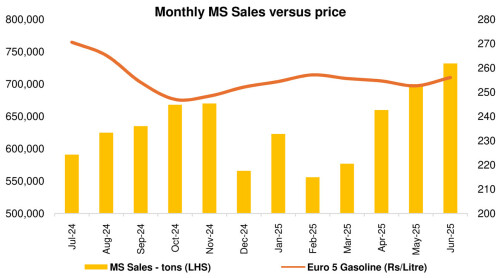
Petrol and diesel prices remained relatively stable or lower for much of FY25, which encouraged consumption. Government price adjustments in response to global crude trends—particularly during periods of lower prices—helped ease pressure on retail buyers and transport operators. Additionally, the rise in sales was supported by a crackdown on smuggled Iranian fuel and higher power generation needs that temporarily revived demand for FO.
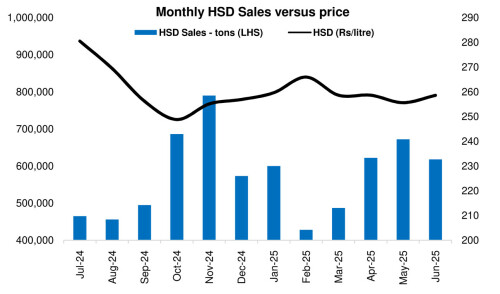
Anticipation of rising local prices in June, fuelled by upward global oil price movements due to Middle East tensions, further contributed to the monthly growth in sales. Looking ahead, analysts expect oil sales in FY26 to grow in the range of 7 to 10 percent, assuming continued recovery in economic activity and a supportive regulatory environment.
However, risks such as volatile global prices, structural shifts away from fossil fuels—especially furnace oil—and weaker demand from agriculture and infrastructure could temper growth.
Overall, FY25 marked a cautious but tangible recovery in Pakistan’s petroleum demand landscape, with pricing dynamics, policy signals, and seasonality playing key roles in shaping consumption patterns.




















Comments
Comments are closed for this article.