


Small traders term budget ‘conventional fiscal document’
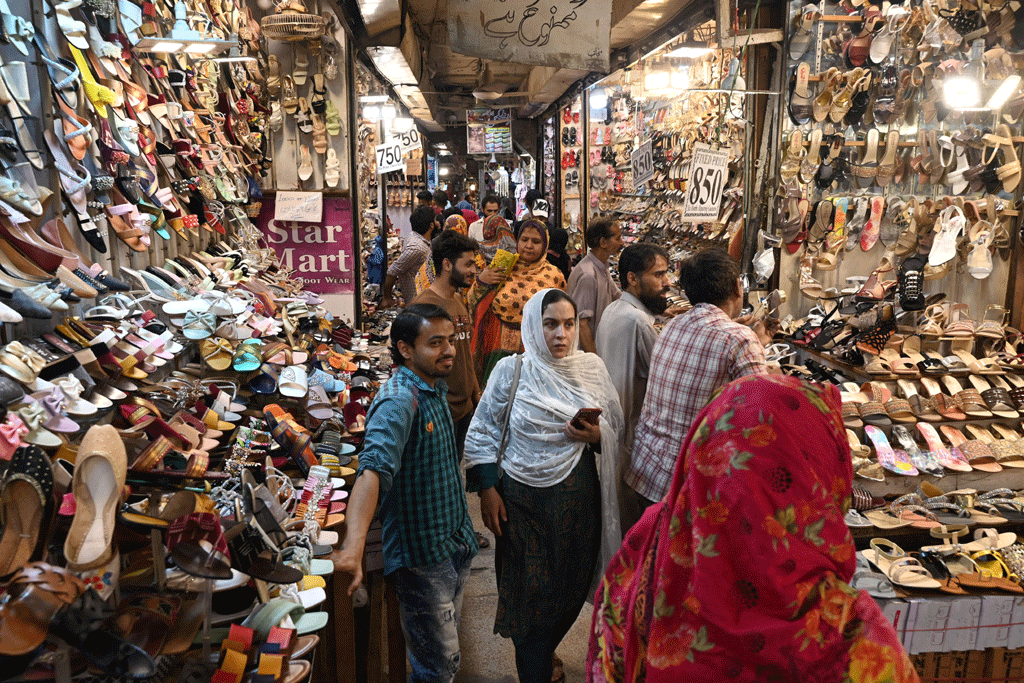

KARACHI: The newly unveiled federal budget for the fiscal year 2025-26 has drawn sharp criticism from the small traders’ community, who have labelled it as a “conventional fiscal document”, lacking vision, innovation, and inclusivity.
The budget, they argue, remains tethered to the constraints of the International Monetary Fund (IMF) without offering any real roadmap for sustainable economic revival.
Speaking to Business Recorder on Tuesday, Mehmood Hamid, President of the All Pakistan Organisation of Small Traders and Cottage Industry, termed the federal budget an unfruitful economic exercise that fails to address the core issues plaguing the small and medium enterprise (SME) sector.
He warned that the government’s increasing dependency on the IMF for fiscal support is eroding national economic sovereignty and threatening long-term growth prospects.
Mehmood Hamid criticised the coalition government for prioritising IMF-dictated austerity measures over home-grown economic solutions. “There is no comprehensive policy framework to revive domestic commerce or incentivize entrepreneurship,” he remarked. “Instead, the emphasis appears to be on widening the tax net without providing structural relief or sectoral support.”
He expressed concern over enhanced powers being granted to the Federal Board of Revenue (FBR), saying that such empowerment, without parallel accountability and transparency, could lead to overregulation, harassment of small businesses, and potential capital flight. “The business community is already overburdened. Aggressive revenue collection measures will only discourage investment and enterprise,” he said.
The trade leader called on both federal and provincial governments to adopt a policy of fiscal austerity by curbing non-developmental expenditures. “There is an urgent need to cut all symbolic and luxury-oriented state expenditures,” he said, citing lavish government protocols, elite entitlements, and discretionary funds for high-ranking officials such as the President, Prime Minister, and Chief Ministers. “Fiscal discipline must begin at the top,” he said. “If the state demonstrates frugality, it would send a strong signal to the markets and help in restoring macroeconomic confidence.”
The SME sector, often described as the backbone of Pakistan’s economy, continues to be overlooked in federal fiscal planning, he lamented. Despite its role in employment generation and contribution to GDP, the sector has not received targeted tax relief, concessional financing, or energy subsidies that could catalyze industrial productivity. “If small traders, SMEs, and the cottage industry are incentivized and protected, they can bolster the industrial value chain, which in turn benefits the larger corporate sector,” he said. “But there is little to no mention of sector-specific interventions in the budget.”
On the issue of power outages, particularly in Karachi, Mehmood Hamid likened the role of K-Electric (KE) to that of a colonial monopoly, describing it as a “modern-day East India Company.” He decried daily electricity load-shedding of up to eight hours in key commercial districts of the old city, warning that it is stifling productivity and undermining business viability, particularly amid the ongoing heatwave. “Energy insecurity has a direct impact on industrial output. Without reliable power supply, no economy can thrive,” he said, pointing to the adverse effects of inconsistent energy provision on urban economic zones.
Copyright Business Recorder, 2025

























Comments
Comments are closed for this article.