BR100 Increased By (0.14%)
BR30 Increased By (0.09%)
KSE100 Increased By (0.22%)
KSE30 Increased By (0.32%)
BECO 5.65 No Change ▼ 0.00 (0%)
BML 64.99 Increased By ▲ 1.11 (1.74%)
BOP 33.64 Decreased By ▼ -0.03 (-0.09%)
CNERGY 8.15 Increased By ▲ 0.01 (0.12%)
DCL 11.60 Increased By ▲ 0.22 (1.93%)
FCCL 52.00 Decreased By ▼ -0.27 (-0.52%)
FCSC 5.76 Increased By ▲ 0.26 (4.73%)
FFL 18.07 Increased By ▲ 0.35 (1.98%)
FNEL 1.39 Increased By ▲ 0.08 (6.11%)
HUMNL 11.20 Increased By ▲ 0.02 (0.18%)
KEL 7.83 Decreased By ▼ -0.03 (-0.38%)
KOSM 5.84 Increased By ▲ 0.20 (3.55%)
MLCF 85.51 Decreased By ▼ -0.09 (-0.11%)
NBP 183.29 Decreased By ▼ -0.33 (-0.18%)
PACE 11.95 Increased By ▲ 0.27 (2.31%)
PAEL 40.10 Decreased By ▼ -0.17 (-0.42%)
PIAHCLA 25.89 Increased By ▲ 0.09 (0.35%)
PIBTL 17.16 Increased By ▲ 0.12 (0.7%)
PPL 224.00 Decreased By ▼ -0.06 (-0.03%)
PRL 34.45 Decreased By ▼ -0.17 (-0.49%)
PTC 64.50 Increased By ▲ 0.51 (0.8%)
SEARL 90.00 Decreased By ▼ -0.09 (-0.1%)
SSGC 26.70 Increased By ▲ 0.10 (0.38%)
TELE 9.09 Increased By ▲ 0.01 (0.11%)
THCCL 69.71 Increased By ▲ 2.35 (3.49%)
TPLP 11.35 Decreased By ▼ -0.07 (-0.61%)
TREET 24.68 Decreased By ▼ -0.03 (-0.12%)
TRG 71.20 Increased By ▲ 0.22 (0.31%)
WAVES 11.35 Increased By ▲ 0.37 (3.37%)
WTL 1.28 Increased By ▲ 0.02 (1.59%)
By

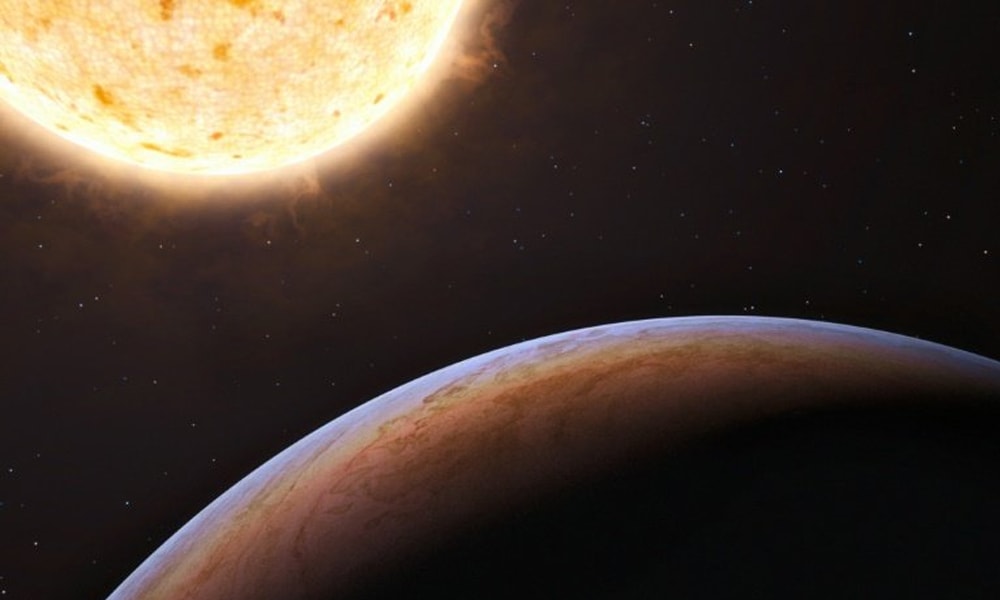
PARIS: Astronomers announced Wednesday they have discovered a massive planet orbiting a tiny star, a bizarre pairing that has stumped scientists. Most of the stars across the Milky Way are small red dwarfs like TOI-6894, which has only 20 percent the mass of our Sun. It had not been thought possible that such puny, weak stars could provide the conditions needed to form and host huge planets.

But an international team of astronomers have detected the unmistakable signature of a gas giant planet orbiting the undersized TOI-6894, according to a study in the journal Nature Astronomy.

This makes the star the smallest star yet known to host a gas giant.

Comments

Comments are closed for this article.