


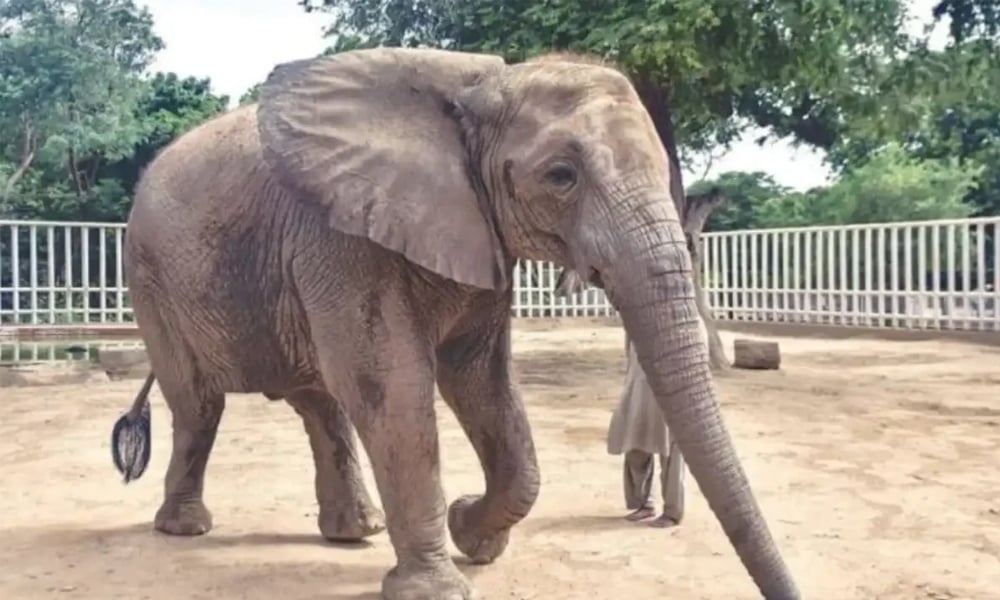

KARACHI: A team of doctors and vets has developed a novel treatment for a pair of elephants suffering from tuberculosis that involves feeding them at least 400 pills a day.
The jumbo effort by staff at the Karachi Safari Park involves administering the tablets -- the same as those used to treat TB in humans -- hidden inside food ranging from apples and bananas, to Pakistani sweets
The amount of medication is adjusted to account for the weight of the 4,000-kilogram (8,800-pound) elephants.
But it has taken Madhubala and Malika several weeks to settle into the treatment after spitting out the first few doses they tasted of the bitter medicine, and crankily charging their keepers
"Giving treatment for TB to elephants is always challenging. Each day we use different methods," said Buddhika Bandara, a veterinary surgeon from Sri Lanka who flew in to oversee the treatment.
"The animals showed some stress in the beginning, but gradually they adapted to the procedure," said Bandara, who has helped more than a dozen elephants recover from the illness in Sri Lanka.
Mahout Ali Baloch wakes early daily to stew rice and lentils, mixed with plenty of sugar cane molasses, and rolls the concoction into dozens of balls pierced with the tablets.
"I know the pills are bitter," the 22-year-old said, watching the elephants splashing under a hose to keep cool.
Four African elephants -- captured very young in the wild in Tanzania -- arrived in Karachi in 2009.
Noor Jehan died in 2023 at the age of 17, and another, Sonia, followed at the end of 2024. An autopsy showed she had contracted tuberculosis, which is endemic in Pakistan.
Tests carried out on Madhubala and Malika also came back positive, and the city council -- which owns the safari park -- assembled a team to care for the pachyderms.
Bandara said it is not uncommon for elephants to contract the contagious illness from humans, but that Sonia -- and now Madhubala and Malika -- had shown no symptoms.
"It was surprising for me that elephants have TB," said Naseem Salahuddin, head of the Infectious Disease Department at the Indus Hospital and Health Network, who was enrolled to monitor staff.
"This is an interesting case for me and my students -- everyone wants to know about the procedure and its progress," she told AFP.
The team of four mahouts wear face masks and scrubs when feeding the elephants to avoid contracting a disease that infects more than 500,000 humans a year.
Karachi Safari Park has long been criticised for the mistreatment of captive animals -- including an elephant evacuated after a campaign by American singer Cher -- but is hopeful its last two elephants will overcome the illness with a year-long treatment plan.




















Comments
Comments are closed for this article.