


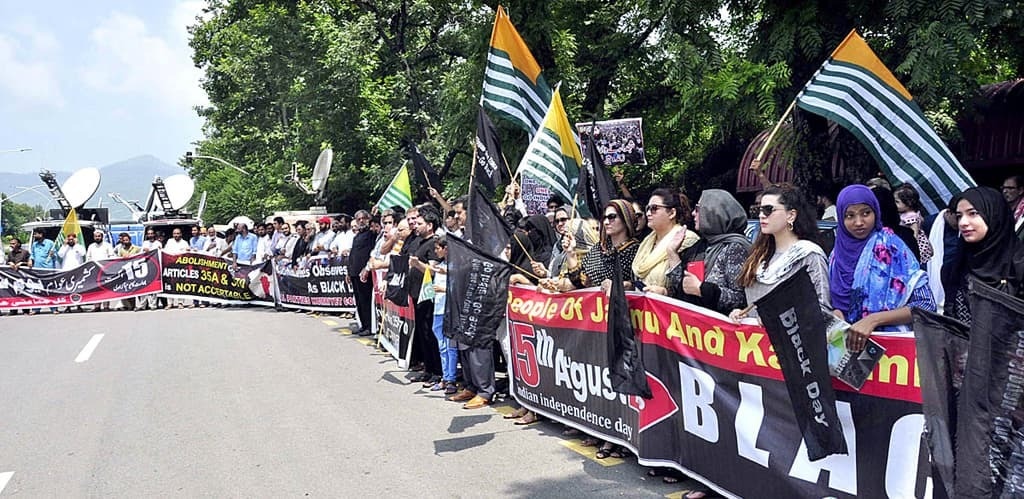
EDITORIAL: Following the cessation of Pak-India hostilities, thanks to US and some regional players’ intervention, the spotlight has turned to the core issue of conflict between the two nuclear-armed states: Kashmir.
The sudden incursions India launched on the night of May 7-8 deep inside Pakistan accusing it of involvement in the Pahalgam terrorist attack have ended badly for it. The Modi government had initiated the conflict, confident of its superiority in terms of conventional forces and modern weapons system it had acquired from various countries.
The ensuing events demonstrated that weapons technologies, the kind supplied to Pakistan by China, had changed the nature of conflict, compelling India to seek the US’ help to secure a ceasefire.**
The ceasefire along the Line of Control in Kashmir and the international border came into effect after what President Trump described as a long “night of negotiations” facilitated by Washington. He has since evinced interest in playing an active role for the resolution of the Kashmir issue.
In a post on his Truth Social platform he said, “I will work with both of you to see if, after a ‘thousand years’ a solution can be found regarding Kashmir.” For its part, Pakistan immediately welcomed the US President’s remarks with the Foreign Office expressing appreciation for his “willingness” to support efforts, it said, aimed at the resolution of the Jammu and Kashmir dispute — a longstanding issue that has serious implications for peace and security in South Asia and beyond.
Although India has yet to react, its enduring position has been that Kashmir is a bilateral issue. For Prime Minister Narendra Modi’s far-right Hindu nationalist government, which thrives on anti-Pakistan hate rhetoric, if not war hysteria, that would be a big letdown though not easy to reject.
Unlike in the case of Ukraine, rather than acting as a peace broker, Washington can nudge the two countries towards back-channel diplomacy, leading at some point to formal result-oriented talks.
It is about time New Delhi realised the folly of its policies. Illegal revocation of the disputed region’s autonomy coupled with relentless repression has not reduced the intensity of the freedom movement.
And the attempt to create a ‘New Normal’ through cross-border air strikes into Pakistan has brought it nothing but humiliation and embarrassment. It would be wise therefore to try to find a solution of the Kashmir issue which is acceptable to the Kashmiri people.
In fact, back in 2001, Gen Pervez Musharraf tried to turn a new leaf in relations with India by offering an ‘out of box’ Kashmir resolution, and found a receptive partner in the then BJP prime minister Atal Behari Vajpayee, though to see it scuppered by hawks in his party.
Later, Congress party prime minister Dr Manmohan Singh took the same path but failed to make progress, this time due to some extraneous developments in this country. One can only hope that the recipe for peaceful coexistence still has takers in New Delhi.
Copyright Business Recorder, 2025






















Comments
Comments are closed for this article.