


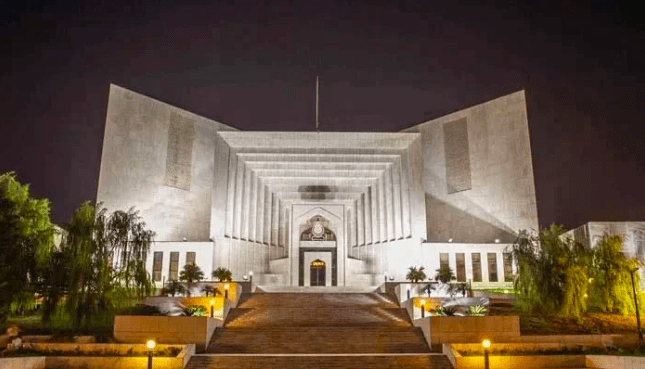

ISLAMABAD: The Sunni Ittehad Council (SIC) counsel sought time to file an application to challenge the constitution of the bench, hearing the review petitions on reserved seats.
A 11-member Constitutional Bench of the Supreme Court headed by Justice Aminuddin Khan, and comprising Justice Jamal Khan Mandokhail, Justice Muhammad Ali Mazhar, Justice Syed Hasan Azhar Rizvi, Justice Musarrat Hilali, Justice Naeem Akhtar Afghan, Justice Shahid Bilal Hasan, Justice Muhammad Hashim Khan Kakar, Justice Salahuddin Panhwar, Justice Aamer Farooq and Justice Ali Baqar Najafi, on Tuesday, heard the review petition of Pakistan Muslim League-Nawaz (PML-N), Pakistan Peoples’ Party (PPP) and the Election Commission of Pakistan (ECP).
At the outset of the proceeding, Faisal Siddiqui, representing the SIC, came on the rostrum and requested the bench adjourned the hearing until next Monday (May 19) so that he can file a formal application challenging the formation of the bench.
Faisal informed that on first hearing, he did not receive the notice, while on the second hearing could not come because of suspension of flights due to Pakistan-India conflict.
The SIC counsel contended that as the flights have resumed operation; therefore, on the third hearing (May13) of the review petitions, he is before the bench but has not prepared the application yet; therefore, needed some time.
The bench accepting Faisal’s plea adjourned the case until May 19.
The PML-N through advocate Haris Azmat on Tuesday filed the additional grounds, submitting that the detailed reasoning (of majority judges), unfortunately, ignored the settled jurisprudence of the Supreme Court, hence, this makes it an “error apparent on the face of the record”. The constitution in Article 51 (6) (d) grants three days to an independent candidate to join any party after the issuance of notification as a returned candidate, contrary to that the majority judges provided 15 days for joining any party. The courts have no power to rewrite the constitution, the lawyer contended.
He mentioned that Justice Yahya Afridi in his separate note stated; “The undeniable power of this Court to do complete justice under Article 187 of the Constitution is recognized, exercising this power in the absence of an aggrieved party directly approaching the Court could set a dangerous and far-reaching precedent. Such a course risks undermining the principles of due process and judicial restraint, potentially leading to an overreach of judicial authority.”
Similarly, Justice Aminuddin Khan in his note held; “We are sitting in a jurisdiction vested in this Court under Article 185 of the Constitution and can exercise jurisdiction under Article 175 of the Constitution, but cannot exercise any other jurisdiction as this is not conferred upon this Court, therefore, it cannot be exercised.”
The petitioner contended that the entire case in the detailed reasoning of the majority judges is built on the fact that even though Pakistan Tehreek-e-Insaf (PTI) has not been formally impleaded and is not a party before the Court, even then it can be granted relief under Article 187 of the Constitution. The same reasoning with respect is absolutely incorrect and hence, the detailed reasoning and the Order under Review is liable to be recalled. It is error apparent on the face of the record.
The petition through Haris Azmat said the Order under Review is liable to be recalled and the Detailed Reasoning has no merit as the same is against the settled principles of law. It is now well-settled that no findings by a Court can be given in a list which is beyond the pleadings or the case set up by the parties in the Appeal or forums below.
It submitted that the PTI never challenged the actions of the RO’s or the Commission before this Court.
Even in the impleadment application, no such orders were appended therewith.
In view of the same, the findings recorded therein are liable to be recalled.
Copyright Business Recorder, 2025




















Comments
Comments are closed for this article.