




Sardar Chemical Industries Limited (PSX: SARC) was incorporated in Pakistan as a private limited company in 1989 and was converted into a public limited company in 1993. The company is engaged in the manufacturing and sale of dyestuffs for the leather, paper, and textile industries.
Pattern of Shareholding
As of June 30, 2024, SARC has a total of 6 million shares outstanding which are held by 1681 shareholders. The local general public has the majority stake of 69.67 percent in the company followed by Directors, CEO, their spouses, and minor children holding 22.54 percent of shares. Around 4.1 percent of SARC’s shares are held by joint stock companies and 3.28 percent by NIT & ICP. The remaining shares are held by other categories of shareholders.
Financial Performance (2018-23)
During the period under consideration, SARC’s topline dipped in 2020 and 2023. Conversely, its bottom line plunged in 2022 and 2023. Its margins portray a fluctuating pattern over the period. In 2019, gross margin plummeted while operating and net margins rose. This was followed by two successive years of growth in margins. In 2022, the margins significantly eroded while in 2023, gross and operating margins improved while net margin continued to decline. In 2024, margins reached their optimum level (see the graph of profitability ratios). The detailed performance review of the period under consideration is given below.
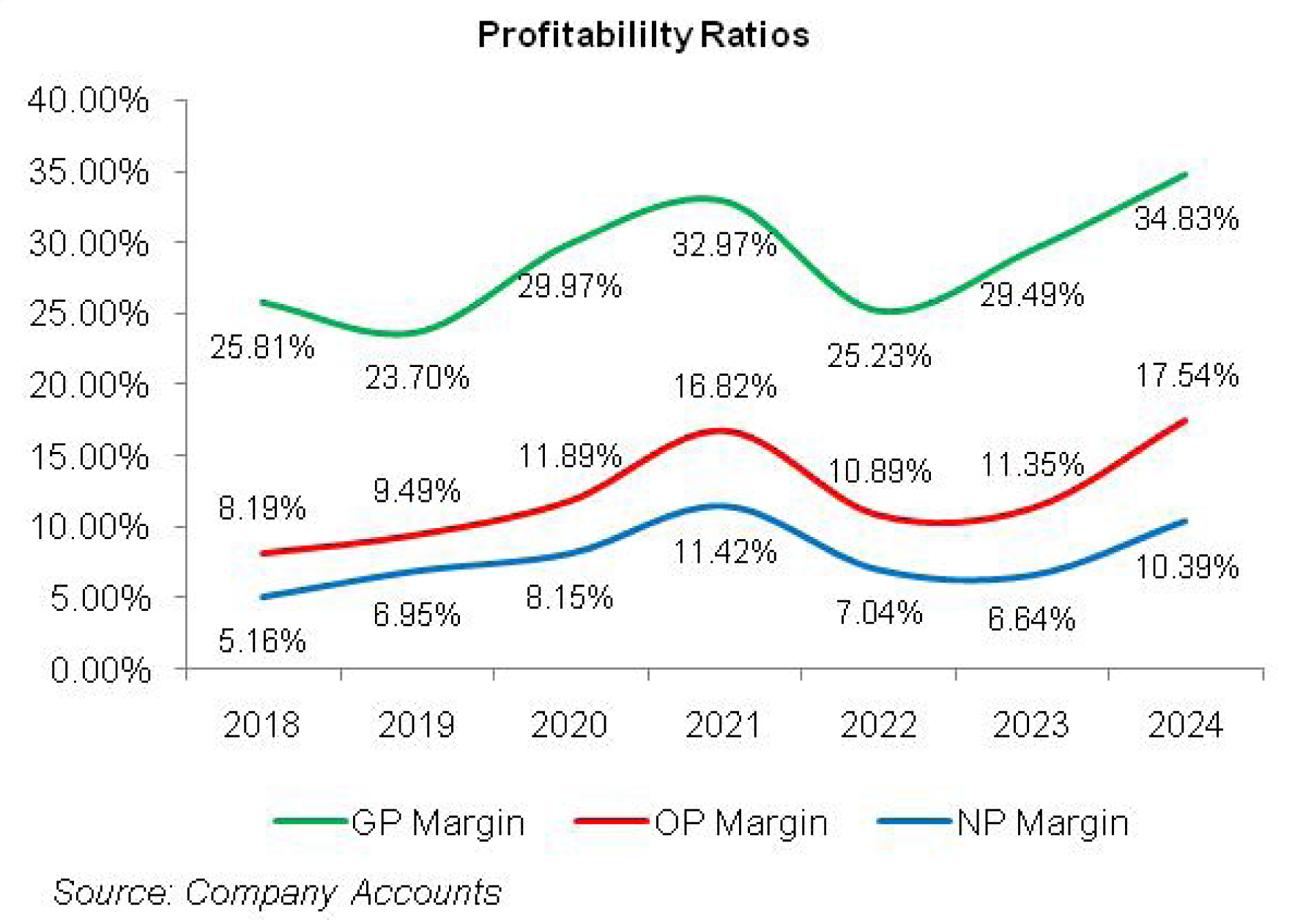
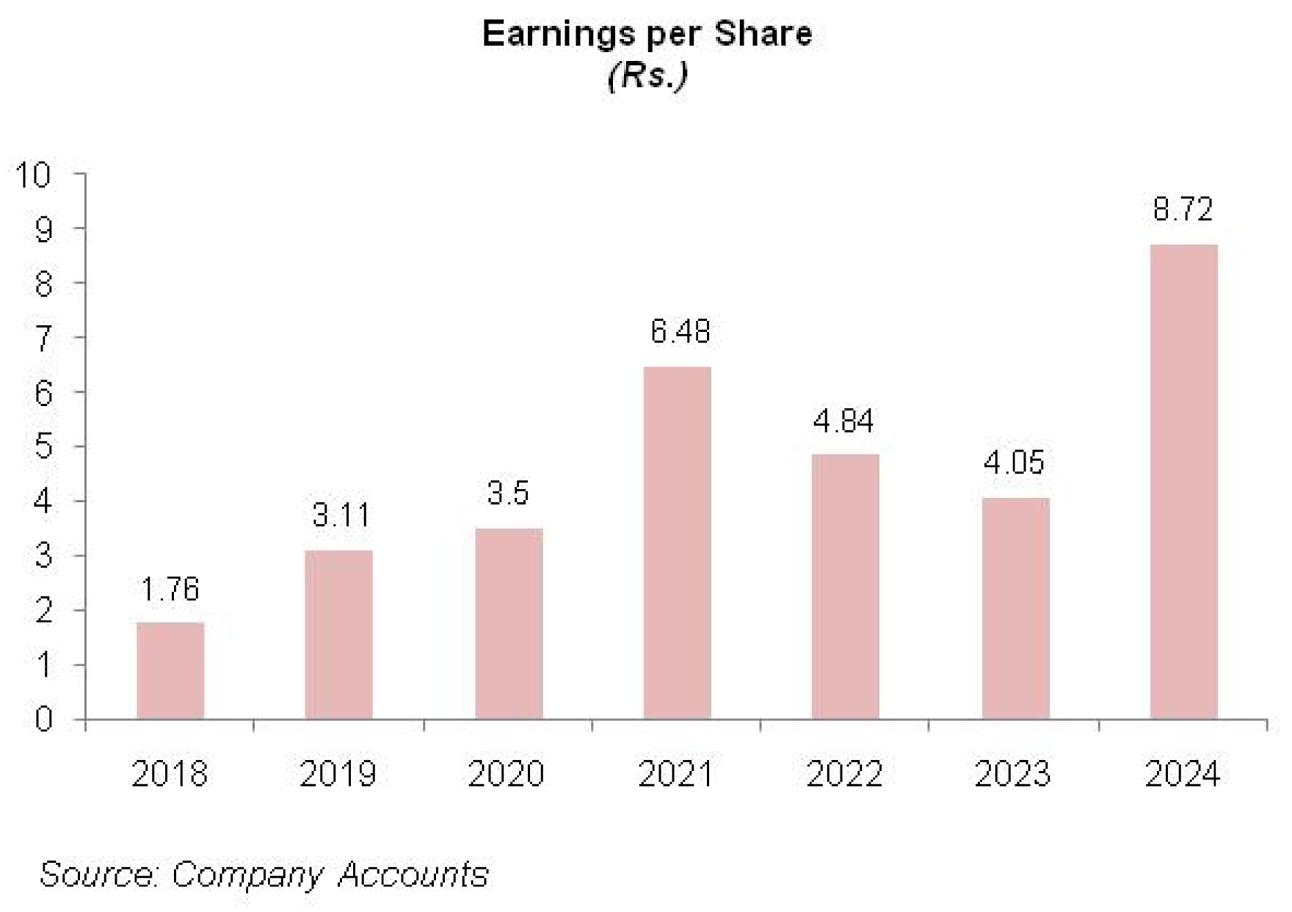
In 2019, SARC’s topline grew by 31.05 percent year-on-year. This was on account of a 1.79 percent increase in the sales volume of the company which clocked in at 386.160 M tons. The company also revised its selling prices in line with the soaring cost of sales on account of elevated prices of energy, transportation, essential raw materials as well as Pak Rupee deprecation. Despite an increase in the prices, SARC couldn’t completely pass on the onus of cost hikes to its customers, which is evident in the fall of GP margin from 25.81 percent in 2018 to 23.70 percent in 2019. This was despite 20.34 percent year-on-year growth in gross profit in 2019. Administrative and distribution expenses surged by 4.02 percent and 7.34 percent respectively in 2019 which was on account of higher payroll expenses, depreciation as well as travel & conveyance charges. Operating profit improved by 51.88 percent in 2019 with OP margin climbing up from 8.19 percent in 2018 to 9.49 percent in 2019. Finance costs escalated by 29.85 percent in 2019 on account of higher discount rates as well as increased borrowings. This resulted in a hike in SARC’s debt-to-equity ratio from 19 percent in 2018 to 24 percent in 2019. Net profit strengthened by 76.62 percent in 2019 to clock in at Rs.18.65 million with EPS of Rs.3.11 versus EPS of Rs.1.76 recorded in 2018. NP margin picked up from 5.16 percent in 2018 to 6.95 percent in 2019.
SARC registered a 3.9 percent year-on-year shortfall in its topline in 2020. This was on account of a drop in sales volume due to COVID COVID-related lockdown imposed during the year as well as a decline in demand. During the year, SARC operated at 35 percent capacity versus the 53 percent capacity utilization achieved in the previous year. This culminated in the production of 230 M tons in 2020. Due to Pak Rupee depreciation, imported chemicals became much more expensive during the year. This coupled with higher electricity and gas prices could have marred the gross profit had the company not implemented effective cost control and price modification strategies. During 2020, SARC’s gross profit improved by 21.54 percent resulting in a GP margin of 29.97 percent. Administrative expenses multiplied by 32.11 percent in 2019 of increased salaries (including directors’ remuneration), repair & maintenance, rent, rates & taxes as well as loss allowance booked during the year. Distribution expenses dropped by 3.4 percent in 2020 on the back of lower carriage & cartage as well as travel & conveyance charges incurred during the year. Operating profit built up by 20.41 percent in 2020 with OP margin rising up to 11.89 percent. Finance costs mounted by 117 percent in 2020 due to higher discount rates for the most part of the year coupled with increased borrowings. This drove up the debt-to-equity ratio to 55 percent in 2020. Net profit progressed by 12.67 percent in 2020 to clock in at Rs.21.02 million with EPS of Rs.3.5 and NP margin of 8.15 percent.
SARC posted 32 percent year-on-year growth in its net sales in 2021. This was mainly on account of upward revision in the prices of the company’s products due to hikes in raw material prices, energy tariffs, freight charges as well as Pak Rupee depreciation. The increase in prices was not well received by the customers and hence SARC couldn’t attain any significant growth in its off-take during the year. Capacity utilization stood at 40 percent resulting in a production volume of 267 M tons. Due to passing on the onus of cost hikes to its customers, SARC registered 45.19 percent growth in its gross profit with GP margin rising up to a new high level of 32.97 percent in 2021. Administrative expenses were magnified by 18.72 percent in 2021 on account of higher payroll expenses as the number of employees grew from 108 in 2020 to 122 in 2021, and also because of higher depreciation expenses incurred during the year. Distribution expenses inched up by 2.39 percent in 2021 due to higher utility charges and carriage & cartage charges on account of increased prices of petroleum products. Higher profit-related provisioning drove up other expenses by 116.19 percent in 2021 while profit recognized on sale of fixed assets resulted in a 123.27 percent rise in other income. All these factors translated into 86.72 percent higher operating profit recorded by SARC in 2021 with OP margin clocking in at 16.82 percent. Finance costs shrank by 26.25 percent in 2021 on account of monetary easing and settlement of all the outstanding short-term borrowings during the year. This took down the debt-to-equity ratio to 20 percent in 2021. Net profit improved by 84.93 percent in 2021 to clock in at Rs.38.87 million with EPS of Rs.6.48 and NP margin of 11.42 percent.
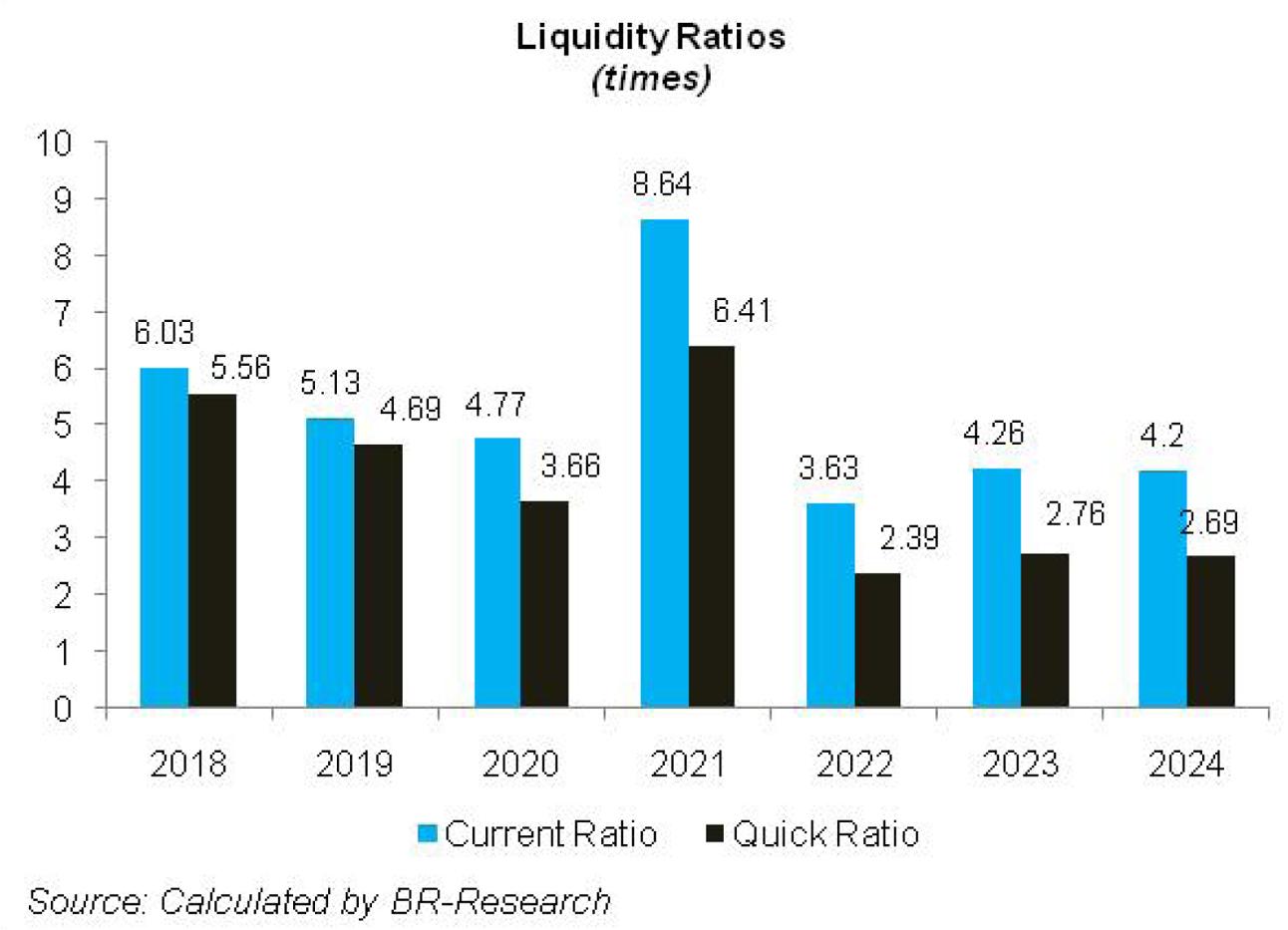
SARC’s topline grew by 21.20 percent in 2022 which was primarily due to upward price revision with no significant movement in sales volume. Capacity utilization stood at 60 percent resulting in a production volume of 394 M tons. Despite price modification, the company couldn’t completely pass on the impact of cost hikes to its customers. This resulted in a 7.26 percent lower gross profit in 2021 with the GP margin dropping to 25.23 percent. Administrative and distribution expenses grew by 8.73 percent and 9.48 percent respectively in 2022 mainly on account of higher payroll expenses (including directors’ remuneration), increased depreciation expenses as well as carriage & cartage charges. Operating profit nosedived by 21.54 percent in 2022 with OP margin contracting to 10.89 percent. Finance cost raised its head yet again and surged by 39 percent owing to monetary tightening. This was despite the fact that SARC replaced its short-term external loans with loans from directors which had a 1 percent lesser mark-up than the existing KIBOR. The debt-to-equity ratio stood at 39.66 percent in 2022. Net profit tumbled by 25.26 percent year-on-year in 2022 to clock in at Rs.29.05 million with EPS of Rs.4.84 and NP margin of 7.04 percent.
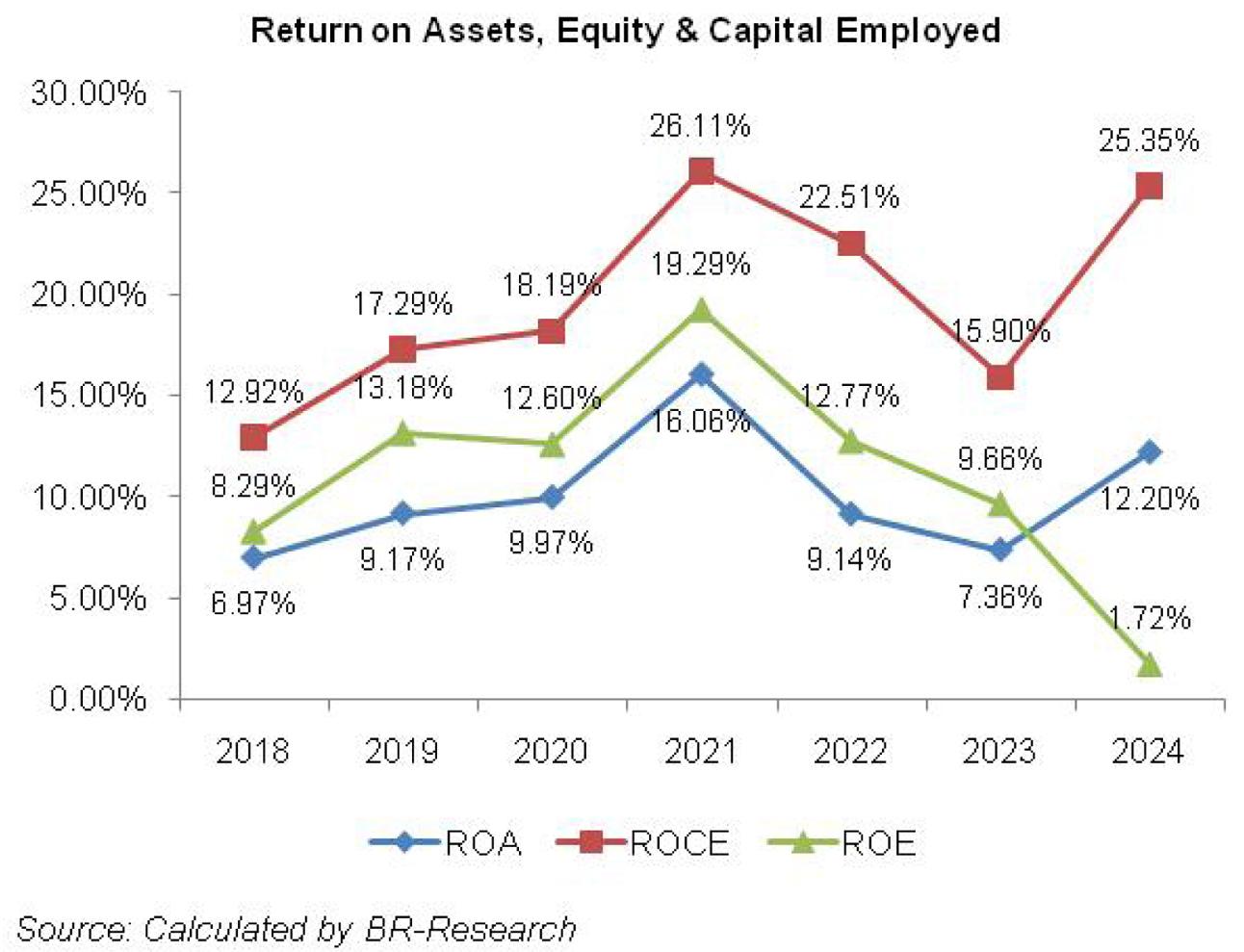
SARC’s topline withered by 11.24 percent year-on-year in 2023. This was on account of the closure of industries on account of high inflation, elevated cost of borrowings, crippling demand as well as import restrictions. Capacity utilization stood at 49 percent resulting in a production volume of 322 M tons. SARC increased the prices of its products to compensate for the soaring cost of sales. This resulted in a paltry 3.76 percent uptick in gross profit with GP margin climbing up to 29.49 percent in 2023. 10.52 percent higher administrative expenses incurred in 2023 was the result of higher payroll expenses and directors’ remuneration as well as bad debts written off during the year. Distribution expenses escalated by 32.5 percent year-on-year in 2023 as high prices of petroleum drove up carriage & cartage charges as well as traveling expenses. Higher salaries also contributed to driving up the distribution expenses in 2023. Operating profit dwindled by 7.49 percent in 2023, however, OP margin inched up to 11.35 percent. Finance costs surged by 133.20 percent in 2023 on the back of higher discount rates. The debt-to-equity ratio lowered to 31.23 percent in 2023. SARC recorded a 16.26 percent lower net profit to the tune of Rs.24.33 million in 2023 with EPS of Rs.4.05 and an NP margin of 6.64 percent.
SARC posted the highest year-on-year topline growth of 37.56 percent in 2024. This was due to increased sales volume as well as upward revision in the prices of the company products. Stable macroeconomic indicators in the home market provided stimulus to the local industry resulting in robust demand for SARC’s products. On the contrary, the company didn’t make any export sales in 2024. SARC utilized 55 percent of its total capacity and produced 362 M tons of products in 2024. Cost of sales surged by 27.14 percent in 2024, much lower than the topline growth. This was due to the strengthening of the Pak Rupee against the greenback as well as stable commodity prices. Moreover, the company also acquired solar systems for its factory which resulted in lesser reliance on external energy sources. Gross profit heightened by 62.48 percent in 2024 with GP margin jumping up to its optimum level of 34.83 percent. Administrative expenses multiplied by 32.71 percent in 2024 due to higher payroll expenses and bad debts recorded during the year. Higher payroll expenses were due to inflationary pressure as well as workforce expansion from 126 employees in 2023 to 131 employees in 2024. Distribution expenses mounted by 25.30 percent in 2024 due to higher salaries of the sales force as well as elevated cartage and carriage charges incurred during the year. Other expenses surged by 149.51 percent in 2024 due to increased provisioning done for WWF and WPPF. Other income also rebounded by 295.61 percent in 2024 mainly on account of increased profit on bank accounts. SARC posted a 112.5 percent improvement in its operating profit in 2024 with OP margin climbing up to 17.54 percent. Finance costs inched up by 6.37 percent in 2024 due to higher discount rates as well as long-term loans obtained under the renewable energy (REEF) category. SARC recorded 115 percent higher net profit to the tune of Rs.52.33 million in 2024. This translated into EPS of Rs.8.72 and NP margin of 10.39 percent.
Recent Performance (1QFY25)
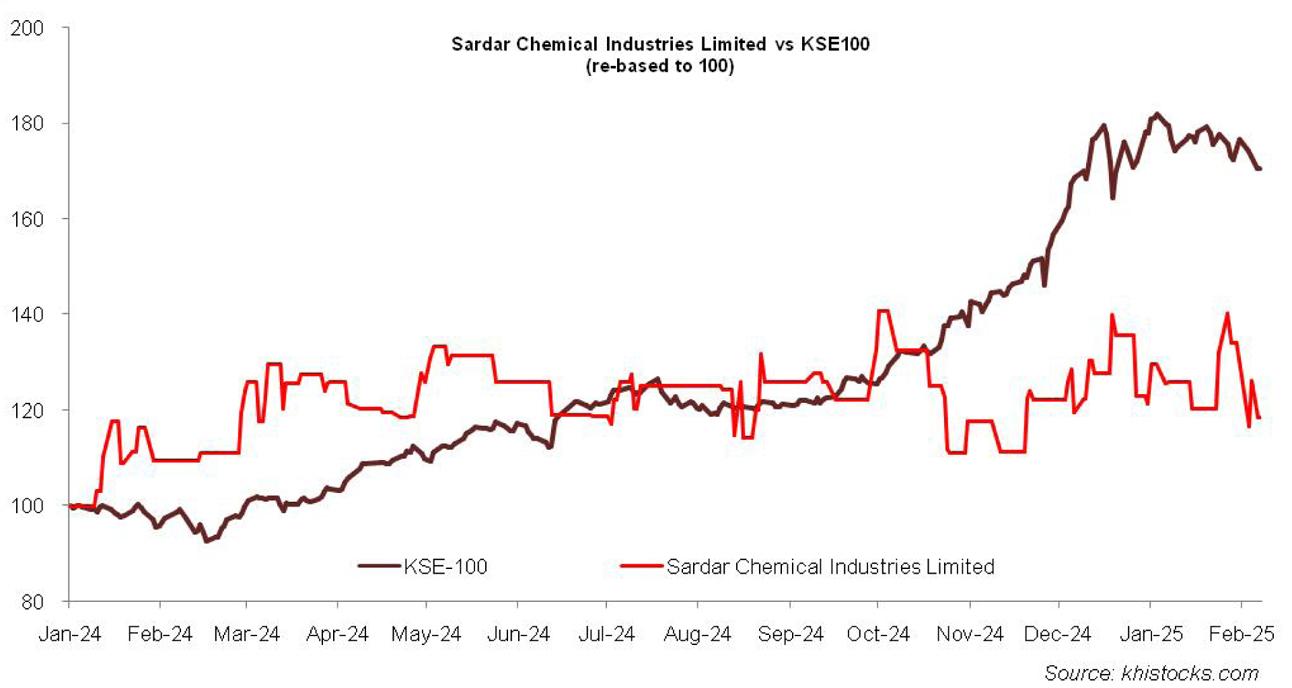
During the first quarter of FY25, SARC’s net sales dipped by 21.26 percent year-on-year. This was due to lower sales volume as sales tax was raised up to 18 percent, resulting in a massive hike in the prices of the company’s products. As a consequence, the dealers, distributors, and wholesalers started importing the dyestuffs instead of purchasing it from the local manufacturers. The cost of sales dropped by only 5.96 percent in 1QFY25 due to lesser absorption of fixed costs. This was despite the fact that the solar system installed during the last year became fully operational during the period under consideration, resulting in lower energy costs. Gross profit tapered off by 42.33 percent in 1QFY25 with the GP margin falling down to 30.81 percent from the GP margin of 42 percent recorded in 1HFY24. Administrative and distribution expenses multiplied by 18.10 percent and 23 percent respectively due to inflationary pressure. SARC recorded a 62.14 percent plunge in its operating profit in 1QFY25 with OP margin clocking in at 15.36 percent versus OP margin of 31.94 percent recorded in 1QFY24. With the onset of monetary easing, finance costs slid by 32 percent in 1QFY25. Net profit eroded by 69.52 percent to clock in at Rs.12.77 million in 1QFY25 with EPS of Rs.2.13 and NP margin of 10.81 percent. This was against the EPS of Rs.6.98 and NP margin of 27.93 percent registered in 1QFY24.
Future Outlook
While the local demand is improving, the company is unable to take the optimum benefit out of it on account of the heightened sales tax imposed on its products. This also impedes the company from increasing its prices to pass on the onus of cost hikes to its customers. However, the company is focusing on operational excellence and cost optimization to stay competitive and improve its profitability and margins. Alternatively, SARC can diversify its sales mix by tapping new industries and geographical markets. This will result in sustained demand and profitability.


























Comments
Comments are closed for this article.