


SC asks whether an army personnel commits crime while at home would be tried under Army Act?
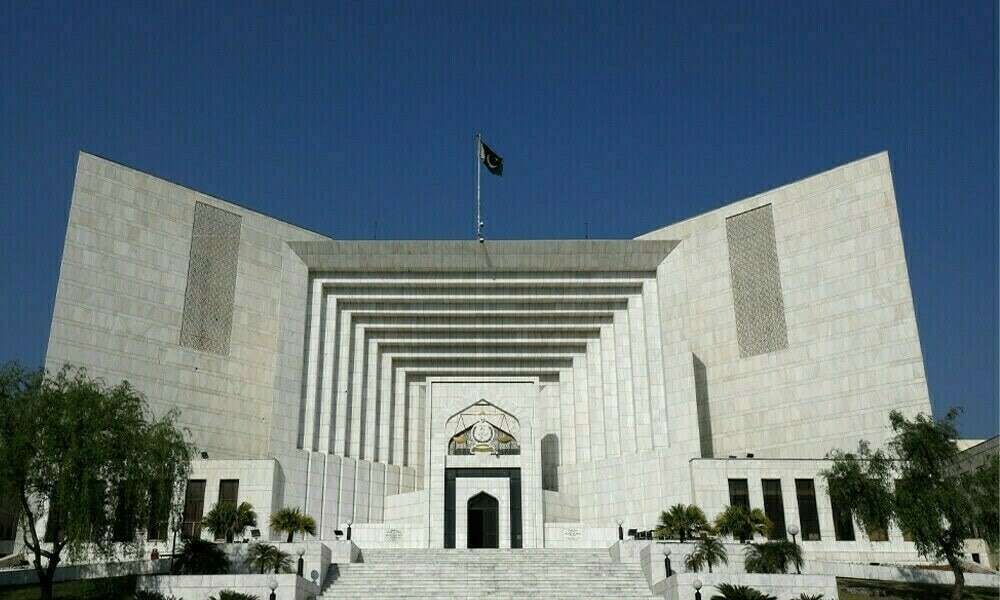

ISLAMABAD: Justice Jamal Khan Mandokhail questioned whether Army Act will be applied if a personnel of armed forces committed a crime while sitting at home.
A seven-member SC Constitutional Bench headed by Justice Aminuddin Khan on Wednesday, heard intra-court appeals (ICAs) against the apex court’s decision on the trial of civilians by military courts.
Justice Syed Hasan Azhar Rizvi questioned if any civilian, acting as a middleman, obtains information from the army institutions and sell it to enemy country then where his trial would be conducted?
Salman Akram Raja, the lawyer for convicted Arzam Junaid, argued that Official Secrets Act, 1923 was there on statute book for this purpose, adding the trial under this Act is also held in-camera. He further argued that such civilians’ trial was also held before the introduction of Section 2 (1) (d) in the Army Act through Defence Services Laws Amendment Ordinance, 1967. He said the trials of civilians, who spy for the enemy country, are held all over the world, but those trial are not under the Army laws.
Justice Naeem Akhtar Afghan asked Raja that during your party’s (Pakistan Tehreek-e-Insaf) tenure, amendments were made in Army Act to allow Indian spy Kulbhushan Jadhav the right to file an appeal against his conviction in a civilian court, then why he had not advised his party then?
Raja, distancing him from the legislation, said he had always opposed civilians’ trials by military courts, adding he was not part of the PTI at that time. “We have to follow the constitution,” he added. He contended that in FB Ali case, the issues of independent forum or court, defence, and engagement of lawyer by an accused were not before the court; therefore, the FB Ali judgment allowed the trial of civilians under Army Act.
Raja argued that his case is related to Articles 10A, 9 and 175 of the constitution, adding wherever the judicial power is exercised it comes under Article 175. He said in India though trial is conducted by Court Martial, but right of appeal is given to accused before the High Court and the Supreme Court. They have developed such system that the Army Colonel, who conducts the trial, knows that his order and judgment would be examined by the High Courts, but in Pakistan the accused’s relative even cannot approach the High Court for bail. The trial in military courts is conducted behind closed doors.
Barrister Aitzaz Ahsan, who was also present in the courtroom, stated that in FB Ali he was counsel of one of the accused. He said the trial in military courts is held in secrecy. The security officials frisk body of lawyer or anyone representing the accused body to make sure you cannot take or bring anything from the courtroom.
Raja added not only in military courts, but whenever he goes to Adiala Jail for pleading Imran Khan’s cases the police search his body. “You can’t take or bring any paper from the jail.”
Uzair Bhandari, another PTI lawyer, told that you can’t even take tissue paper.
Earlier, Justice Jamal Mandokhail questioned whether a member of the armed forces, committing an offence at home, would fall under the Army Act’s jurisdiction.
Salman said that the case involved two issues, one of which was related to Article 175. He said that the doors would not be closed as far as fundamental rights were concerned.
Justice Mandokhail inquired whether merging fundamental rights with a specific act could lead to their violation. He further questioned if a soldier, marrying a second time without his first wife’s consent, would be tried in a military court.
Raja responded by calling the Army Act a “black hole,” arguing that any amendments could compromise fundamental rights. He maintained that for an offence to fall under the Army Act, the offence must be directly related to military service. Providing an example, Raja said that while kite-flying is banned in Punjab, a military officer engaging in the act while at home would not be subject to a military trial but rather civilian law.
During the proceedings, Raja also referenced the 1975 FB Ali case, where Section 2 (1) (d) of the Army Act was first discussed.
Justice Muhammad Mazhar Ali questioned why the apex court repeatedly reviewed Article 2 (1) (d), to which Raja replied that legal frameworks evolve, necessitating judicial review. He added that Article 8 (3) does not provide an exception for Article 2 (1) (d).
The lawyer assured the court that he would not present arguments contrary to the Constitution, saying that fundamental rights could not be revoked arbitrarily. “It cannot be that a commanding officer simply demands a suspect and they are handed over,” he asserted.
Justice Mazhar pointed out that a five-member bench had already struck down Section 2 (1) (d), ruling that espionage suspects could no longer be tried in military courts. However, he noted that civilian employees within the army still fall under the Army Act’s jurisdiction. The case was adjourned until today (Thursday).
Copyright Business Recorder, 2025

























Comments
Comments are closed for this article.