



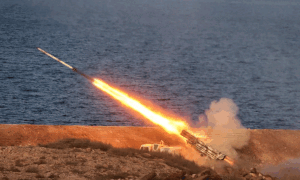
The seemingly never-ending seesaw between market fundamentals and geopolitical risks entered another fresh episode last week. Oil prices having receded to the lowest point since the start of 2024, took less than three days to cut to size the ground gained by bears in a sustained bear run for weeks. It took Hezbollah’s missile attack on Israel for the war risk premium to take over the fundamentals.
For most of the post-Russia-Ukraine conflict and the one ongoing in the Middle East, fears of supply disruptions never really materialized. There was a short period of sea vessels taking longer routes when the Red Sea situation worsened, but the barrels in the market, by and large, stayed on, with no meaningful amount going off the market.
That now seems to be changing altogether, as Libya becomes the first casualty of the heightened tensions in the Middle East. News from the Middle Eastern key oil producer suggests that almost all of Libya’s 1.17 million barrels per day of oil production could be potentially affected. Oilfields in Eastern Libya are tipped to be shut until further orders, as internal political disputes have flared up. This is the first significant blow to supply since the Middle East conflict started.
Libya had already been facing patchy production this month after outages in some of its major fields. Much of the country’s exports are shipped via ports in the east, largely supplying markets in Europe. Citigroup Inc. analysts see the supply drop temporarily pushing Brent back to the mid $80s a barrel. The Iran factor is still lurking over the horizon, as it is yet to act on its earlier “promised revenge” of the killing of the Hamas leader on its soil.
Before the Libya supply disruption was announced, markets had already started rallying on the US Fed interest rate call next month – where the reversal of the monetary cycle is not a certainty. Although much of it is priced in, the magnitude of the rate cut could have a bearing on how international commodities react. Concerns about the US economy entering into recession have subsided, after the worrying job data that shook the markets across the globe earlier this month.
On the other hand, fundamentals have been relatively unperturbed over the longer term. Demand slowdown into 2025 is now projected even from the historically more optimistic observers. Even the likes of Opec have revised the demand growth projections for 2025. Non-Opec oil producers have been ramping up production and are in a position to offset any announced or forced supply disruption from the Opec Plus group. Opec herself has not shown any intentions to roll back the phased winding down of production cuts. Demand from China has come as a major surprise and is not expected to turn for the better at least for another two quarters. All in all, the near-term jitters may keep oil prices elevated, but fundamentals will eventually take charge, in what appears to be an oversupplied market entering 2025.















Comments
Comments are closed for this article.