


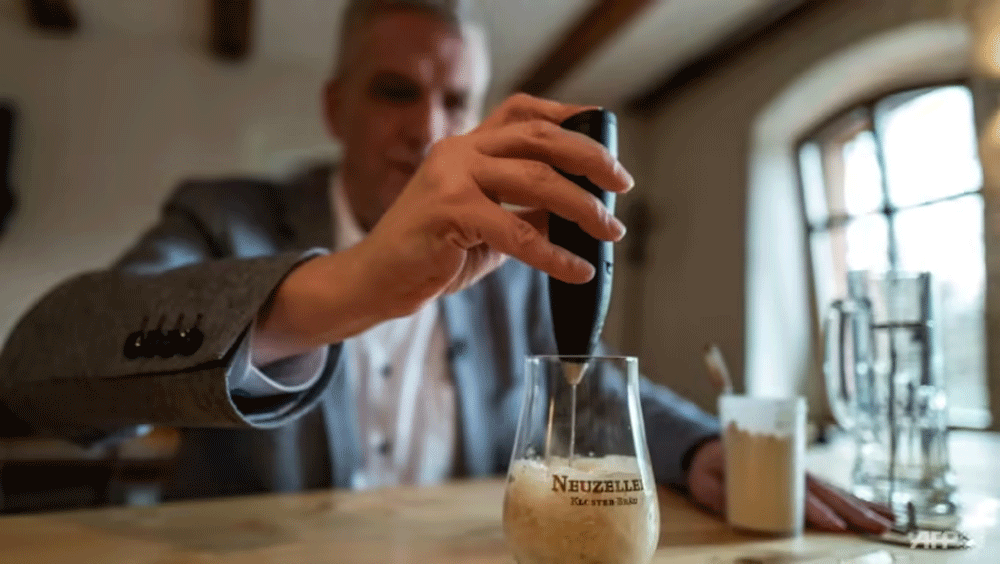
NEUZELLE: With its golden hue, bittersweet notes and frothy head, Stefan Fritsche’s latest brew looks and tastes like any other beer.
But the revolutionary tipple, developed at Fritsche’s brewery in the German town of Neuzelle, was made with just two ingredients: powder and water.
“Everyone can have their own home brewery” with his new invention, Fritsche told AFP at the premises near the border with Poland.
For now, the recipe finalised earlier this year is non-alcoholic and also contains no carbon dioxide, meaning it has no bubbles.
But Fritsche, 56, is also developing an alcoholic version and eventually planning to add bubbles to make it even more beer-like.
The main target market will be African and Asian countries, since a powder is far easier and cheaper to transport over long distances than bottles of beer.
But the product may not go down too smoothly at home in Germany, which has a 500-year-old purity law around beer known as the “Reinheitsgebot”.
“We know that pilsner drinkers and craft beer enthusiasts, especially in Germany, will initially be sceptical about our product,” the brewery admits on its website.
It is unclear whether the product could even be marketed as beer under the strict rules, which limit the ingredients to malt, hops, yeast and water.
Fritsche declines to reveal his recipe but argues that his invention is necessary in a world that needs sustainable solutions.
The brewer is still working with investors to roll out the powder commercially, but is hoping to start selling it within around four months.
Sustainable ambitions
The powdered format, developed with European laboratories over the past two years, makes the beverage 90 percent cheaper to export than traditional beer, he said.
“We want to become the first sustainable brewery in the world.”
According to the Impact CO2 carbon footprint calculator, packaging and transport account for 70 percent of the environmental impact of a litre (around two pints) of beer.
The powdered format also saves time, as laboratory production is faster than traditional brewing, which takes two months on average.
But German experts are sceptical about whether the idea will catch on.
Powdered beer is a “nice innovation”, but “it will not endanger or even challenge our traditional breweries”, said Benedikt Meier of the Bavarian Private Breweries Association.
Hundreds working for Germany in Russia forced to quit, leave
The “Bier und Wir” brewers’ association also has doubts.
“The enjoyment of beer is primarily about conviviality, as it is enjoyed in pubs, in your local, at a party or among friends and like-minded people,” it said.
“A beer powder whose use focuses on preparation at home is not a serious alternative for this target group.”
Previous attempts to market powdered beers have fallen flat.
And in 2014, US company Lipsmark made headlines with its hard-liquor sachets, but the product was banned in most states and then withdrawn before it even hit the shelves.
But Fritsche is determined that his product will succeed where others have failed.
“We want to go down a new path, so to speak… to make a real, normal and good-tasting beer out of powder,” he said.



















Comments
Comments are closed for this article.