


China banks challenge credit curbs with new products

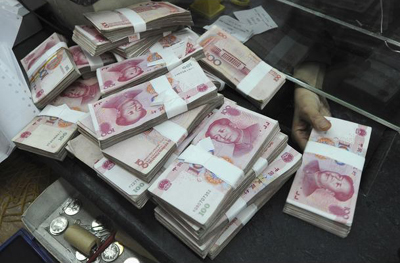 BEIJING: Looking for a "golden key", a "diamond fortune" or "happy heart wealth"?
Chinese banks, chafing under the government's loan curbs, are getting creative, pumping out high-yielding wealth management products with enticing names to woo depositors who are otherwise bereft of investment opportunities and channel credit to preferred clients.
But this is not just a matter of banks making an end-run around regulations. The wealth products are also a form of financial experimentation in China, laying the groundwork for a liberalised interest rate market, a reform that is essential to the economy's long-term health.
"Our products are selling very well. You can see inflation pressures are big and people don't have plenty of investment opportunities nowadays," said Liu Ruixue, a sales assistant at a branch of China Merchants Bank in Beijing's financial district.
People with spare cash to invest have few options in China. The stock market has been sluggish for months, government policy tightening has dented the appeal of property and savings rates in banks are lower than inflation. Hence the appeal of the wealth-management products.
Chinese banks sold an accumulated 7 trillion Yuan ($1.07 trillion) in wealth products last year, up nearly 50 percent from 2009, according to state media. All indications are that this momentum continued into 2011.
Investors recently snapped up all the shares of a short-term investment product offered by Merchants Bank in just a few hours, Liu said. The product, which had a one-month maturity, offered a 4 percent annualised return compared with the one-year benchmark bank deposit rate of 3.25 percent.
A nearby branch of Beijing Rural Commercial Bank branch is courting customers with an 18-month product that offers a 7.5 percent annual return.
"It's not just about inflation, it's about competing for deposits and they are willing and capable to offer higher rates to attract deposits because of lending controls," said Ting Lu, China economist at Bank of America Merrill Lynch in Hong Kong.
Chinese inflation sped to a 32-month high of 5.4 percent in the year to March. The government's main tool for taming prices -- far more important than interest rates -- is to order banks to issue fewer loans.
That was on display Sunday, when the central bank raised banks' required reserves for the fourth time this year, locking up a record 20.5 percent of deposits from the country's biggest banks.
Data last week showed Chinese banks extended 679.4 billion Yuan in new local currency loans in March, well above the market's expectations.
Wealth management products help the banks in two ways, analysts say.
First, as off-balance-sheet vehicles they do not count towards the quota of loans that banks are allowed to grant. Second, they allow banks to attract a bigger deposit base, a precondition to issuing more loans.
Most banks channel proceeds from wealth products into money and bond markets, where yields have been rising in recent months because of sustained cash withdrawals by the central bank.
The explosion of such wealth products casts doubt on the effectiveness of the government's credit tightening plan.
Last year, banks rushed to sell loans to trust firms to get them off their balance sheets, until regulators cracked down on this practice.
Wealth-management products are helping to fill that gap.
"Even if some of these avenues are either shut down or brought into much closer oversight, we will continue to see new ways around the rules simply because credit demand is so high," Charlene Chu, senior director at Fitch Ratings, said last week.
There is at least one reason for regulators to tolerate the rise of the wealth management products: they offer a relatively safe, small niche for loosening controls on interest rates.
China took a big step toward liberalising interest rates in 2004 by letting banks charge borrowers well above benchmark rates and giving them some leeway to cut deposit rates.
Liberalisation has made little headway since then, even though the central bank has said more liberalised interest rates are key to ensuring efficient allocation of capital. Officials fear any rush to free up interest rates, particularly deposit rates, could destabilise the financial sector.
China still bans banks from raising Yuan deposit rates above the benchmark and keeps a floor under lending rates. That partly explains why banks are so excited about wealth products, which give them leeway to get around rigid rate controls.
For example, banks moved quickly to raise returns on their wealth products after the central bank increased interest rates on April 5 for the fourth time since last October.
"The development of wealth management products clearly shows that spontaneous interest rate liberalisation has become a strong undercurrent in China's financial sector," said Lu Zhengwei, senior economist at Industrial Bank in Shanghai.
"Interest rate liberalisation is an unstoppable trend."

















Comments
Comments are closed for this article.