



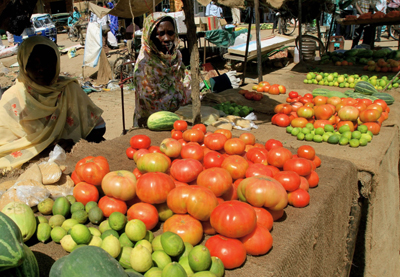
 KHARTOUM: Sudanese consumers and market traders struggling to cope with rising prices on Tuesday warned of social unrest as living standards deteriorate since the country's partition.
According to official media, inflation hit 19 percent in January, up from 18 percent the previous month -- and analysts say it could go higher.
Prices soared in recent months while the currency fell in value after the economic shock of South Sudan's separation in July.
The South took with it 75 percent of Sudan's oil output, which accounted for the vast majority of Khartoum's export earnings and a substantial portion of state revenue, leaving the government short of immediate alternatives.
"Families are suffering. If things keep going like this definitely there will be an explosion," said Hassan Abdelhamid, 54, a father of five who works for a private company.
He earns 1,500 pounds a month (about $300 at the black market exchange rate) but said that amount "means nothing" compared with the high price of food.
Since October, the family has cut back, concentrating on school fees and other needs of the children, he said.
In September, riot police used tear gas to disperse youths demonstrating in Khartoum against the unaffordable cost of food.
Sara Omer, 45, a government employee shopping in Khartoum North, said she and her husband earn 2,000 pounds a month -- around 10 times the minimum wage -- but have had to reduce spending.
"We cut down our consumption of some things like beef," the mother of three said.
Her family also fired its Ethiopian housekeeper at the beginning of February, she said.
"Things are getting worse," said another shopper, Amana Mohammed, 65.
For the past several months the three salaries of her husband, eldest son and daughter have barely been enough to cover family expenses, and they can no longer save, she said.
"Now we use all these salaries for food, education and medical expenses," Mohammed said.
With customers buying less, Ali Abdelbagi, 40, said he offers fewer vegetables for sale at the market where he works in south Khartoum.
"For the past three months my income has been falling," he said, warning: "If the people feel hungry they can do anything."
At a different market, fruit seller Omar Mohammed Ismail, 56, complained of a 50 percent drop in sales.
"If this continues I won't be able to fulfill my family's needs," he said in the Omdurman district.
The UN's Food and Agriculture Organisation said this month that Sudan will face a "significantly below average" 2011-2012 crop harvest that will likely cause rising food insecurity across the country.
"Increased imports of cereals will be needed at a time when Sudan's economy has poor foreign exchange earnings and a fiscal deficit," it said, forecasting further possible rises in food prices.


















Comments
Comments are closed for this article.