



 PARIS: The Greek debt crisis began just over two years ago and in that time politicians, media and financial markets have used dramatic language to explain, to blame, to threaten and to protest.
In the last few weeks a clear tone of mistrust emerged from some countries in northern Europe, causing financial markets to factor in a possible chaotic default right up to the last moment.
With agreement on a second package of rescue loans and a debt write-off now agreed, here are some of the comments as the final details were being worked out on Monday.
For financial analyst two important questions remain, concerning the Greek debt-to-output ratio, and concerning a reported difference of opinion between Chancellor Angela Merkel and her finance minister:
At Deutsche Bank, Gilles Moec: A rebalancing of current accounts across the euro-zone would be a sure sign of resolution of the crisis.
Big progress has been made with external deficits being halved in three years, without a matching fall in surpluses in the strongest euro-zone countries. This suggested that the "doomsday view" that the weaker countries were unable to compete "is not validated by the facts."
But "we think that European leaders are still in their overwhelming majority convinced they do not have in place the type of firewalls that would allow them to mitigate the impact of a Greek default."
At Berenberg Bank, Holger Schmieding: "Despite serious risks, the outlook for Europe is positive. The euro will not implode.
Amid the turmoil, Europe is tackling some of its key structural problems."
At Lloyds Bank WBM Research: "The second bailout is unlikely to be the end of the story. The cost of getting the country's debt-to-GDP ratio down from the present level of 163 percent to 120 percent might not be feasible. "The conditions "may leave Greece questioning the price of euro area membership."
At CMS Markets UK, Michael Hewson: Talk of an agreement "is set against whispers of discord between Chancellor Merkel and her finance minister Schaeuble who remains unconvinced that the bailout deal will in anyway bring Greece's debt-to-GDP ratio down to 120 percent of GDP"
Hewson said that Merkel seemed still opposed to any talk of Greek default, and also commented that a reported decision by the European Central Bank to swap some of its Greek bonds for new ones could be considered legally dubious and therefore might be challenged by other creditors.
At BNY Mellon Global Markets Research, Simon Derrick: Two points are key in how events develop from here, the first being debt sustainability and the target of a debt-to-GDP ration of 120 percent. The second "and arguably even more significant stumbling block comes from the apparent split growing between Angela Merkel and Wolfgang Schaeuble."
At Rabobank, Jane Foley: In the event of an agreement "there is less hope, however, that Greece will put in place all the austerity measures that have been asked of them" suggesting there is a strong chance that "the problems that are facing the country will continue to play out potentially for years."
Contagion risk is not so high as it was at the start of the Greek crisis "but is still a significant threat," she said.
At JLT Management Services, analysts said: "The question remains as to how much appetite Athens has to persist in a cycle of implementing increasingly punitive fiscal measures to avoid default, amid widespread public disobedience during its sixth consecutive year of recession. Athens could consider leaving the Euro to be the lesser of two evils."
Greek Finance Minister Evangelos Venizelos, before the agreement: "The Greek people are sending Europe the message that they have, and they will, make the necessary sacrifices in order for our country to regain its place within the European family.
For Greeks, this is a matter of national dignity and a national strategic choice and no other integrated and responsible choice can be opposed to it."
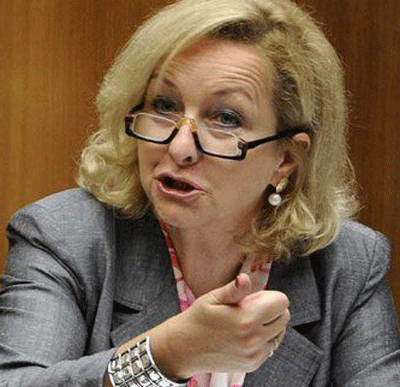
Austrian Finance Minister Maria Fekter said that "Greece must be shadowed on its reform path so that the money arrives where it is meant to."




















Comments
Comments are closed for this article.